News

February 6, 2025

SHARE:

The Ascension to Power

As Trump is re-elected, new reforms and policies are taking shape. Among them is his threat to impose a 25% tariff on Mexico and Canada, alongside a 10% tariff on China—claiming these countries allegedly failed to address illegal immigration and co-conspirators for illegal fentanyl distribution in the United States (US). 

Yet the article is not to stir political debate but to explore the ramifications of these tariffs on consumers and Asian countries. While many news outlets have focused on the potential setbacks in the affected countries, few have explored how others might either suffer or benefit from the situation. Hence, this piece shall highlight how Trump’s ascension to power might become the best opportunity for some Asian economies.

The Price of Tariffs

The Guardian defines a tariff as a tax imposed on foreign goods entering a country. As the world’s largest importer, the US brought in $3.2 trillion worth of goods in 2022, with imports from Canada, Mexico, and China totaling $1.2 trillion in 2023. Trump takes pride in this idea, believing the US government would receive more revenue through these tariffs, coining tariffs as the “most beautiful word in the dictionary” in an interview with Bloomberg. 

Brown University Professor of Economics Şebnem Kalemli-Özcan disagrees by arguing, “For many economists, tariff is actually the worst word in the dictionary.” She explains that ultimately American consumers and businesses will pay the price. As a trade-deficit nation, the US imports more than its exports. According to the Tax Policy Center, a 60% levy on Chinese goods accompanied by a 20% worldwide tariff could raise the costs for the average US household to up to $3,000 in 2025.

As companies face higher costs for goods, they often transfer those expenses to consumers through price increases. This can reduce consumer spending, which in turn lowers business investment and may lead to job losses.

Jason Miller, a professor of supply chain management at Michigan State University reaffirms such claims stating, “Because of the combination of these three countries, it’s going to be difficult to go down an aisle of a grocery store and not see some sort of inflationary effect.” Capital Economics projected that the newly announced tariffs could drive annual inflation up from 2.9% to as much as 4%.
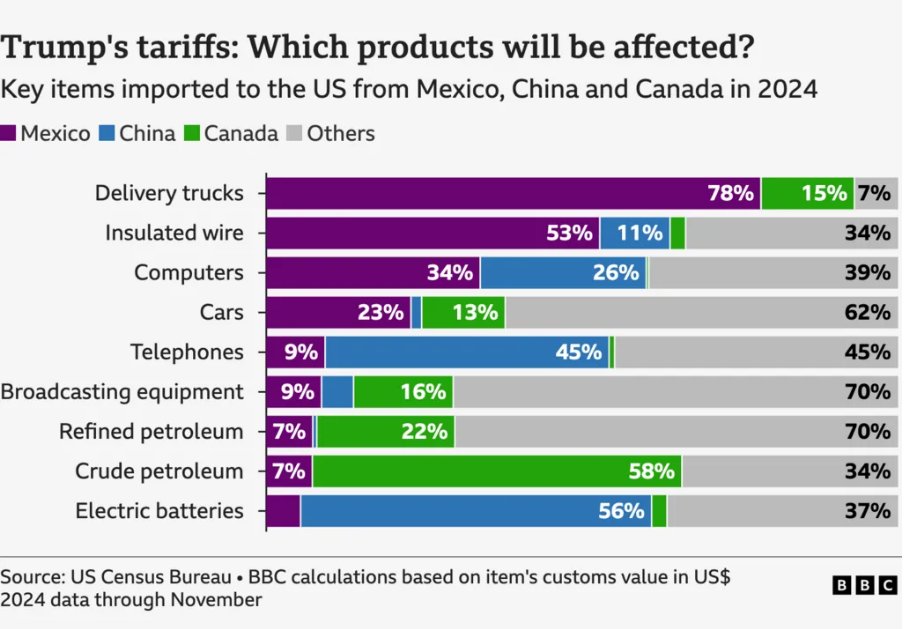
Products affected by Trump’s Tariffs (Image source: BBC)

Nevertheless, Trump’s tariff threats carry weight, as they could impose significant economic pressure on targeted countries, prompting businesses to relocate. According to the BBC, Chinese factories with 500 workers have shrunk to just 200 employees, while American buyers are already exploring alternative manufacturing hubs in neighboring regions outside of China.

Business owner Huang Zhaodong, who recently relocated his factory, told the BBC that customers had pressured him to move production overseas. He agrees with their concerns, estimating that a 10% tariff increase could cost him an additional $800,000 in earnings. “Manufacturing clothes in China under these tariff conditions is simply unsustainable,” he said.

A Victor Emerges

Cases like Mr. Huang’s have proved the challenges that Trump’s tariff has imposed on countries like China. The beginning of the Trump trade war has led businesses to flee to Southeast Asian nations, most notably Vietnam. 

While other Southeast Asian nations also benefit from shifting supply chains, Vietnam has emerged as a top destination due to its growing industrial capacity and strategic location. The country recently rose to become the Association of Southeast Asian Nations (ASEAN) champion with an estimated 40% of all ASEAN exports to North America being from the country alone. Though it is difficult to quantify how many businesses have relocated from China, BBC reports that major brands like Puma, Nike, and Adidas have already moved production to Vietnam. Sources from Vietnam Briefing indicate Intel and Samsung have rapidly ramped up their investment in Vietnam and are projected to reach $100 billion in revenue by 2050. Propelled by robust exports and foreign investments, Vietnam’s economy has recently grown by 7.09%, reaching $476.3 billion—outpacing the 5.05% expansion seen in 2023.

It is debatable whether Trump’s glare will graze upon this nation. Experts debate whether he will target Vietnam with tariffs, as his trade policies often focus on countries with a trade surplus. In 2024, Vietnam held the third-largest trade surplus with the United States at $104.6 billion, accounting for nearly 30% of its total exports. This substantial trade imbalance makes Vietnam a potential target for Trump’s tariff threats. In this scheme, the nation might experience radical changes due to trade balances, exchange rates, supply chains, and foreign direct investment (FDI). However, Vietnam is more likely to benefit from US-imposed tariffs. This prediction is supported by trends from Trump’s first term when the country experienced significant economic growth due to an influx of manufacturers and factories relocating to Vietnam. 

Despite lingering skepticism, Trump has maintained a favorable view of Vietnam. As early as 1980, Trump publicly opposed the Vietnam War and visited the country twice during his first term. His business ventures have also extended to Vietnam, with his organization partnering with Kinh Bac City Development Holding Corporation (KBC) to develop a $1.5 billion complex in Hung Yen Province. Meanwhile, his new confidante, Elon Musk, has positioned Vietnam a key production hub for SpaceX’s Starlink satellite internet project, shifting suppliers and manufacturing from Taiwan to Vietnam to reduce geopolitical risks.

Reversing these investments may be impractical or simply too late. The confidence that both Trump and Musk have placed in Vietnam highlights the country’s growing role in global supply chains. Amid rising geopolitical tensions, Vietnam’s diplomatic strategy—often referred to as the “bamboo policy” for its balance of resilience and adaptability—has strengthened its international position. As long as the country continues to wisely navigate political and diplomatic negotiations and steer clear of populist pitfalls, Vietnam is well-positioned to sustain its economic growth and global influence.

Related Articles

medium-jpeg

News

Phantila Phataraprasit: Embracing Thai Culture and Sustainability in Furniture

In the transition from dormitory living to her own apartment, Phantila Phataraprasit found herself grappling with a challenge familiar to many recent graduates: the quest for affordable, stylish, and eco-friendly furniture. Sustainability has played a significant role throughout her life due to her mother’s involvement in running eco-friendly lodges in Thailand.

Phataraprasit and her college friend Caitlin Ellen teamed up to start Sabai – a Thai word that means feeling comfortable and relaxed. Sabai is a direct-to-consumer furniture company that prioritizes sustainability without sacrificing affordability.

Sabai’s core mission revolves around empowering young professionals to align their values with their furniture choices. For them, achieving true sustainability involves more than using eco-friendly materials.

Their sofas, crafted in a family-owned North Carolina factory, feature Sustainable Forestry Initiative (SFI)-certified wood, recycled fiber fill, and upcycled fabrics, free from harmful chemicals. They introduced a “Repair Don’t Replace” program and a buyback initiative to ensure longevity and affordability.

After initially diversifying into various home furnishing categories, Sabai recognized that sustainability remained the driving force for their customers. They refocused their efforts on seating, catering to those with unique aesthetic preferences. This strategic shift enables them to deliver on their core sustainability promise while offering diverse design options.

Aside from this, Sabai also understands the importance of forming meaningful connections with customers. Furniture is intimate, and Sabai recognizes that today’s generation cares deeply about their living spaces.

By amplifying their sustainability initiatives and engaging with consumers, Sabai aims to inspire a lot of people to live a more sustainable lifestyle.

Featured Image Source: Medium

005_min_1_scaled.0-jpg

News

Trung Nguyên Legend Cafe Introduces Vietnamese Coffee From Saigon to U.S.

Adding a fresh chapter to its storied history, the esteemed Vietnamese coffee chain, Trung Nguyên Legend Cafe, has ventured across the Pacific to Westminster, Southern California.

With nearly three decades of experience and a robust presence in Vietnam comprising four factories and 110 stores, Trung Nguyên has also made its mark on the global stage, with distribution networks spanning over 60 countries.

Trung Nguyên Legend Cafe proudly serves phin- and espresso-based coffee drinks, crafted exclusively from 100-percent Vietnamese-grown Robusta and Arabica beans. The menu caters to diverse tastes, featuring an array of espresso-based classics such as lattes, mochas, and cappuccinos, alongside quintessential Vietnamese specialties like cà phê trứng (Vietnamese egg coffee) and cà phê chồn (civet coffee). Patrons can relish the brand’s signature dine-in coffee service, elegantly presented on ornate wooden trays, a unique experience now accessible in the U.S.

Jennie Tang, representing H & L Wholesale Food Corporation, the Los Angeles-based distribution company behind this franchise venture, underscores the essence of Vietnamese coffee culture. Beyond being a mere beverage, it embodies the art of connecting with one another while savoring the moment.

Trung Nguyên Legend Cafe is located at 9039 Bolsa Avenue #101, Westminster, CA 92683. The cafe welcomes visitors daily from 7 a.m. to 5 p.m., promising an authentic Vietnamese coffee experience.

Featured Image Source: LA Eater

337065635_5962298030490632_6699761041658586964_n-jpg

Stories

A Doctor’s Journey of Following His Passion and Becoming a Full-Time Comedian

In the world of comedy, they say that laughter is the best medicine, and for Dr. Jason Leong, this couldn’t be more true.

Up until 2010, Jason Leong’s life had followed the typical Asian narrative.

He had been a straight-laced kid, never earning anything less than an A in his exams. He secured a scholarship to pursue Medicine and eventually became a doctor in Malaysia.

Despite his initial success, the harsh reality of the workforce hit Jason hard. As a junior doctor, he endured grueling 36-hour shifts at least six times a month, with 100-hour workweeks becoming the norm. Sleep deprivation, constant hunger, overwhelming stress, and meager pay plunged him into the lowest point of his life. But things were about to change.

One day, he stumbled upon an opportunity for a monthly open mic show in Kuala Lumpur, the first of its kind in Malaysia. His wife encouraged him to try out. So he took 2 days off from work, drove 4 hours to the venue, and performed his first 5-minute standup. He left the stage saying to himself, “I want to do this forever.”

In 2011, Jason transferred to Kuala Lumpur and did regular gigs while being a full-time doctor. He loved being a doctor by day and a comedian by night, but it was still a lot of work for him. So in 2014, he made the big leap and did a not very Asian thing.

He quit being a doctor.

Having experience in the medical field not only informs Jason’s comedy, but it also makes his style a bit more unique. “The rigors of being a doctor made me all the more grateful to be able to tell jokes for a living,” he said.

At first, Jason didn’t tell his parents that he quit his job as a doctor. His parents now know of his career shift and support his journey wholeheartedly, with his mother saying, “If this comedy thing doesn’t work out, at least you have something to fall back on.” 

Jason’s comedy has since blossomed with two successful Netflix specials, “Hashtag Blessed” and “Ride With Caution.”

He boasts a portfolio of five solo one-hour specials, having graced stages at the Melbourne International Comedy Festival, featured on Comedy Central and Just For Laughs in Montreal, and won at the 7th Annual International Hong Kong Comedy Competition.

Jason is set to perform his solo show BRAIN DRAIN in Los Angeles on September 29 and San Francisco on October 4.

“Making a move to my passion and the arts is something that has allowed me to find real meaning in my work. I hope to inspire others within the Asian community to take the same risks and reach their real potential,” Jason shared with Asian Hustle Network.

CONNECT WITH JASON

Facebook: Dr. Jason Leong

Instagram: @drjasonleong

Tiktok: @drjasonleong

News

How Wang Xiaokun Turned His Milktea Business into a Billion-Dollar Success

Wang Xiaokun, a 40-year-old Chinese entrepreneur, has achieved a remarkable feat by becoming a billionaire through his milk tea venture. He is the visionary founder of Cha Panda, a Chinese tea chain.

Recent funding rounds have catapulted his tea business’s valuation to an impressive $2.1 billion. Forbes estimates Wang’s personal fortune at a staggering $1.1 billion, primarily due to his substantial 60% ownership stake in the Chengdu-based beverage chain.

Over the past three years, Cha Panda has experienced rapid expansion, now boasting an extensive network of over 7,000 stores. The chain is known for its signature beverages, including mango pomelo sago, taro bubble tea, and jasmine milk green tea, all offered at an affordable price point of $3.60 or less, as reported by Forbes.

Notably, Wang’s wife, Liu Weihong, has also enjoyed a substantial increase in her wealth, with an estimated fortune of $700 million, thanks to her 33% ownership stake in the company. She plays a pivotal role as the chair of the supervisory committee, responsible for overseeing Cha Panda’s daily operations, as indicated in a preliminary prospectus filed with the Hong Kong Stock Exchange. 

According to MSN, the roots of Cha Panda trace back to 2008 when Wang began selling fruit and bubble tea from a modest shop near a school in Chengdu, known for its spicy cuisine and as the home of giant pandas. Over the subsequent decade, Wang diligently expanded Cha Panda’s network of stores to 531 by 2020. However, the pivotal moment occurred when he embraced a franchising model.

Today, Cha Panda focuses on crafting beverage recipes and supplying ingredients like fruit and tea leaves to Cha Panda-branded beverage shops. This innovative approach allows Wang to maintain lower operational costs compared to competitors like Hong Kong-listed Nayuki Holdings, which grapple with higher employee salaries and rental expenses for their directly operated stores.

Featured Image Source: India Times