News

February 6, 2025

SHARE:

The Ascension to Power

As Trump is re-elected, new reforms and policies are taking shape. Among them is his threat to impose a 25% tariff on Mexico and Canada, alongside a 10% tariff on China—claiming these countries allegedly failed to address illegal immigration and co-conspirators for illegal fentanyl distribution in the United States (US). 

Yet the article is not to stir political debate but to explore the ramifications of these tariffs on consumers and Asian countries. While many news outlets have focused on the potential setbacks in the affected countries, few have explored how others might either suffer or benefit from the situation. Hence, this piece shall highlight how Trump’s ascension to power might become the best opportunity for some Asian economies.

The Price of Tariffs

The Guardian defines a tariff as a tax imposed on foreign goods entering a country. As the world’s largest importer, the US brought in $3.2 trillion worth of goods in 2022, with imports from Canada, Mexico, and China totaling $1.2 trillion in 2023. Trump takes pride in this idea, believing the US government would receive more revenue through these tariffs, coining tariffs as the “most beautiful word in the dictionary” in an interview with Bloomberg. 

Brown University Professor of Economics Şebnem Kalemli-Özcan disagrees by arguing, “For many economists, tariff is actually the worst word in the dictionary.” She explains that ultimately American consumers and businesses will pay the price. As a trade-deficit nation, the US imports more than its exports. According to the Tax Policy Center, a 60% levy on Chinese goods accompanied by a 20% worldwide tariff could raise the costs for the average US household to up to $3,000 in 2025.

As companies face higher costs for goods, they often transfer those expenses to consumers through price increases. This can reduce consumer spending, which in turn lowers business investment and may lead to job losses.

Jason Miller, a professor of supply chain management at Michigan State University reaffirms such claims stating, “Because of the combination of these three countries, it’s going to be difficult to go down an aisle of a grocery store and not see some sort of inflationary effect.” Capital Economics projected that the newly announced tariffs could drive annual inflation up from 2.9% to as much as 4%.
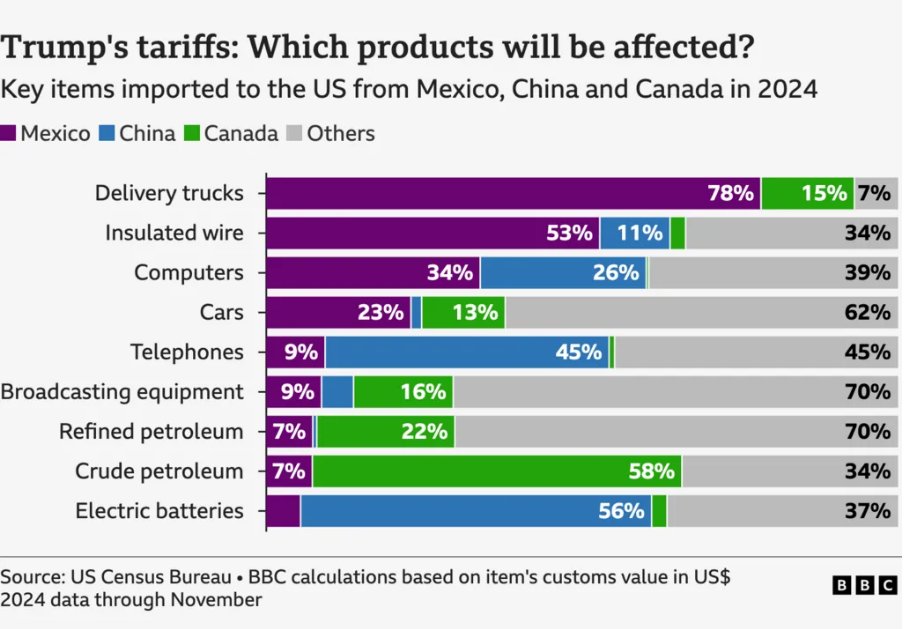
Products affected by Trump’s Tariffs (Image source: BBC)

Nevertheless, Trump’s tariff threats carry weight, as they could impose significant economic pressure on targeted countries, prompting businesses to relocate. According to the BBC, Chinese factories with 500 workers have shrunk to just 200 employees, while American buyers are already exploring alternative manufacturing hubs in neighboring regions outside of China.

Business owner Huang Zhaodong, who recently relocated his factory, told the BBC that customers had pressured him to move production overseas. He agrees with their concerns, estimating that a 10% tariff increase could cost him an additional $800,000 in earnings. “Manufacturing clothes in China under these tariff conditions is simply unsustainable,” he said.

A Victor Emerges

Cases like Mr. Huang’s have proved the challenges that Trump’s tariff has imposed on countries like China. The beginning of the Trump trade war has led businesses to flee to Southeast Asian nations, most notably Vietnam. 

While other Southeast Asian nations also benefit from shifting supply chains, Vietnam has emerged as a top destination due to its growing industrial capacity and strategic location. The country recently rose to become the Association of Southeast Asian Nations (ASEAN) champion with an estimated 40% of all ASEAN exports to North America being from the country alone. Though it is difficult to quantify how many businesses have relocated from China, BBC reports that major brands like Puma, Nike, and Adidas have already moved production to Vietnam. Sources from Vietnam Briefing indicate Intel and Samsung have rapidly ramped up their investment in Vietnam and are projected to reach $100 billion in revenue by 2050. Propelled by robust exports and foreign investments, Vietnam’s economy has recently grown by 7.09%, reaching $476.3 billion—outpacing the 5.05% expansion seen in 2023.

It is debatable whether Trump’s glare will graze upon this nation. Experts debate whether he will target Vietnam with tariffs, as his trade policies often focus on countries with a trade surplus. In 2024, Vietnam held the third-largest trade surplus with the United States at $104.6 billion, accounting for nearly 30% of its total exports. This substantial trade imbalance makes Vietnam a potential target for Trump’s tariff threats. In this scheme, the nation might experience radical changes due to trade balances, exchange rates, supply chains, and foreign direct investment (FDI). However, Vietnam is more likely to benefit from US-imposed tariffs. This prediction is supported by trends from Trump’s first term when the country experienced significant economic growth due to an influx of manufacturers and factories relocating to Vietnam. 

Despite lingering skepticism, Trump has maintained a favorable view of Vietnam. As early as 1980, Trump publicly opposed the Vietnam War and visited the country twice during his first term. His business ventures have also extended to Vietnam, with his organization partnering with Kinh Bac City Development Holding Corporation (KBC) to develop a $1.5 billion complex in Hung Yen Province. Meanwhile, his new confidante, Elon Musk, has positioned Vietnam a key production hub for SpaceX’s Starlink satellite internet project, shifting suppliers and manufacturing from Taiwan to Vietnam to reduce geopolitical risks.

Reversing these investments may be impractical or simply too late. The confidence that both Trump and Musk have placed in Vietnam highlights the country’s growing role in global supply chains. Amid rising geopolitical tensions, Vietnam’s diplomatic strategy—often referred to as the “bamboo policy” for its balance of resilience and adaptability—has strengthened its international position. As long as the country continues to wisely navigate political and diplomatic negotiations and steer clear of populist pitfalls, Vietnam is well-positioned to sustain its economic growth and global influence.


Related Articles

Walden Lam

Awaken* newsletter

From Hong Kong to Silicon Valley: Unspun’s Journey to Revolutionize Sustainable Fashion

In this interview, we delve into the inspiring journey of Walden Lam, the co-founder of Unspun, a company on a mission to revolutionize the fashion industry through sustainable practices and innovative technology. Walden shares his story, from his early exposure to manufacturing in Hong Kong to the challenges of raising capital for a deep-tech venture in Silicon Valley. He discusses the initial years of Unspun, the complexities of operating a global supply chain, and his vision for the future. Walden also reflects on how his Asian heritage has influenced his entrepreneurial journey and offers valuable advice for young entrepreneurs.

HanYue: Tell us about how Unspun was started. 

Walden: I grew up in Hong Kong, in a family that did manufacturing, so I always had exposure to that. I graduated undergrad during the financial crisis, which forced me to reconsider my career paths. My initial projects out of undergrad were climate-related, exposing me to the complex problems and the structured, yet often inflexible, approaches usually taken in strategy consulting. 

HanYue: What were the first 2-3 years of Unspun like? 

Walden: My journey to the GSB was fueled by hypotheses about consumer-facing ventures. Just weeks before graduation, I learned through a Design school blast about a co-founder opportunity that aimed to bring additive manufacturing (like 3D printing) to commercial applications. This meeting, where I saw a desktop mockup, changed the trajectory of my life. Every Silicon Valley VC then was really scared of “deep-tech” companies, it was a hard time raising capital for what we wanted to do.

HanYue: What was it like to operate a company that has operations on both coasts? 

Walden: In the early years, Unspun resembled an R&D company, keeping our product development under wraps until late 2022. After going through a hardware accelerator and securing government grants, we spent our initial months in Shenzhen and Hong Kong, leveraging the good manufacturing ecosystem. Operating on both coasts highlighted the benefits of a global supply chain, essential for managing garment production still predominantly based in Asia, but processed globally.

HanYue: What is next for Unspun? What is your vision? 

Walden: Our unwavering vision focuses on reducing emissions globally—a significant challenge given the industry’s varied estimates on emission impacts, ranging from 4-9%. Our goal is not just to be a standalone brand but to influence the industry by integrating lower-impact practices into their manufacturing practices. We’re starting with basic products and gradually expanding into more refined and performance-oriented categories, aiming to transform efficiency and cost into a platform beneficial for all.

HanYue: How has being Asian influenced your entrepreneurship journey? 

Walden: Growing up in Hong Kong has shaped my approach to both life and business. It has fostered a curiosity and a desire to break out of local confines, driving me to pursue opportunities abroad. I always raise my hand when it comes to getting out of my own environment. Back in my consulting days, I volunteered for a project in Nigeria – my colleagues thought I was crazy. 

But I always had the notion that there’s so much that happens outside your own bubble. This openness has been instrumental in building a company with a flexible, global perspective, partnering with brands and manufacturers across continents. With the company, we now have brand partners in the EU, manufacturing partners in Asia, and capital partners elsewhere. That opened up lots of opportunities. Our goal is to influence a global industry, we need that mindset and curiosity.

HanYue: It sounds like growing up in Hong Kong has given you open-mindedness and the courage that you are not afraid to deal with people and environments different from yours. That is VERY precious. What advice would you give to young entrepreneurs these days? 

Walden: My advice for young entrepreneurs is to adopt a long-term perspective. Do not be afraid of having a contrarian view.  We are really focused on building a cross-generational company that endures and transcends time. 

Another piece is to think more like an architect of your own company, and less about your individual contribution, hopefully charting a course for the company that can sustain you, you don’t have to do everything all by yourself.

HanYue: That’s a really insightful take. Where can we find Unspun jeans now? 

Walden: You can find more about us at unspun.io, where you can shop for our customized jeans online. We also launched a small collection at NY Fashion Week, which is still available. 

As Unspun continues to push the boundaries of sustainable fashion, Walden Lam’s journey serves as a testament to the power of innovation and global collaboration. Keep an eye on Unspun as they strive to reshape the industry, one custom pair of jeans at a time.

Stories

Sophia Li Unites Two Cultures for Climate Action and Social Advocacy

AHN and Meta Prosper have partnered on a new podcast series highlighting API creators. Meta Prosper is dedicated to amplifying and supporting the API community and driving economic growth and equitable representation. The Creators Podcast series delivers stories on how creators achieved success and created impact through their platforms, serving as an inspiration for the community.

In the fourth episode of Creators Podcast, we embark on an empowering journey as AHN and Meta Prosper sit down with Sophia Li, a phenomenal Chinese American journalist, climate advocate, and public speaker. In this episode, Sophia Li addresses her cultural heritage and how she raises awareness of complicated subjects including climate justice, civil rights, and technology with ease. 

Even though Sophia was born and raised in the US, she spent two years of childhood with her grandparents in Shandong, China before returning to the US for preschool. Her adjustment to the US culture, along with Buddhist influence throughout childhood, has turned her cross-cultural journeys and wisdom into impact, bridging the two worlds apart into one globally mutual cause – sustainability. 

Sophia has always been a social advocate. After graduating with a Bachelor of Arts in Fashion Design and Merchandising, her paper on cotton globalization enabled her to receive a $2,000 grant from Cotton Inc., travel the world for fashion studies, and land a four-year position at Vogue.

Now, leveraging her platform and knowledge, she co-founded STEWARD, a project that emphasizes sustainability in the world of Web3 while serving as the co-chair of the World Economic Forum’s Web3 Sustainability Coalition. 

Moreover, Sophia does not stop at climate change but she’s also a vocal advocate for social justice. Sophia is an official United Nations Human Rights Champion and a strong supporter of the #StopAsianHate movement and youth education. 

Listen to the Creators Podcast featuring Sophia Li here.

CONNECT WITH SOPHIA LI

Instagram: @sophfei

Website: sophfei.com

image1-png

Awaken* newsletter

Transforming the Future of Work: An Insightful Conversation with JJ on Entrepreneurship, Innovation, and Personal Growth

In this candid conversation, JJ reflects on his remarkable journey, from gaining admission to Stanford GSB to founding Onloop. He discusses his proudest achievements, the challenges of building a pioneering company, and the invaluable lessons learned along the way. JJ also shares his vision for Onloop in the evolving landscape of remote work and generative AI, his approach to angel investing, and offers insightful advice for aspiring entrepreneurs. Join us as we delve into the experiences and insights of a trailblazing entrepreneur committed to transforming the future of work.

HanYue: You have accomplished a lot in your career. What’s your proudest achievement so far?

JJ: My proudest achievement remains getting into the Stanford GSB MBA program. Before Stanford, I had spent my entire life in Asia. Moving to Stanford marked a significant shift in both my career and personal development. Immersing myself in the challenging yet enriching environment of the Bay Area was transformative, and I just returned there for my 10-year reunion.

HanYue: Can you tell us about the origins of Onloop?

JJ: Onloop originated from personal frustrations I encountered while managing teams at Uber for 3.5 years, especially with inefficient HR processes. This led to extreme frustration with the outdated systems. After leaving Uber in September 2019, I started OnLoop to solve some of these frustrations. We developed our first product around changing how performance reviews get done using GPT3 in early 2021. We’ve come a long way building out our platform and focused on helping every manager become a great manager using habit-forming technology and applied AI It’s been an exhilarating journey, shaping a company that contributes to the evolving future of work landscape especially given all the transformative impact of distributed & hybrid work as well as the maturity of large language models (LLMs).

HanYue: What have you learned from building Onloop?

JJ: Building Onloop has taught me that a founder’s longevity hinges on their conviction in their mission and the people they surround themselves with. Pioneering in any field is incredibly challenging—far more so than creating a copycat startup. Jensen Huang famously said he’d say ‘hell no’ if asked to do it all over again. The world resists change, and you must consistently challenge the status quo. 

Growing up in an Asian household where academic success was prioritized and entrepreneurship was uncommon, taking a non-salary path wasn’t easy. This background often amplifies the voices of doubt during challenging times, yet confidence and eloquence are the most significant drivers of success in the early days. 

Life in your late 30s and 40s has many more responsibilities with respect to family so it’s not always easy to take the plunge, but the learning experience from entrepreneurship is absolutely invaluable. I’m better off for it, even if things don’t pan out as expected. Starting a company is like becoming a parent—it’s a transformative experience that teaches you new ways to live.

HanYue: What’s your vision for Onloop?

JJ: Our vision at Onloop is to help knowledge workers fully realize their potential during this era of significant transformation. The rise of remote work and the advent of generative AI—akin to an industrial revolution for knowledge workers—presents new challenges and opportunities. We aim to help these professionals optimize their careers in a rapidly changing environment. The knowledge work sector is vast and often influenced by chance, especially in job placement – knowledge worker wages are a multi-trillion dollar asset class allocated by chance. My goal is to develop and disseminate optimal strategies for knowledge workers, enabling them to seize the best opportunities available.

HanYue: Tell me about your angel investing career and how it impacts your entrepreneurship journey.

JJ: I don’t subscribe to the notion of work-life balance but prefer to maintain a purpose portfolio, which currently includes my family, OnLoop, and enhancing Singapore’s status as a global hub, especially for highly innovative companies. My approach to angel investing focuses more on the people than the ideas themselves, reinforcing my belief that the right people drive success. And I apply this same principle in my work with other CEOs and founders.

While I believe any manager can become great with the right support, a CEO doesn’t have a direct manager, making coaching essential. I therefore coach a handful of founder CEOs and  this interaction offers mutual learning opportunities and enhances my own growth as a CEO/founder 

Talking about angel investing, it isn’t just for the rich and wealthy. I have made six investments so far in the range of US$1,000 through syndicates to US$15,000 in certain founders that I know personally. I have learned that while my bets on ideas have failed, my bets on people have not. This supports my hypothesis that early-stage investing is 80% about the founding team. 

Lastly, having become a Singaporean last year, I feel even more committed to the Singaporean ecosystem and proud to build in it.

HanYue: Advice for young entrepreneurs these days? 

JJ: When I was single and enjoyed partying, I never imagined I’d find myself here today. People seek pleasure when they lack purpose, as Victor Frankl famously spoke about. Today, living a life of purpose is crucial for happiness — it involves engaging in activities that you deeply enjoy and believe are your calling. This philosophy has guided both my personal and professional life and serves as my constant motivation. 

JJ’s journey exemplifies the blend of purpose and innovation needed to navigate the evolving landscape of modern work. His insights into entrepreneurship, the importance of mission-driven leadership, and the power of transformative technology offer invaluable guidance for the next generation of innovators.

{"ARInfo":{"IsUseAR":false},"Version":"1.0.0","MakeupInfo":{"IsUseMakeup":false},"FaceliftInfo":{"IsChangeEyeLift":true,"IsChangeFacelift":false,"IsChangePostureLift":false,"IsChangeNose":false,"IsChangeFaceChin":false,"IsChangeMouth":false,"IsChangeThinFace":false},"BeautyInfo":{"SwitchMedicatedAcne":false,"IsAIBeauty":false,"IsBrightEyes":false,"IsSharpen":false,"IsOldBeauty":false,"IsReduceBlackEyes":false},"HandlerInfo":{"AppName":2},"FilterInfo":{"IsUseFilter":false}}

Stories

How Benny Yap and Jae Tan Drive TGFX Agency’s Success

Benny Yap and Jae Tan are not just co-founders of TGFX Agency; they are a powerhouse duo transforming businesses through innovative branding and marketing.

Benny Yap, a seasoned entrepreneur, is renowned for his outstanding achievements in the marketing and advertising industry. His expertise encompasses advertising, branding, illustration, and ideation. Benny Yap’s leadership and artistic vision play a pivotal role in shaping TGFX’s distinctive approach to branding and marketing, driving its success.

Jae Tan is a dedicated and results-driven entrepreneur with over a decade of experience in branding, web development, and video production. Under his strategic guidance and leadership, Jae has propelled TGFX to unprecedented success.

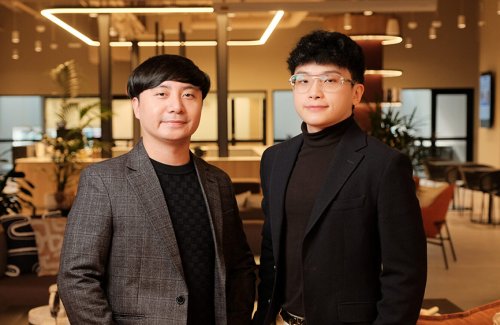
Jae Tan (left) and Benny Yap in a meeting.

In an exclusive interview with Asian Hustle Network, Benny and Jae share their journey, challenges, and insights, offering a glimpse into the dynamic partnership driving TGFX. Read on to discover how they are transforming brands and making a lasting impact on the marketing industry.

EARLY CAREER AND THE BIRTH OF TGFX

Benny Yap and Jae Tan both studied graphic design and advertising and initially met through a design project. This collaboration not only brought them together as best friends but also sparked the idea of starting a business together. They realized that by combining their forces—their creativity and design skills—they could tackle the business world more effectively as a team. This shared vision and partnership led them to start TGFX.

OVERCOMING INITIAL CHALLENGES

Benny and Jae faced significant challenges when starting TGFX, especially during the COVID period. One of the biggest hurdles was adapting their business model. Initially, they focused on one-off jobs, but they soon realized the need for stability and consistent cash flow.

They decided to pivot to a retainer basis, particularly in social media marketing. This shift not only helped them navigate through a difficult time but also allowed them to build stronger, long-term relationships with their clients.

DYNAMIC PARTNERSHIP

As co-founders, Benny and Jae complement each other perfectly in running TGFX. Benny, previously from BBDO Advertising agency, brings a wealth of creativity and innovative ideas, driving the creative direction and ensuring the campaigns are cutting-edge, Meanwhile, Jae excels in managing operations and strategic planning, providing a solid foundation for the business. This dynamic allows them to leverage their individual strengths, resulting in a well-balanced and effective partnership.

TGFX’S MISSION AND CORE VALUES

TGFX’s mission is to help businesses across Australia succeed and thrive. Their core values include providing world-class services and being recognized as one of the best and most innovative agencies in Australia. They emphasize treating clients like family and growing alongside them, fostering strong, long-term relationships built on trust and mutual success. 

INDUSTRY-SPECIFIC CHALLENGES

Having worked with numerous businesses across various industries, TGFX encounters several industry-specific challenges. Key issues include maintaining brand consistency, attracting the right customers, and building a loyal customer base.

TGFX addresses these challenges by tackling each core issue one day at a time and maintaining consistency in everything they do for the brand. This methodical and dedicated approach helps their clients overcome obstacles and achieve long-term success.

IMPACT ON THE ASIAN COMMUNITY

As entrepreneurs with roots in the Asian community, Benny and Jae see TGFX Agency as having a significant impact and contribution to this community. With 80% of their clientele being Asian-owned businesses, TGFX Agency is dedicated to helping the Asian business community in Australia thrive. By providing tailored branding and marketing strategies, they support these businesses in achieving success and growth.

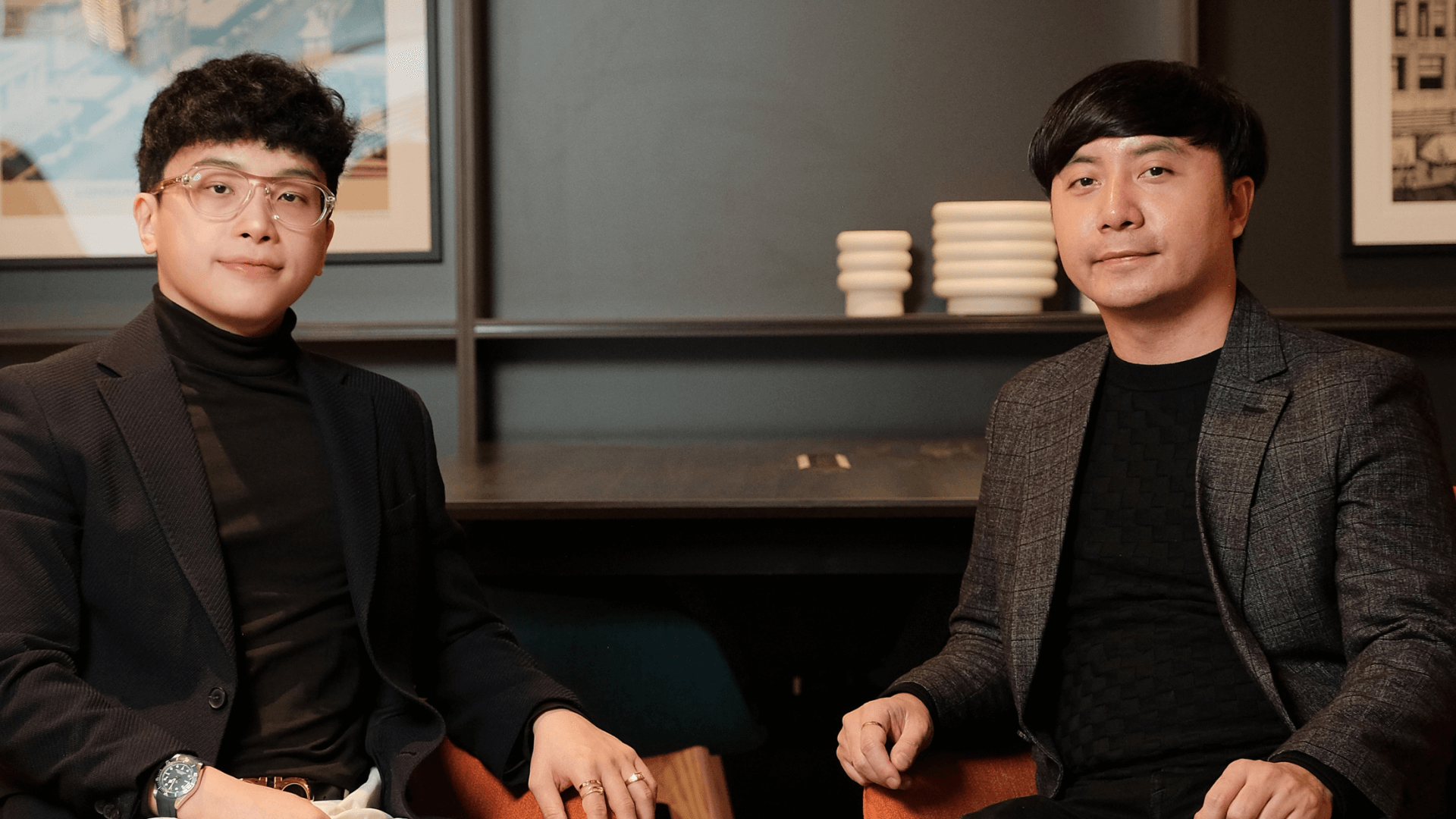
Jae Tan (left) and Benny Yap
With TGFX, the duo aim to uplift Asian businesses in Australia.

ADVICE FOR ASPIRING ENTREPRENEURS

Benny and Jae emphasize the importance of adding value to the marketplace. Aspiring entrepreneurs should understand their consumers’ needs and preferences thoroughly, conduct extensive market research, and stay attuned to industry trends and client feedback.

“Persistence is key—never give up, even when faced with challenges. Building a successful agency requires resilience, continuous learning, and an unwavering commitment to delivering exceptional service and results. In addition to that, our team is the cornerstone of our success. Without their dedication and hard work, we wouldn’t have achieved our current position. Each member plays a crucial role in our accomplishments, bringing unique skills and perspectives that drive our progress forward. We are deeply grateful for their commitment and contribution to our shared goals. Together, we continue to grow and thrive, thanks to their invaluable efforts,” Benny and Jae shared.

Benny Yap (left) and Jae Tan
Benny (left) and Jae highlight persistence, market research, and a strong team as keys to success.

FUTURE VISION AND GOALS

TGFX Agency continually strives to expand into new areas across Australia and different industries, aiming to deliver data-driven results to businesses in need of growth. They are also committed to expanding their Malaysia agency, bringing on new businesses, and growing the team there.

Benny and Jae are excited about the future and look forward to furthering their impact on businesses both locally and internationally. Their advice to others is to stay focused, and consistent, and always strive to add value. Understand your customers’ needs and don’t shy away from innovation.

CONNECT WITH TGFX

Website: tgfx.com.au

Instagram: @tgfx.agency