News

January 24, 2025

SHARE:

Japan has an old proverb: “The nail that sticks up gets hammered down.” 

While in China, there is a saying, “The higher the tree, the stronger the wind.”

In a critical lens, both idioms illustrate harmony and unity – a vital essence of Asian culture and heritage. Nevertheless, the proverbs also shed light on a contrasting school of thought: conformity and crab mentality. 

Crab mentality refers to the situation one can explore by placing a crab or a collective of crabs in a bucket. A lone crab can inevitably crawl out of the bucket, however, a peculiar scenario would arise if one situates a group of crabs in a bucket. As a crab tries to crawl out, the other crabs will pull it back down. If it tries again, the others will rip its claws off to ensure it can never do so again. Ultimately, no crabs can go anywhere besides the stew pot you are brewing. 

Crab in a bucket scenario (Image source: Microsoft Designer)

Crab in a bucket scenario (Image source: Microsoft Designer)

It is naivety to assume human beings are a unified collective group. History, wars, and jealous conflicts are testaments to human being’s selfishness. Hence, it is arguable that we are inclined to place ourselves above others, even if it means at the expense of our peers. Despite being a precarious thought, this insight opens new dimensions to understanding crab mentality in the human context. 

“Remember your cousin Timmy in China? He has 15 years of experience. He’s nine!” 

Steven He’s dad (played by Steven He) exclaimed.

Terms like “Asian-level difficulty,” “Tiger Moms,” and “Asian parents” have become widely recognized through memes, movies, and other mainstream media, serving as a lens for global audiences to understand and appreciate aspects of Asian culture. Yet, one community still paints a negative view of the Asian community, even discriminating against its individuals – and the answer is ironically the Asian community itself.

The purpose of this work is not to discriminate or criticize any peculiar group but to foster intellectual discourse and encourage reflection on societal dynamics and individual perspectives. The chosen quote embodies this intention, capturing four intertwined facets.

Understanding the concept of face is crucial when discussing Asian culture and heritage. Face serves as a societal construct that governs social interactions and determines one’s standing within a social hierarchy. It is a dynamic measure that can be given, earned, taken away, or lost, often extending beyond the individual to include family and friends. For those unfamiliar with this concept, here’s a simplified explanation:

  • A wife who earns a promotion gains face for herself in front of her boss, while also bringing face to her husband and parents through her achievement. 
  • Conversely, a student who performs poorly on an exam loses face among peers, and their parents, in turn, lose face within their social and familial circles.

Despite being debatable, visualizing face as a form of currency provides an interesting lens through which to examine crab mentality in Asian communities. Much like any valuable asset, currency must be earned, safeguarded, and strategically utilized. Losses, even those meant for long-term gains, are approached with caution and calculation. Consequently, individuals strive to enhance their reputation while using criticism to diminish the face of others.

The concept of face is deeply tied to education and parenting, playing a role in fostering crab mentality. Asian children are often raised to prioritize self-achievement above personal aspirations, adhering to predetermined paths for the “greater good” of the family. This emphasis on collective reputation often comes at the cost of individual dreams, reinforcing a mindset where personal success is weighed against familial expectations.

Parenting can affect mindsets, a reflection on Tiger Moms (Image source: Mims On The Move)

Parenting can affect mindsets, a reflection on Tiger Moms (Image source: Mims On The Move)

Indeed this is a generalized claim that leaves certain minorities for speculation, but the interplay between face and sacrifice is crucial in understanding the environment Asian children grow up. Literary works like Truyện Kiều (Tales of Kieu), a renowned Vietnamese poem, highlight traditional ideals through terms like cầm-kỳ-thi-họa—the four virtues defining a successful woman. Similarly, the stereotype of Asian children being expected to become doctors or lawyers has become a familiar cultural reference in contemporary discourse.

No parents want their children to grow up as bad people. Hence, it would be injudicious to blame parents and the system for a negative societal mentality. Yet, there are certain repercussions to sacrificing a child’s dream in return for a destined path to greatness. This leads to the third facet of crab mentality in Asian communities: A ramification for every child following the same success path means comparison and competition. 

Let’s revisit Steven He’s joke: Timmy is used as a benchmark for comparison. The only way for Steven to save face is by climbing the same ladder and offering Timmy a similar spiteful insult. This vicious cycle of comparison fuels crab mentality within families, peers, and the broader community. True to reality, Asian students often spend countless hours in extra classes and clubs to meet rigorous expectations. Tiger moms push their children to excel in every class as if their lives depend on it. There is no middle ground—you’re either a winner or a failure.

This brings us to the final facet: the absence of praise and apologies. Ironically, according to BBC and Vocal Media, Asia is home to some of the politest people in the world, with countries like Japan and Thailand leading the way. Despite this, hierarchy plays a pivotal role in relationship dynamics. To save face, many Asian parents rarely offer praise to their children. Astonishingly, when it comes to apologies, parents often go to great lengths to defend their actions rather than acknowledge their mistakes. 

A similar response can be seen in Asian workplaces, where higher-ups are more inclined to criticize and are far out of reach from their team members. Individuals will praise their peers and colleagues in hopes of receiving similar treatment instead of actual commemoration. Workers often segregate themselves into teams of interest to promote one another instead of collaborating as a group. These groups create outcasts who, despite their talents, are looked down upon and have their accomplishments taken or snuffed out by negative criticisms. This reluctance to give praise and apologize reinforces a mindset of self-achievement above all else. At first glance, mentality such as these are not wrong, but they leave cracks for detrimental thoughts of arrogance and selfishness – ultimately sustaining the crab mentality.

While this article explores the crab mentality within the Asian community, it is important to recognize that this negative mindset is not exclusive to any one group—it exists everywhere. The concepts of face, self-achievement, competitiveness, community, and sacrifice are what make Asian heritage unique and beautiful. This work argues that these cultural elements are not the root cause of the crab mentality, but rather, insights into why such a mindset may emerge. 

Related Articles

Image Source: Locke Bio

Uncategorized

How This Sci-Entrepreneur Became A Company CEO At The Age Of 18

Capitalizing on her 14-year-old self’s science enthusiasm 12 years ago, Cathy Tie, transformed herself into a successful bioinformatician and entrepreneur.

At 18, the young Canadian became the co-founder of the $1 million dollar worth Ranomics company, a health risk prediction provider. While she co-founded Locke Bio, an e-commerce platform for pharmaceutical and other FDA-approved product suppliers when she was 23.

Today, the 26-year-old sci-entrepreneur shares that having a broader view is her key to being integrative and cross-disciplined in the many fields she is engaged in, as art and creativity are easier said than done.

During an interview with CNBC, Tie mentions her ability to connect ideas and see them far differently from how others perceive, including how science can grow and expand for beginners which she thinks is more artistic and creative than technical. 

This skill, however, is uncommon among teenagers. Yet, Tie’s innate dexterity manifested in her secondary years as she reserved a special place for science and relevant practical activities in her heart ever since a kid. 

Discontented with the standard curriculum, she wrote unsolicited letters to her professors seeking to tour the school labs, perform studies, and assist in their scientific projects, which taught her a lot until she had her first paper published in a peer-reviewed journal at age 16. 

However, she realized that getting entrepreneurial financing is better than relying on academic allowances since she could do more research. She applied to entrepreneur programs to assist her in the startup world.

Upon getting acquainted with Leo Wan who was then a Ph.D. student at the school where she was a neophyte, they worked together and were admitted into IndieBio, a startup platform that finances and mentors science entrepreneurs.

With Tie having prime knowledge on how to figure out issues on genetic trial precision, she subsequently co-founded Randomics with Wan after quitting college and leaving for San Francisco where she became the CEO for the three early years.

Thereafter, she was asked to apply and was accepted to The Thiel Fellowship, which aids a $100,000 subsidy to out-of-college inexperienced entrepreneurs.

A year following her collaboration with Cervin Ventures, she founded Locke Bio, which currently has three U.S. and Canadian business resources.

Tie’s business is nonexempt to challenges that a company experiences, yet, hard work and reflection make it possible for her to always “see the bigger picture. In this light, she and her team have a lot ahead for the company.

Image Source: Maye Felices-McDonald Facebook

Uncategorized

Former Caregiver Now CEO Of Multi-Million Dollar Companies In The US

Stirred by her dream, perseverance, and thrust, Filipina-American Maye Felices-McDonald etches her name as the owner and CEO of quite a few businesses in the US such as GETMEFIT Slimming Products, and Mama’s Angels Senior Care.

Maye’s voyage was not a piece of cake. She developed her entrepreneurial skills as a vendor of sweets and paper dolls in school when she was still a kid, as a caretaker of her mother’s sari-sari store (sundry store), and as a student assistant when she was in college while studying Ladderized Nursing.

In 2017, Maye started as a part-time caregiver who made her car home for eight long months. Eventually, she courageously established her own caregiving firm named Mama’s Angels Care and later on catered to and met the caregiving demands in Maryland, Washington D.C., and Virginia starting with three caregivers to 49 healthcare providers at present. With this, she was also able to help fellow Filipinos by hiring them into her company.

As a dream-chaser, Maye capitalized on her 5Ps: Passion, Persistency, Perseverance, Positive Mindset, and the Power of Resilience which led her to the realization of her dreams which she found in the US.

As her business considerably grew, it became distinguished in the US, and in September this year, she proudly ramped up her well-known product on the esteemed New York Fashion Week runway putting in high spot her advocacy of unifying health, wellness, fitness, and fashion and her drive to take part in her young ambassadors’ will of fostering mental health awareness to the young ones.

Maye toiled and worked hard in achieving her dreams making her more than deserving of receiving laurels for her successful business undertakings along the lines of Modern CEO, Most Influential Young CEO for Business and Entrepreneurship, and Best Slimming Product of USA.

Image Source: Brían Nguyen Instagram

Uncategorized

Vietnamese-American Transgender Model Made History Winning local ‘Miss America’ Pageant

In the 100-year history of Miss America, 19-year-old Brían Nguyen has become the first transgender contestant to win a local Miss America Organization beauty pageant, Miss Greater Derry 2023.

The teenager from New Hampshire won a crown, title, and scholarship. She ecstatically wrote on her Instagram, “No words can describe the feeling of having the opportunity to serve my community and represent my community for the very first time at Miss New Hampshire.” 

Nguyen continued, “I am so honored to be crowned your new Miss Greater Derry 2023, and I am thrilled to show you all what I have up my sleeves. This will be an amazing year.”

Founded in 1986, the Miss Greater Derry Scholarship Program awards scholarships to young women in the Greater Derry area for academic skills, talent, character, community service, and poise.

The Miss Greater Derry Scholarship Pageant is also a preliminary event for the Miss New Hampshire Pageant and, ultimately, the Miss America Pageant.

As the new Miss Greater Derry, she recently attended the annual Best Buddies Champion Gala to support those with intellectual and developmental disabilities. $150,000 was raised over that night to help out their champion nominees. She will be working with Best Buddies New Hampshire throughout her reign.

Image Source: Carla Tramullas / MycoWorks

Uncategorized

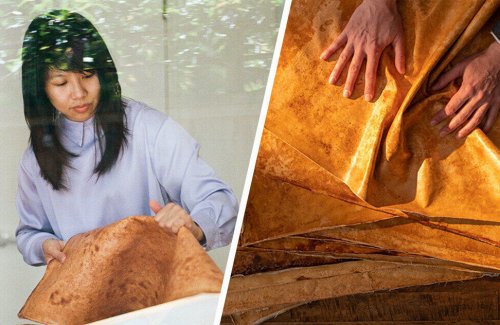
MycoWorks’ Sustainable Mushroom Leather Raised Over $187M From General Motors and Hollywood A-Listers

“Growing the future has only just started. This industry will continue to surprise people,” says Philip Ross, co-founder of MycoWorks, a mycelium material founder and producer.

As the innovator of high-quality mushroom “leather” for the luxurious Hermes bags, the business acquired $187 million from Natalie Portman, John Legend, and General Motors and will soon cover the latter’s electric car interiors.

Ross unintentionally discovered leather-like material in reishi mushrooms, a fungus he farmed for his cancer and AIDS more than four decades ago. He then became a mycelium artist and featured his fungus-based works at famous museums.

According to Sophia Wang, co-founder of MycoWorks whom Phil met six years before they founded the firm while working together on art ventures, Ross’s discovery marked the “leather’s” birth to the globe.

Wang and Ross continued to discover more about mycelium and later realized that the material is enticing to buyers who don’t like synthesized contaminants and materials which are produced from animals.

Alongside raising their funding source, the company also conducted a groundbreaking at South Carolina Factory with the aim of attaining a sufficient supply of their fancy product.

With about 200 employees, Matt Scullin, the company’s CEO, said that the “Brands are making very significant changes to address what is really a growing demographic of people who want to buy sustainable products that have provenance and traceability and a lower carbon footprint, lower water use—and mycelium does all of those things.”

Compared to animal leather, the mushroom leather-like material is far more environmentally friendly as the former adds up to about a million tons of carbon dioxide which is tantamount to 30 million cars’ yearly emissions.

Despite environmental and animal issues, people prefer biomaterials or “next-gen” materials over the past decade making it in-demand as multi-billion dollars are invested in the industry.

Nonetheless, Hermes’ firm in France is soon to release its $4,200-worth “Victoria” bag made from MycoWorks’ amber-hued exquisite mycelium.