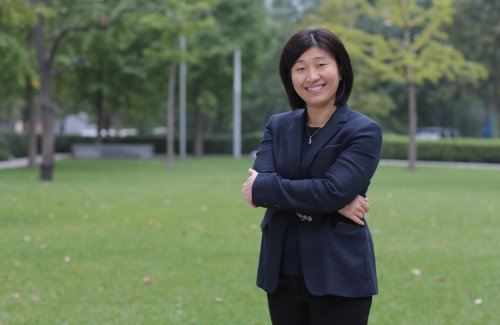
Wei Deng is the Co-Founder and CEO of Clipboard Health, a company that connects healthcare facilities with local professionals who can work unfilled shifts. Since Clipboard’s inception in 2016, Clipboard Health has filled millions of shifts for thousands of facilities nationwide, putting millions of dollars in the pockets of healthcare professionals. Throughout her journey, Wei has never lost sight of her ultimate mission of helping people socioeconomically. In this interview with AHN, she discusses her upbringing and the early days of her founder’s journey.
HanYue: Tell us about the early days of Clipboard Health, what type of challenges did you have to overcome?
Wei: It wasn’t called Clipboard Health when I started. It was initially a way to refinance student loans. I spent time talking to customers, figuring out who wanted to buy the fintech products, and talking to different customers again but I just didn’t feel the pull of the market, but I noticed that nurses wanted help finding a job. However, the hospitals only wanted to help people with experiences. So I pivoted to a clinical fellowship to help train nurses, figuring out what the clinical partners need, and help nurses find jobs.
After pivoting through 6-7 different ideas – I finally landed on the Clipboard Health model, a marketplace that helps with nurse staffing. In the early days, we were very much focused on launching a product and talking to users.
Edwin: How do you judge when to pivot and when to stop working on an idea?
Wei: I wish there was a magic formula – but there isn’t. Having seen some other friends who have found PMF was helpful. For our products, our customers could live with it or without it. They didn’t have any strong opinions about it. That was a sign to me that it’s not working. For most ideas, I gave it to 3-6 months. What was frustrating is that sometimes you would have some initial glimmer of hope – some people are using it, and you wonder to yourself, is that a real sign?
For a good product, I found out that even if the product isn’t built out, people still want to use it, and people care about it a lot. You can feel the pull of the market.
HanYue: There is clearly an unrelenting drive to pursue entrepreneurship, what kept you going during the early days?
Wei: Quitting just never occurred to me. In the beginning, I mostly called the things I worked on projects, and when they didn’t work out, I just never gave up.
Of course, there were frustrating moments: when I first went fundraising, I got told no 16 times. I was a solo founder, so there was no one to help me. I taught myself coding and sales to get started. I think the big realization is that even if you encounter nos and the product is not working, as long as you keep working and don’t quit, you are getting closer to a yes.
HanYue: That was really inspiring – as long as you keep working, you are getting closer to a yes. Want to switch gears a little bit, how did you meet your co-founder? What was it like building out the initial team?
Wei: In the early days, it was just me. My husband joined me after 3 years. By that time we already raised Series A, we were growing and had some traction. He initially joined to help out for 3 months, then stayed on for a few years.
Building out the team, we had a lot of trials and errors. We definitely made some mistakes – I had engineers whom you couldn’t get ahold of even when I was trying to fire them. We had one head of sales who built out our sales team but it turned out he was working for a competitor at the same time and was giving them our customer list, and all the people who worked for him were also working for the competitor. But luckily, some good people stayed and really they are what made us successful.
HanYue: Tell us about the people who stayed. What made them successful?
Wei: Oh, I love talking about this because it is what we look for during hiring. They have to care about the problem a lot. It is actually very obvious whether people are just here to collect paychecks, going through the motions, or if they really care about the problem.
They are really curious. They are always looking for clues. If a customer says no, or churns, they are always digging in and figuring out why, instead of taking it as a given – oh they just didn’t want to use the product.
They also have ownership and initiative. They never just bring a list of problems. The best people I’ve had, they’ve brought me problems I didn’t know we had, and they’ve already thought about how to solve them.
So initiative, ownership, and curiosity are our people and company values.
HanYue: That’s wonderful to hear that there is such a close alignment between the people’s values and company values. What was your proudest achievement so far?
Wei: Honestly, I think it’s assembling a great team. We’ve gone through a lot of great pains in hiring, but now we have an awesome team to move together. Nowadays, even if I pull my foot off the gas, they are still serving our customers the best they can, and that is very special.
The second thing is the customers we’ve been able to help, but that is honestly more of a proxy of how great our team is.
HanYue: Tell us a bit about your upbringing. How has being Asian influenced your entrepreneurship journey and your general approach to life?
Wei: I grew up with my mom and my dad. We grew up in Kentucky, there were not a lot of Asians in Kentucky.
My dad had this mentality: you don’t need permission to learn something. I remember trying to go to a national science fair – I was 16 and needed to learn calculus, but calculus was a college-level class and I was thinking, “Oh, maybe I can’t because I had to wait to learn calculus later.” My dad just said, get a textbook and figure it out yourself. That’s something I carried forward in life.
When I started, I didn’t have to have someone who knew how to code, I could just learn coding myself and get started. I never did sales before and didn’t have someone I could rely on for sales, but I could just pick up a phone and start doing cold calls. It’s the sense that nothing is beyond my reach, you don’t need to wait for the perfect moment or something/someone to depend on to get started.
There weren’t many Asians in the area I was from. We stuck together but we were also super competitive with each other. There were two people in high school I was constantly competing against, and I think in a lot of ways it brought out the best in me. Personally, I am not competitive, but I found having someone neck-to-neck with you really makes me thrive.
HanYue: Congrats on the unicorn status – it’s an incredible achievement! What suggestion do you have for founders who are still searching for product market fit out there?
The only thing that matters is to understand the customer’s pain points deeper than anything else. Rather than spending time on solutions, spend more time on understanding the problem. Actually, you might find that you are not even starting with the right customers – you might have to pivot a few times to find the right customers.
When you find them – look at their habits. People who are saying they want to lose weight, but if they are not going to the gym or tracking their calories or metrics, then weight loss is just not that big of a deal to them.
When talking to them, you need to look for: Are they spending money on it? Are they spending a lot of money but still can’t solve the problem? That is a potential area you can go to. The chances are that you can find a lot of good solutions – you can have the greatest AI and greatest product, but if it is not solving a real problem, then no one will end up paying for the solution.
Edwin: Are there mechanisms and processes you use to tease this information out?
Wei: We just look at their behaviors. Are they spending money? Is the pain point really painful?
When it came to staffing, it was obvious, that the customers we talked to were spending all of this money to putting together spreadsheets and tracking attendance. It was clearly a big pain point they wanted to solve.
My father passed last year, I remember spending so much time looking for a caregiver for him. If someone gave me a set of solutions, even if not super built out – just a list of caregivers or a list of places that could care for him, I would definitely want to talk to that person.
HanYue: Thanks for sharing a deeply personal moment with us. It really makes sense that as founders we needed to find the most painful problem to solve. Where do you go from here? What’s next for Clipboard Health?
Wei: Personally, I have two kids and I spend a lot of time with them. For the company, we want to continue expanding beyond healthcare professionals. We started with nursing – but we wanted to allow workers of all industries the benefits of flexibility and economic empowerment.
At Clipboard Health, we also have an internal MBA-like program. If you are a product manager but want to learn, we will teach you cross-functional skills – engineering, sales, and other things.
The hypothesis is that eventually if people leave and want to go and start their own company, I could enable them to have a much broader scope than just their own focus. We have engineers doing sales, customer support, and product and they all love it because they get to implement and continue to broaden their scope. One of our heads of sales was a product manager – they kept asking questions and wanted to learn about sales so they got the chance to lean into their curiosity.
I want to scale this program up as the company scales up to develop people. Because if you invest in people internally, what you get is phenomenal: People who are already invested in your culture, and know your product really well have more methods to help your customers and grow better.
Edwin: I see some parallels to your journey as well – the early days when you had to teach yourself coding and sales. One thing you talked about is expanding to verticals, how are you finding the new verticals?
Wei: We have a more systematic approach: we read the Bureau of Labor Statistics, and try to look at professions that need help. Maybe some professions are losing steam, etc. We also have lots of customers in healthcare and there is a a surprising number of professions to fill up there – we need janitors to clean up, cooks to cook for the dining hall, servers and waiters, and trainers for physical therapy patients. There are some natural adjacent areas. Customers are providing those insights to us and where they need help.
Edwin: Are you afraid of losing focus?
Wei: Focus is overrated, You should try to be good at some core competencies – but it all depends on how you define your core. if we define our core as a flexible labor marketplace, then we have lots of room to build.
If you look at any ambitious company, they have a ton of products and they might seem totally unorthodox to each other. Amazing doesn’t look focused: they have AWS and it has nothing to do with selling books. Or if you think of people around you, some of them are good at maths, instruments and some type of sports. No one is like: you should only be good at math – people develop expertise in multiple areas.
There is certainly a concern about chasing shiny new projects. We try to only pursue things that we have pre-thought out and really ask ourselves – do we want to be more ambitious than we currently are, or are we just chasing a shiny new object?
Wei’s journey with Clipboard Health underscores the importance of persistence, adaptability, and deep customer understanding. Her story is a testament to the power of resilience in entrepreneurship, demonstrating that with unwavering determination and a keen focus on solving real problems, success is within reach. The AHN team thanks Wei for having this conversation with us!