Uncategorized

September 12, 2022

SHARE:

Some business owners spend years building a company only to see it fail before it even takes off. How are you going to survive and cope? Will you just give up that dream business?

We all know that life as an entrepreneur is complex, but once you hit it, everything falls into place. Following the example of 27-year-old Thai entrepreneur Vanessa Techapichetvanich as she trusted the process and waited for the right moment to reap the benefits of her efforts.

Read through as Vanessa shares her story with the AHN community about building her passion-driven business Jamulogy, a 100% plant-based Indonesian herbal tonic. She discusses her struggles that almost made her give up, and what kept her going in order to reach her successes today.

Hitting Rock Bottom At The Very Start

2 years ago, I poured all my life’s savings into building Jamulogy. I raised quite a significant amount of funding through families and angel investors, built my first factory from scratch, and lost over $1M, due to the pandemic and an over-prioritization of FoodTech R&D.

I was devastated. This tremendous loss was beyond tragic. I was at the point where I wondered whether it was stupid for me to leave my high pay corporate job only to lose all my savings along with a sum of money from my investors.

What am I going to feed myself tomorrow? What will my employees do when they lose their job? How will I regain all the money I’ve lost? How will it affect women founders’ reputation in the startup ecosystem?

These questions and my desperation kept me wide awake at night for months. I was distressed, depressed, and hopeless. It was one of the lowest moments of my life.  

It also made me realize that when someone says “life as an entrepreneur is tough”, it is very much an understatement. You’re pretty much living on the edge 24/7, giving your 10000% best while success isn’t guaranteed.

What am I going to feed myself tomorrow? What will my employees do when they lose their job? How will I regain all the money I’ve lost? How will it affect women founders’ reputation in the startup ecosystem?

-Vanessa Techapichetvanich

Shedding Some Light On Untapped Opportunities

I almost gave up. I would have.. had I not coincidentally connected with someone from AHN who is in the import and export business. One really good thing about this group is you have people from everywhere around the globe, and they are able to share insightful expertise on some stuff you’re not familiar with. 

I joined AHN more than a year ago when Facebook suggested the group to me. One day, I saw some people posted about expanding their food products to big retailers like Walmart, Wholefoods, and Costco, and from there, I got to connect with someone from San Francisco who works for a national distributor company in the US, and that’s how Jamulogy’s products entered the US market. 

This encounter shed some light on untapped opportunities and calls for a pivot in our business model. And I have been rebuilding since January. Despite the adversity I have been put through, this journey has been my greatest teacher yet.

I’m proud to share that Jamulogy is now available in 5 countries worldwide, including the US, Australia, Singapore, Hong Kong, and Thailand. Jamulogy has also recently “graduated” from Southeast Asia’s biggest FoodTech accelerator program. 

Despite the adversity I have been put through, this journey has been my greatest teacher yet.

-Vanessa Techapichetvanich

Transforming Traditional And Holistic Drinks Into Recipes Of Yummy 

Jamulogy was born out of my passion for a healthy lifestyle and my dream to bring Asian pride to the global stage. My mother is Indonesian, and I was introduced to Jamu when I was 5. The word “Jamu” itself means herbs in Indonesian. Sadly, our generation in Asia has overlooked these Indonesian herbal drinks that have over 1,300 years of history as they often associate herbal blends with older people.

Vanessa and her mother

Using modern food tech and all-natural non-GMO ingredients, we aim to recreate traditional Indonesian Jamu as a way to restore health to modern consumers. We are also committed to debunking the myth that healthy food tastes terrible.

Our concept is “From farm to bottle,” and we take every opportunity to support local farmers & growers around Asia. Each bottle contains only 40-80 calories without cane sugar or highly processed ingredients.

Going forward, we are also diverging our product offerings into herbal powder mix to cater to different consumer lifestyles across the world. 

Inspiration To Keep Going and Work Harder

What inspires me the most are our customers. I received all sorts of feedback from customers, both positive and negative. Whenever I hear our customers telling us how our products have created a value-adding impact on their health and life, I can’t help but smile to myself. 

But of course, we also received negative feedback and complaints, which I got a lot of value from as those have helped us improve, adjust, and create even better products for our customers. Truth be told, we have experimented with over 150 recipes. It was a struggle at the start, but “fall seven times, get up eight.” 

It’s the joy of being able to create a positive impact in society that keeps me going. 

It’s the joy of being able to create a positive impact in society that keeps me going. 

-Vanessa Techapichetvanich

Advice To Aspiring Entrepreneurs

  1. Don’t be afraid to ask for help when you need it. 
  2. Do not let your failures define who you are, but do learn from them. Every successful person I know has gone through several major failures before they get to where they are today.
  3. Surround yourself with like-minded people. I can’t stress enough the importance of this. 

For me, the most important traits of being an entrepreneur are a growth mindset and adaptability. It’s not about who has the most brilliant ideas or who has the highest IQ, but more so who adapts the quickest to fit the market’s needs and customers’ expectations. 

Connect With Vanessa

You may check out our IG/FB at @drinkjamulogy.

If you’re just starting an F&B business or planning on exporting to Asia and want some advice, feel free to reach out as well. I’ll try my best to answer ⭐

Related Articles

Image Source: Wu Tsai Foundation

Uncategorized

Brooklyn Nets Owners Launched The Largest Business Accelerator for Minority-led Startups

After George Floyd’s controversial death in 2020, growing VC investments in businesses founded by people of color became a top priority. According to Crunchbase, just 2.4% of VC financing between 2015 and 2020 went to Black or Latinx enterprises. Funding for black entrepreneurs quadrupled to $1.8 billion in 2021. This year, however, saw a sharp decline in investments in minority founders.

Entrepreneur and co-owner of the Brooklyn Nets, Clara Wu Tsai, launched BK-XL, the biggest business accelerator that aims to support 12 startups founded by Black, Indigenous, and other minority founders in 2023 by investing up to $500,000.

In an interview with The Associated Press, Wu Tsai stated that a shortage of finance is a major barrier to wealth growth for BIPOC businesses. She and her husband Joseph Tsai believe investing in BK-XL would be the greatest approach to overcome this challenge and generate wealth for the entrepreneurs and the jobs they create.

Wu Tsai stressed that she aims to highlight the underutilized entrepreneurial potential in Brooklyn to assist the neighborhood get back on its feet. She also thinks that BK-XL will demonstrate to the rest of the nation that investing in Black businesses pays off and is a smart move.

She added that any money made from investments in the BK-XL startups will be put back into Brooklyn-based companies. “The best way to demonstrate our faith in Brooklyn and Black-owned businesses,” she continued, “is to invest in them and demonstrate to the rest of the world that they are wise financial decisions.”

Prior to the release of BK-XL, Tsai’s Social Justice Fund also introduced “EXCELerate” last year, which offered no-interest loans to Black-owned small companies in need of assistance in order to recover from the closures caused by the COVID-19 pandemic.

As part of her strategy to leverage a combination of investments and donations to achieve goals for the neighborhood, she stated that BK-XL will shortly be followed by a philanthropic grant program to assist other businesses in Brooklyn.

All Brooklyn-based, BIPOC-led firms may submit a BK-XL application starting on December 5. But only companies in industries where the Tsais have the expertise, like e-commerce, will be approved.

Image Source Ken Chan Facebook

Uncategorized

Pandemic Turns Filipino Actor Ken Chan Into A Serial Entrepreneur

Ken Chan, a 29-year-old Filipino actor, proves that the pandemic has not only caused bad things but has also brought good fortune to some, being a celebrity-turned-entrepreneur after losing his job during the crisis.

Ken swiftly expanded his franchised iFuel gas station with 10 branches in different parts of the country in just a year. He also opened Cafè Claus, a Christmas-themed café, which has extended into three branches around Metro Manila, Philippines.

Nonetheless, he also braved the wellness industry with his Aromagicare Luxury Massage Chair. He mentioned that his triumph is also because of saving and spending wisely. 

Ken said he had taken to heart the financial lesson his parents had taught him wherein he learned not to overspend on himself.

During his recent interview, Ken said that he takes pride in the fact that he rarely makes purchases for himself and even makes the most of his cars while they are still roadworthy.

The actor realized during the pandemic that artists should secure their fallback in case they lose their jobs in the industry.

Image Source: Koury Angelo / Forbes

Uncategorized

Rejections Didn’t Stop Kinside CEO Shadiah Sigala To Reach A Stellar Entrepreneurial Career

Shadiah Sigala co-founded HoneyBook, a $2 billion financial management software platform for small businesses, motivated by her ability to negotiate uncertainty while gathering information and making decisions.

When Shadiah was a child, her Mexican mother together with her two siblings moved to southern California. Despite most of her family members being unable to attend college, she was an honor student whose lifelong ambition was to acquire the greatest degree of education.

Shadia attended Pomona College for Latin American Studies and Harvard Kennedy School for public policy. As a result, she established a strategy for reaching goals she wasn’t sure about.

Before becoming an accomplished millennial, she finished her master’s degree and became the highest-earning member of their family as a project manager at Aetna, a health insurance company, where she learned about entrepreneurship, realized she is a “builder,” and thought starting her own company was the best option.

However, Shadia realized that she wouldn’t be happy there since she wouldn’t be valued. Shadia ultimately started a personal chef business in 2010, using her Pomona College alumni network to find well-off grads who wanted someone to cook for them.

In 2012, another realization occurred to her that cooking wasn’t for her. Shadiah then decided to move with her then-husband to San Francisco and found tech. She arranged informative interviews with everyone in the sector and learned that the problem she wanted to tackle was one she’d experienced as a business owner: no effective method to handle backend logistics like emails, payments, and bills.

With the three Israeli business people who have a similar concern as hers, they decided to digitize all these tedious procedures that micro small firms must complete to free them up to genuinely focus on doing what they love.

Using that concept, Shadia established HoneyBook in 2013 and worked there for five years according to CNBC.

As her most recent business, Shadia co-founded Kinside in 2018, a child-care marketplace that is available to employees that offers new parents a centralized location to look for daycare in their neighborhood, which has reached over $16 million, according to Crunchbase. 

Letting fear and excitement be one’s guide and being open-minded is what Shadia advises to other aspirants. According to her, opportunities that “feel like they are beyond your pay grade” are exactly how stellar is made.

Image Source Artbound

Uncategorized

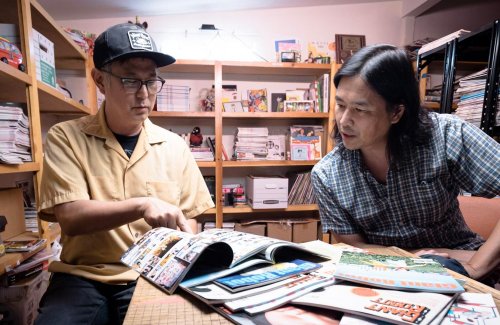
ARTBOUND Features Giant Robot’s Asian-American Pop Culture Influence In Its Latest Episode

Highlighting the impact of the Asian-American pop culture publication Giant Robot, the debut of the latest episode entitled “Giant Robot: Asian Pop Culture and Beyond” was finally aired last October 26 in the acclaimed arts and culture series ARTBOUND on KCET.

The episode showed Giant Robot’s examination of Sawtelle Boulevard as a Japanese-American neighborhood, sparking interest in Asian and Asian-American popular culture which resulted to a long line of Asian American artists who won recognition on a global scale. 

Established in 1994, Giant Robot was a bimonthly journal that focused on Asian popular culture that soon included works by Asian-American artists including David Choe and James Jean.

Eric Nakamura began publishing Giant Robot as a digest-sized zine. The piece covered a variety of subjects, including trendy Asian American independent filmmakers, Japanese punk rock, and contemporary Hong Kong films. National media sources including the New York Times, Wired, and LA Weekly published the story.

In 2001, Nakamura opened his first store named “Giant Robot Store” in Sawtelle Japantown and expanded in 2003.

Giant Robot co-founder, Martin Wong edited all 68 issues of the glossy magazine on Asian, Asian-American, and new hybrid culture from 1994 to 2010, when it was still a punk zine. His wife Wendy Lau served as Giant Robot’s graphic designer beginning with issue 18. Even today, Martin continues to publish zines and contribute to them.

The popular weekly television program and online site ARTBOUND captures the essence of California’s expanding arts and cultural scene and investigates how it is transforming the state into the world’s creative capital. 

The KCET Original series investigates and clarifies contemporary cultural challenges, offering insightful in-depth study of how the arts and culture impact society.