Stories

July 5, 2023

SHARE:

Growing up with stereotypical Asian tiger parents, Angie had always been interested in entrepreneurship but was constantly discouraged.

Angie Kim is the physician and CEO of Glow Up MD Medical Aesthetics and Wellness Practice. Her journey to success was far from easy. Angie grew up with traditional Asian immigrant parents who believed that taking risks in business was foolish.

She did all the stereotypical Asian things such as playing piano, being good at math, and going to a good college. She studied engineering and went on to complete medical school. And like most Asian women are expected to be, Angie was very quiet and had low self confidence.

But after completing her medical training, Angie realized that working for someone else was not what she wanted for her life. She refused to work for people without medical education and decided to take a chance on herself.

Starting her own business was an intimidating prospect for her. She had no background in business and had to navigate legal regulations, insurance requirements, and financial planning on her own. But with determination and persistence, she and her husband were able to set up a successful brick and mortar practice within just a few months.

Angie’s journey serves as a reminder that there is never a perfect time to start a business and that sometimes the best way to learn is by doing.

I DID IT ANYWAY

Even in middle school and high school, starting a business always piqued Angie’s interest. She had even presented a few ideas, such as a t-shirt business, to her parents when she was in middle school. Unfortunately, her parents always shot her ideas down, telling her they were stupid.

Angie’s parents have always been extremely risk averse and were against anything that required any type of investment with uncertain return. They wouldn’t even let her spend money to create a website.

Despite the discouragement, Angie was still very interested in entrepreneurship. She would constantly read articles about people who developed new apps or websites that became very popular. However, she had to put those aspirations on the backburner and focus on her education as her parents placed a high emphasis on education.

Even still, she would come up with ideas every so often and kept a list of these on her computer, hoping to return to them one day to get them started. “One thing that’s been constant since my childhood has been that whenever they told me I wouldn’t be able to accomplish something, I did it anyway,” she said.

BIGGEST CHALLENGES

Initially, one of their biggest challenges was trying to figure out the laws surrounding opening a medical practice. They looked at so many sources but kept finding contradicting or incomplete information.

The actual legalese was difficult to understand and they didn’t trust their interpretation of it. They finally spoke to a lawyer who confirmed what they understood. This allowed them to feel comfortable enough to continue on.

As of right now, the biggest challenge they’re facing is marketing and getting the word out. They are still trying to figure out the best way to do this. It has been mostly through trial and error. They are constantly trying different strategies, such as Facebook ads, in-person events, local SEO, local media and print, and direct mailing.

THE TURNING POINT

While working in the hospital, Angie began noticing little things over time that pointed towards the toxicity of the working environment, such as how little control and autonomy physicians have in taking care of their own patients, the backstabbing from other healthcare workers, and how physicians from other healthcare systems all had similar stories.

“I came to the realization that this would not change if I just changed jobs. The only solution was to start my own practice,” she said.

LOOKING BACK ON HER JOURNEY

The most rewarding aspect for Angie is the freedom to practice medicine the way it should be practiced. “I can spend as much time as I need to with patients. I don’t need to spend extra time trying to fight insurance companies. And my patients have been happy with their results,” she said.

She is hoping to grow her practice enough that she can open a second location and eventually franchise it, which would allow her to help even more patients and improve the healthcare system in her own small way.

“If I were to do it all over again, I would document my journey. I thought about it this time, but I felt like I didn’t know what I was doing the whole time.”

ANGIE’S ADVICE FOR OTHERS FACING SIMILAR CHALLENGES FROM THEIR FAMILIES

“People are always going to doubt you when you start, especially those closest to you. You can’t let that get to you. If it’s what you really want and you can’t stop thinking about it, then you should go for it. It’s going to be lonely and somewhat isolating when you start, but it’ll be worth it,” Angie said. 

She believes that there’s always a way to solve a problem. If you feel like you’ve hit a roadblock, you can try looking at the problem from a different perspective.

Right now, Angie still hasn’t told her parents about her business and she’s waiting for the right time when she can finally tell them.

CONNECT WITH ANGIE

Instagram: @glowupmdspa

Facebook: Glow Up MD Medspa
Related Articles

AHS EMAIL ANGLE (4)

Blogs, Development

Know Your Value Proposition

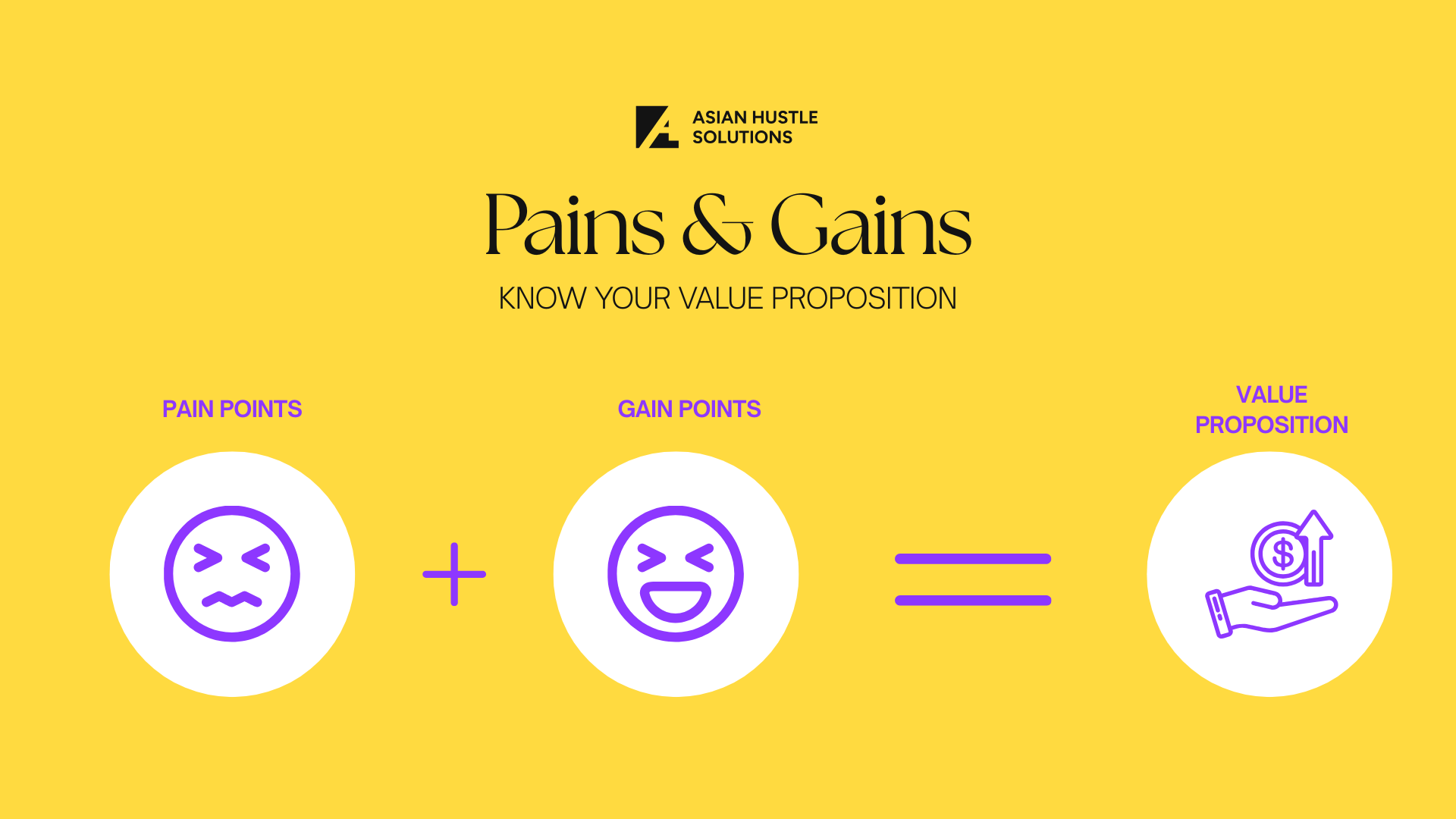
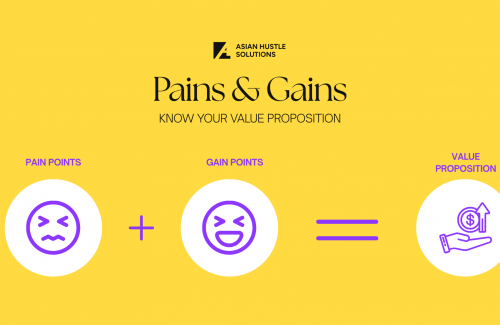
Pain points and gain points are not necessarily new concepts, but some might think they are opposing concepts, when in contrast, the two complement each other. Through customer pain and gain points, you can get a better understanding of your customers’ needs, and offer a unique value proposition.

  • Pain point: As the name suggests, it’s something that “pains” your customers; an issue that they have that needs to be addressed; a challenge that they need to overcome.
  • Gain point: Gain point, on the other hand, is more about you. What can your product or service do for the customers; what can they gain from using your service; what can you help them with?

The two are extremely simple and are a good place to start when you’re trying to advertise your product or service since they consider both your and your customer’s sides to offer a value proposition that is valuable. 

[Book a FREE call with us]
If you want to explore our services more, visit the Asian Hustle Solutions website at AHS.

Development

Winning The Race by Understanding Customer Journey

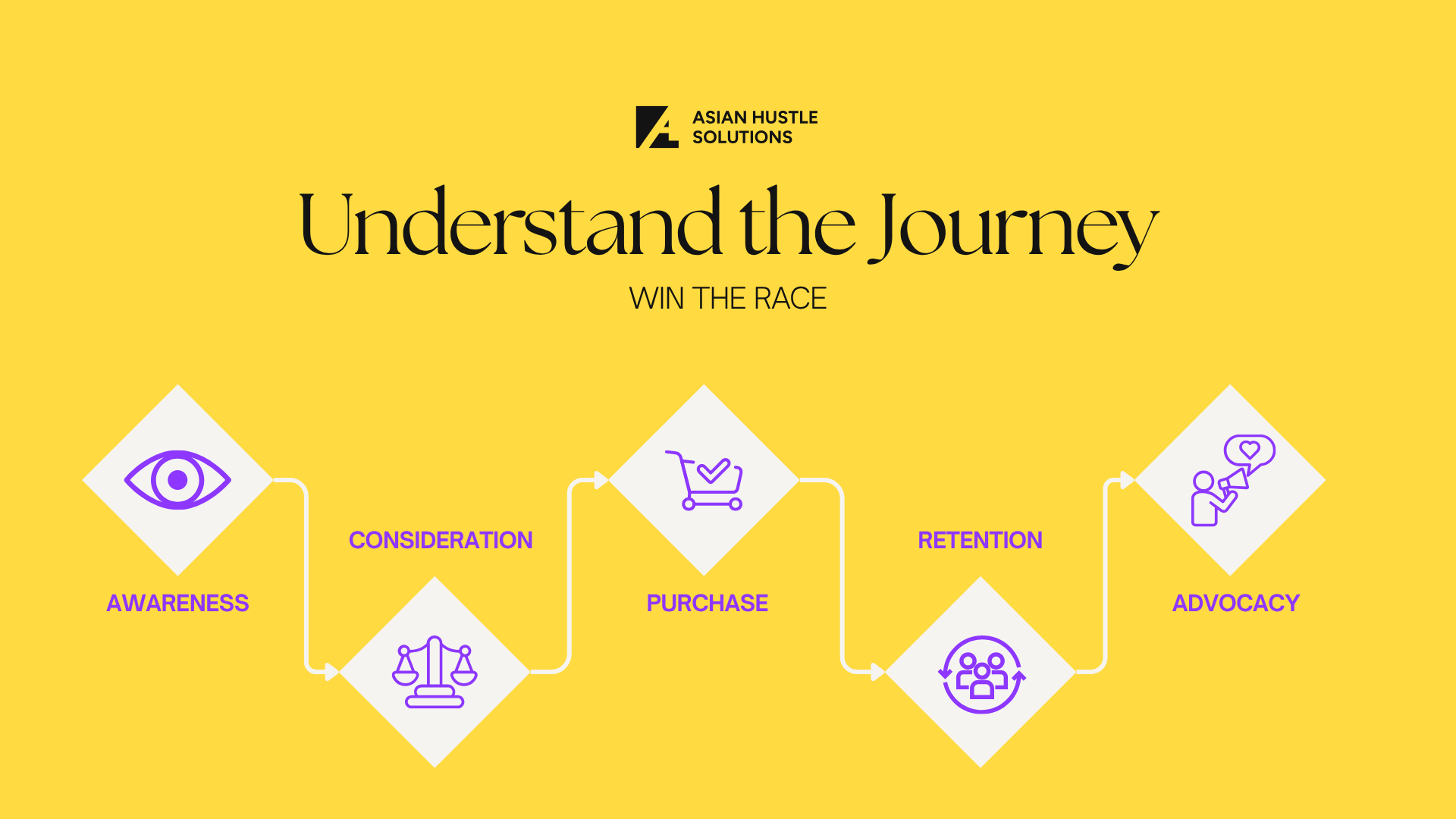
Before becoming a loyal customer, a lead has to interact with your product/service at various stages. This entire process is summarized in the customer journey, divided into 5 main stages:

  • Awareness: The customer becomes aware of your brand and your product, usually through search engines when searching for a solution to their problem.
  • Consideration: The customer is aware of your brands but also your competitors’;, they start wondering which of the options they should choose from.
  • Purchase: The customer makes a buying decision, either from your brand or your competitors’.
  • Retention: After the purchase, you need to consider how to get them to repurchase many more times, since retaining is cheaper than recruiting.
  • Advocacy: At this stage, the customer is basically your brand ambassador., Tthey love your product;, they tell their acquaintances about your product.

Understanding the journey and what stage the audience is at can help you understand their needs and adjust accordingly. Each stage has a different touchpoint as well, so adjusting to said touchpoint makes it more effective and less costly. Understanding the journey can help you win the race.

Why Asian Hustle Solutions?

At AHS, we specialize in helping brands capture attention and inspire action — whether you’re launching a new product or scaling your business, we’ll guide you to marketing that resonates and delivers results.

If you want to learn more about our services, visit the Asian Hustle Solutions website at asianhustlenetwork.com/services/

AHS EMAIL ANGLE (1)-png

Blogs, Development

Getting Back To Basics: 4Ps Marketing Mix

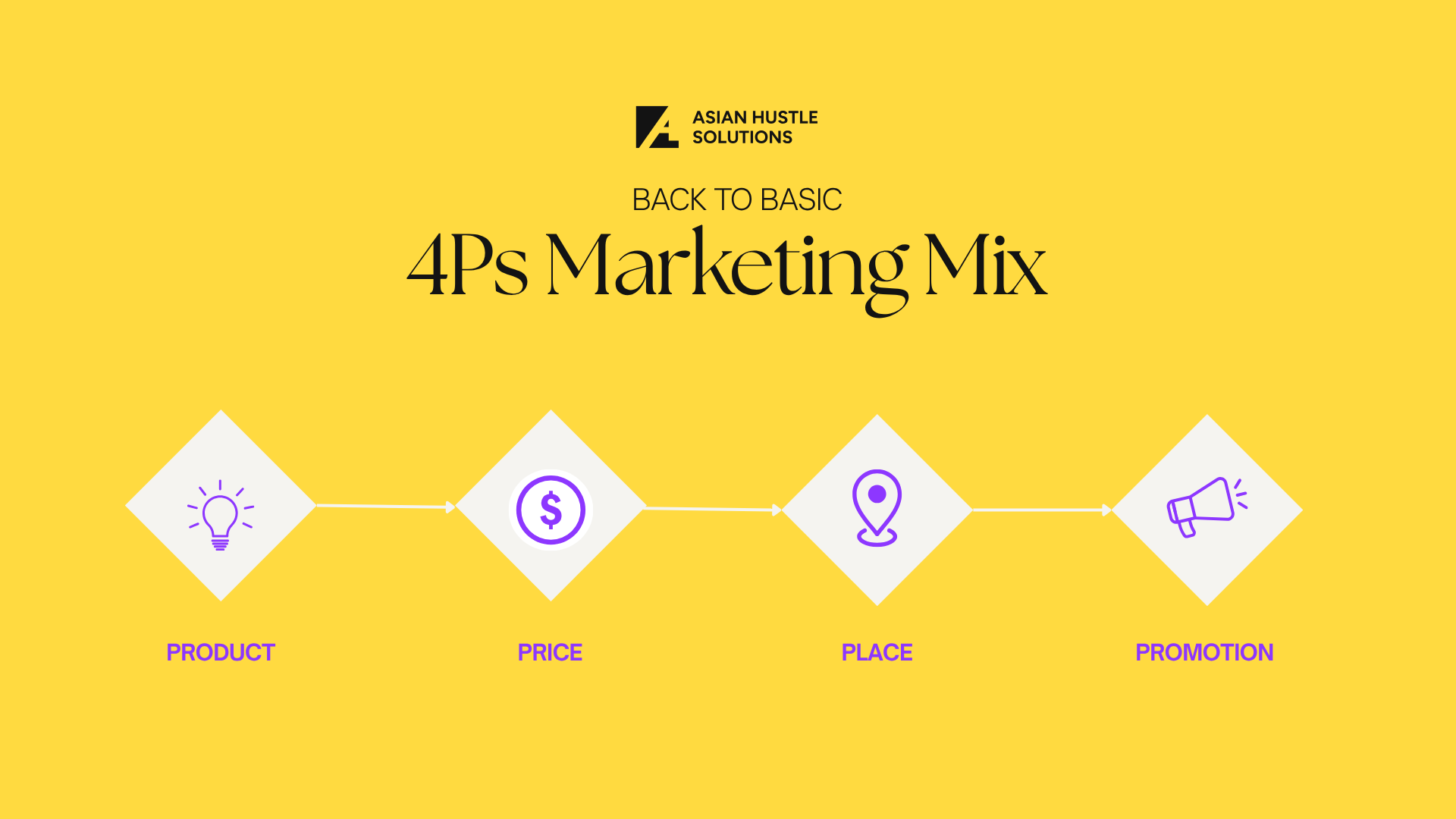
Sometimes, to create an effective marketing strategy for your business means going back to the basics. Popularized by Neil Borden, the 4P’s model is still widely used today, with each P representing a core aspect of the marketing mix:

  • Product: The core of your business, whether it is a physical product or a service. Understanding your product, what differentiates it from the competition, what is unique about it, etc.
  • Price: How much your product should be sold for. This should be based on the supply cost, how you position your product, and whether you should increase or decrease the price based on your target audience.
  • Place: The “where” of your product. Where can the customers purchase your products (online or physical stores, drug stores or supermarkets, etc). More so, it is also where you choose to advertise.
  • Promotion: How you reach your customer, either through advertising, public relations, or promotion, increases your brand awareness.

Why Asian Hustle Solutions?

At AHS, we specialize in helping brands capture attention and inspire action — whether you’re launching a new product or scaling your business, we’ll guide you to marketing that resonates and delivers results.

If you want to learn more about our services, visit the Asian Hustle Solutions website at asianhustlenetwork.com/services/

Stories

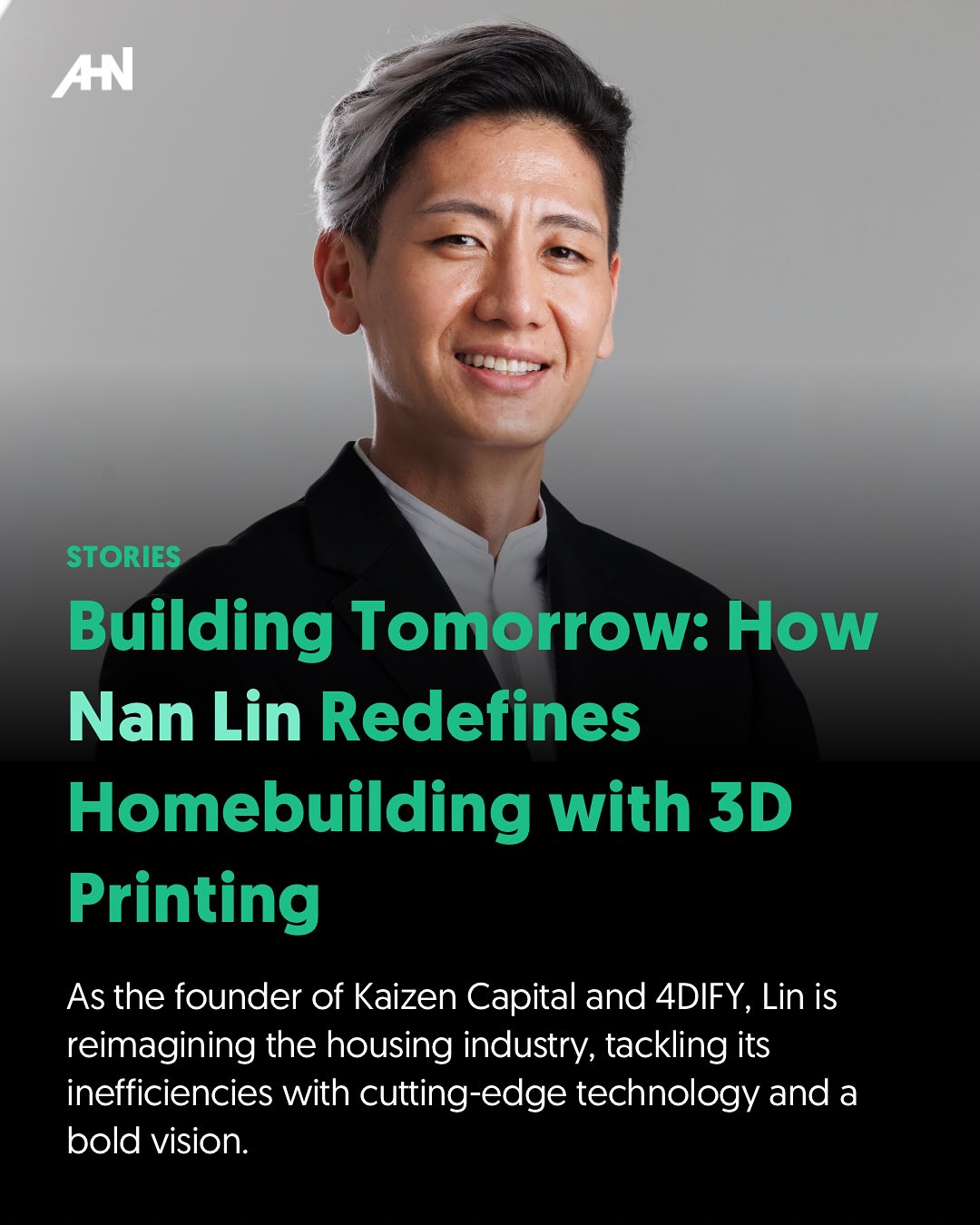
Building Tomorrow: How Nan Lin Redefines Homebuilding with 3D Printing 

For Nan Lin, entrepreneurship isn’t just business; it’s freedom. A freedom earned through sacrifice, relentless execution, and a refusal to accept the limits of a broken system. As the founder of Kaizen Capital and 4DIFY, Lin is reimagining the housing industry, tackling its inefficiencies with cutting-edge technology and a bold vision. His mission? To build stronger homes faster, at lower costs, empowering communities and challenging the status quo.

From Immigrant Roots to Visionary Leadership 

Lin’s journey began at age 10, when he immigrated to America with his mother. While adapting to a new country, he was inspired by his loving parents’ sacrifices, which shaped his relentless drive. “I saw the lengths they went to give me a better life,” Lin says. “Their love and dedication became my compass.” Years later, that resolve led to the creation of Kaizen Capital, where he transforms underutilized properties into vibrant housing solutions: ADUs, subdivisions, condo conversions, and luxury short-term rentals. By unlocking hidden value in land, he delivers market-rate and affordable housing that strengthens neighborhoods.

But Lin saw a deeper problem: traditional construction is slow, costly, and vulnerable to fire, pests, and natural disasters. Frustrated by an industry stuck in the past, he founded 4DIFY to lead a new era of construction through 3D-printed concrete homes.

Nan Lin | Founder and Principal of Kaizen Capital and 4DIFY

3D Printing: The Future of Housing, Today

Lin’s vision for 4DIFY was sparked by a frustrating reality: “Wildfires destroy neighborhoods every year, yet we keep building stick-frame homes that burn like kindling,” he says.

After visiting several 3D printer manufacturers, Lin partnered with New York–based SQ4D. It took nearly a year to secure exclusive licensing rights, navigate regulatory hurdles, and obtain building permits, but he got it done.

Now, 4DIFY is building California’s first community of 3D-printed concrete homes. As this article goes live, their first printed home is nearing completion, despite heavy regulations and a steep learning curve. The team is already outperforming traditional timelines and cost benchmarks. The second and third homes will soon print simultaneously, targeting completion in two months, effectively one home per month at under $200 per square foot.

Despite challenges as an Asian immigrant, Lin managed to transform them into motivation and success. 

“We’re aiming to build at half the cost and in a quarter of the time,” Lin says. “That’s not a dream. It’s the direction we’re heading.”

Built with concrete, reinforced with rebar, and topped with metal roofs, these homes are resilient against fire, wind, earthquakes, mold, and pests. They’re also designed for long-term savings, with lower maintenance, less waste, and reduced energy and insurance costs.

“Critics doubted it would work,” Lin reflects. “But seeing is believing. This is the future.”

A Philosophy of Purpose and Resilience

Lin’s journey has been marked by relentless challenges, some seemingly insurmountable. “Obstacles never stop,” he admits. Yet he transforms adversity into opportunity, fueled by a positive mindset, solution-driven focus, and disciplined execution. His trusted team is his backbone. “No one succeeds alone,” he says. “My team turns the impossible into reality.” This resilience shapes his leadership, blending bold vision with purposeful action to create opportunities, particularly for communities long excluded from wealth-building. “Housing isn’t just a product,” Lin says. “It’s a platform for empowerment.”

Recognition and Inspiration

Lin’s impact is gaining notice. The Sacramento Bee named him one of the Top 20 AAPI Change Makers, and he was honored in the Business Elite Awards’ 40 Under 40. But for Lin, the real reward is inspiring others. “I want to show the next generation of Asian entrepreneurs what’s possible when we claim our seat at the table,” he says.

Lin wants to create opportunities for those marginalized by elevating the future of construction, making it more accessible for his community.

Join the Housing Revolution

Nan Lin isn’t just building homes, he’s redefining what’s possible. Through Kaizen Capital and 4DIFY, he’s creating a future where housing is affordable, resilient, and sustainable. Follow his journey and see the revolution unfold.

Connect with Nan Lin: