How Stephanie Lau Jensen Turned a Personal Identity Journey Into CULTR, a Marketplace for Cultural Brands - AHN Media Group

Stories

June 15, 2026

SHARE:

Stephanie Lau Jensen grew up between Hawaii and California. Like many Asian American kids raised in predominantly non-Asian communities, she learned early how to move between worlds. Parts of her culture stayed in the background, not because she pushed them away, but because the environment made it easier to leave them there.

She later returned to Hawaii for college, where her father is originally from. Being there placed her in a community where Asian culture was woven into daily life through food, language, and family traditions. It was not a rediscovery, it was a reminder of what had always been hers.

Years later, as a mother of three and a founder with a background in commercial real estate investing, she built CULTR, short for Created for Culture. A curated marketplace for AAPI  and third-culture families raising kids between cultures, one that makes cultural products easy to find and part of everyday life, not just special occasions.

A Birthday Conversation That Changed Everything

The idea for CULTR took shape at one of Stephanie’s birthday gatherings. She was talking with a close friend about identity and culture when a childhood friend overheard the conversation and joked that Stephanie used to be one of them before she moved to Hawaii and really leaned into her Asian side.

Everyone laughed. Stephanie included. But the comment stayed. It put words to something she had been sitting with for years. Culture is not something that automatically transfers to the next generation. It has to be lived daily. If it is not in the house on a regular Tuesday, it probably is not there at all.

When she became a mother and started looking for books, clothing, and toys that reflected her culture, she saw the problem clearly. The products existed. The founders were there, but their work was scattered across small websites and Instagram pages, invisible to most families who needed them.

The Platform She Wished Had Existed

Stephanie’s background in real estate investing trained her to look closely at markets and recognize opportunity gaps. As she continued discovering founder-led cultural brands online, she saw a clear problem: families who wanted these products had no easy way to find them.

That realization led her to build CULTR, a curated marketplace that brings modern cultural brands from around the world into one central destination. The platform highlights independent founders, many from Asian and immigrant communities, whose products carry culture through everyday objects, from children’s books to home goods, apparel, even everyday products you would have never known were made by AAPI makers. With a refined, modern aesthetic, CULTR presents these brands in a way that feels contemporary, approachable, and deeply connected to heritage.

Building CULTR came with its own challenges because the platform did not fit neatly into an existing category. It sits somewhere between a retail marketplace and a cultural storytelling platform, which meant Stephanie had to develop the platform while also helping people understand the vision behind it.

Bringing Culture Into Everyday Family Life

For Stephanie, culture often lives in the smallest everyday objects. A children’s book written in the language your grandparents spoke, a toy tied to tradition, or a piece of clothing that carries a story can shape how the next generation understands identity and belonging.

Alongside CULTR, she is also building PenPals Collective, a project designed to spark global curiosity and connection for children, and launching a podcast called Series M that explores career, motherhood, and identity. Each project reflects her interest in connecting people across culture, family, and generation.

Through each project, and while raising three young children, Stephanie continues working toward the same goal: creating spaces where culture is not something people rediscover later in life, but something families live with every day.

Learn more about CULTR here:
📍Website

Related Articles

IMG_6214 (1)

Stories

From Prison to Purpose: How Tuan Huynh Brewed Redemption Into VietFive Coffee

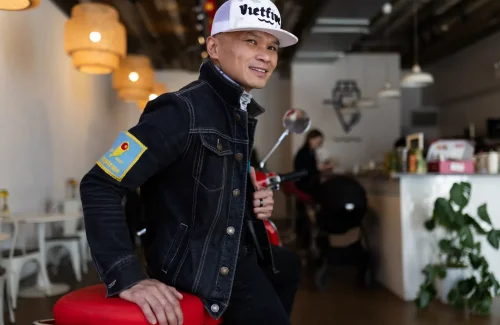
When you walk into VietFive Coffee in Chicago’s West Loop, the first thing you notice isn’t the rich aroma of Vietnamese Robusta beans. It’s the energy. Strangers sit shoulder-to-shoulder, conversations spark, and a sense of belonging fills the air. For founder Tuan Huynh, this space is far more than a café. It’s proof that redemption is real.

Tuan didn’t set out to build a coffee brand. He set out to rewrite a life story that once seemed destined to end behind prison walls. Today, he’s not just serving bold coffee; he’s serving hope, heritage, opportunity, and community.

The Darkest Chapter

Tuan’s early life was marked by conflict. Born in Vietnam, his family fled to the U.S. when he was just three years old, carrying little more than hope for a better future. They settled in government housing, where poverty pressed down on daily life. Like so many kids searching for belonging, Tuan got swept into the culture of gangs and drugs. At just 18 years old, barely an adult, his life took a devastating turn.

Convicted of first-degree murder, Tuan was sentenced to life in prison with the possibility of parole after 15 years. He spent the next decade and a half in Lansing Correctional Facility, one of the country’s maximum-security prisons.

Prison has a way of stripping people of their identity. For many, it cements a cycle of despair. But for Tuan, it became the crucible where transformation began. “Even in the darkest places,” he says, “I knew my story wasn’t finished.”

Choosing Creativity Over Despair

Inside those walls, during the latter half of his prison experience, Tuan chose to reimagine his life. He leaned into art and design, creative outlets that gave him purpose and revealed a talent for visual storytelling. Every sketch, every concept was an act of defiance against the idea that his future had already been written.

When he was finally paroled on June 21st, 2011, a date and time he still recalls with reverence, Tuan stepped into a world that had changed beyond recognition. He was a free man, but freedom didn’t come with an instruction manual. He carried the stigma of incarceration, the weight of lost time, and the daunting task of rebuilding from scratch.

A Door Opens in the Most Unexpected Place

Determined not to waste his second chance, Tuan pursued higher education, earning a Bachelor of Fine Arts in Conceptual Design. His portfolio caught the attention of the world’s largest advertising agency, which offered him a role in Chicago. For a refugee kid who had once been told he would never amount to anything, it was validation.

But something was still missing. After eight years in advertising, Tuan felt the pull of something deeper, something personal. On a trip back to Vietnam, the first since leaving as a child, he discovered his family’s legacy: generations of farmers cultivating Robusta coffee. That revelation ignited a vision.

Coffee, he realized, could be the perfect medium. It wasn’t just a drink. It was heritage, resilience, and connection poured into a cup. And with that, VietFive was born.

Tuan Huynh (right) with his uncle

Building VietFive Against All Odds

Launching a business as a formerly incarcerated person was no small feat. Doors closed before Tuan could step through them. Banks hesitated, investors doubted, and skeptics assumed his past would define his future. But Tuan refused to let rejection write his story.

Instead, he built VietFive from the ground up, importing beans from his family’s farm, shaping the brand through design, and pouring his heart into creating not just a business, but a movement.

VietFive is vertically integrated, meaning Tuan controls the process from farm to cup. That ensures authenticity, quality, and fair practices. But more than that, it provides every sip tells a story. A story of Vietnamese resilience. A tale of personal redemption.

The Power of Representation

For Tuan, VietFive is not just about coffee. It’s about representation. Too often, the stories of immigrants, refugees, and formerly incarcerated people are missing from mainstream narratives. By building VietFive, Tuan created a stage where those voices can’t be ignored.

“When people drink our coffee,” he says, “I want them to taste more than flavor. I want them to taste legacy, survival, and pride.”

That representation extends to the community VietFive has built. Walk into the café, and you’ll see it as a true “third space” where all are welcome. From business leaders to students, from immigrants to lifelong Chicagoans, VietFive has become a gathering point for connection.

Turning Pain Into Purpose

Tuan’s proudest achievement isn’t revenue numbers, though VietFive is on track to approach seven figures this year. His real pride is seeing familiar faces return, watching conversations unfold, and knowing that his café has become a home for many.

The struggles he faced, incarceration, rejection, and underrepresentation, didn’t vanish. But he reframed them. Each obstacle became a stepping stone, each “no” a chance to persist, each bias an opportunity to prove that transformation is possible.

In Tuan’s words, “VietFive is not just about beans. It’s about belonging.”

A Vision for the Future

Tuan’s mission is clear: to elevate Vietnamese Robusta on the global stage, to create spaces of connection, and to rewrite narratives that society often overlooks. He envisions VietFive not only as a coffee brand but as a global movement rooted in heritage and social impact.

For the Asian community, VietFive stands as an affirmation, proof that their culture, history, and voices belong at the table. For those who carry the weight of incarceration or failure, it’s a beacon of hope that broken beginnings can lead to beautiful new chapters.

Redemption in Every Cup

At its core, VietFive is more than coffee. It’s a story of redemption steeped into every brew. It’s the story of a refugee child who stumbled, a prisoner who refused despair, and an entrepreneur who now builds bridges where walls once stood.

When you sip VietFive, you’re not just tasting Robusta, you’re tasting resilience. You’re part of a narrative that proves our past does not define our future.

As Tuan Huynh himself puts it: “VietFive is my second chance in a cup. And I want every person who walks through our doors to feel that same possibility, that no matter where you’ve been, there’s always a way forward.”

Connect with Tuan Huynh

AHS EMAIL ANGLE (5)

Blogs, Development

Understand Conversions with Attribution

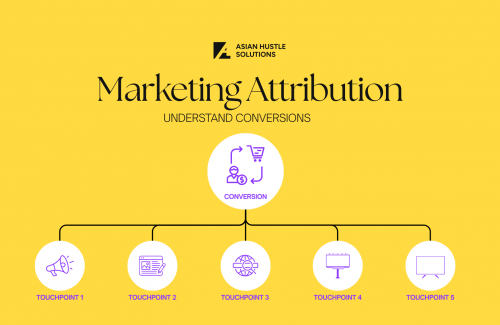
To win your customers, you need to run many marketing activities across multiple channels. And then those conversions came pouring in, but you don’t exactly know where those conversions come from since there are too many ongoing activities. That’s what marketing attribution does. By assigning credit to touchpoints, you can gauge how effective each touchpoint is to the conversion.

There are two types of Attribution:

  • Single-source attribution: Credits are given fully to one touchpoint, assuming that is the most effective one at driving conversion.
  • Multiple-source attribution: More complex models. This type of attribution model acknowledges that multiple touchpoints contribute to the buying decisions and gives partial credit to each.

Understanding attribution will help you to know where the revenue comes from so you can optimize your budget and gain more from your spending. to said touchpoint makes it more effective and less costly. Understanding the journey can help you win the race.

Why Asian Hustle Solutions?

At AHS, we specialize in helping brands capture attention and inspire action — whether you’re launching a new product or scaling your business, we’ll guide you to marketing that resonates and delivers results.

If you want to learn more about our services, visit the Asian Hustle Solutions website at asianhustlenetwork.com/services/

AHS EMAIL ANGLE (4)

Blogs, Development

Know Your Value Proposition

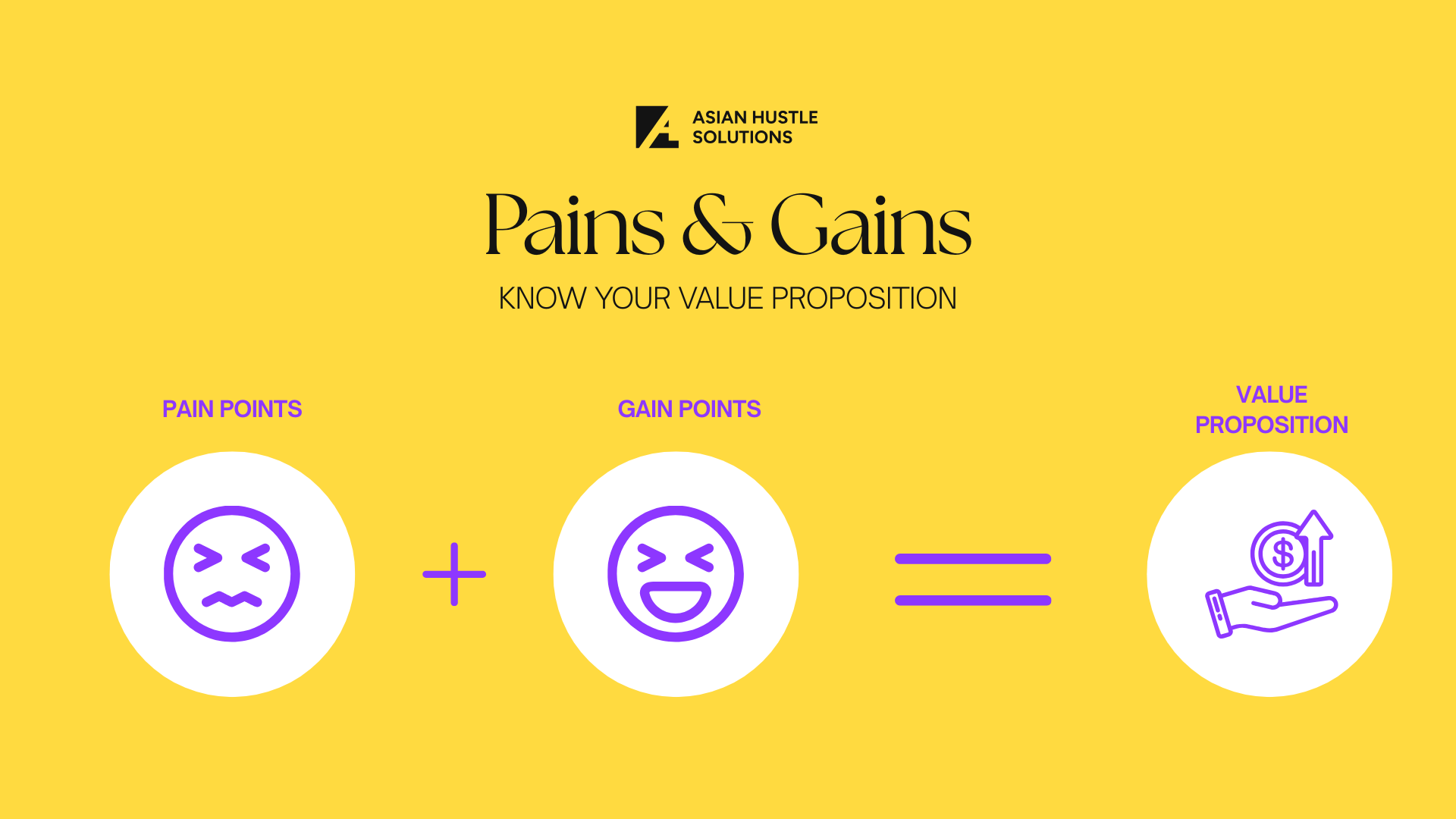
Pain points and gain points are not necessarily new concepts, but some might think they are opposing concepts, when in contrast, the two complement each other. Through customer pain and gain points, you can get a better understanding of your customers’ needs, and offer a unique value proposition.

  • Pain point: As the name suggests, it’s something that “pains” your customers; an issue that they have that needs to be addressed; a challenge that they need to overcome.
  • Gain point: Gain point, on the other hand, is more about you. What can your product or service do for the customers; what can they gain from using your service; what can you help them with?

The two are extremely simple and are a good place to start when you’re trying to advertise your product or service since they consider both your and your customer’s sides to offer a value proposition that is valuable. 

[Book a FREE call with us]
If you want to explore our services more, visit the Asian Hustle Solutions website at AHS.

Development

Winning The Race by Understanding Customer Journey

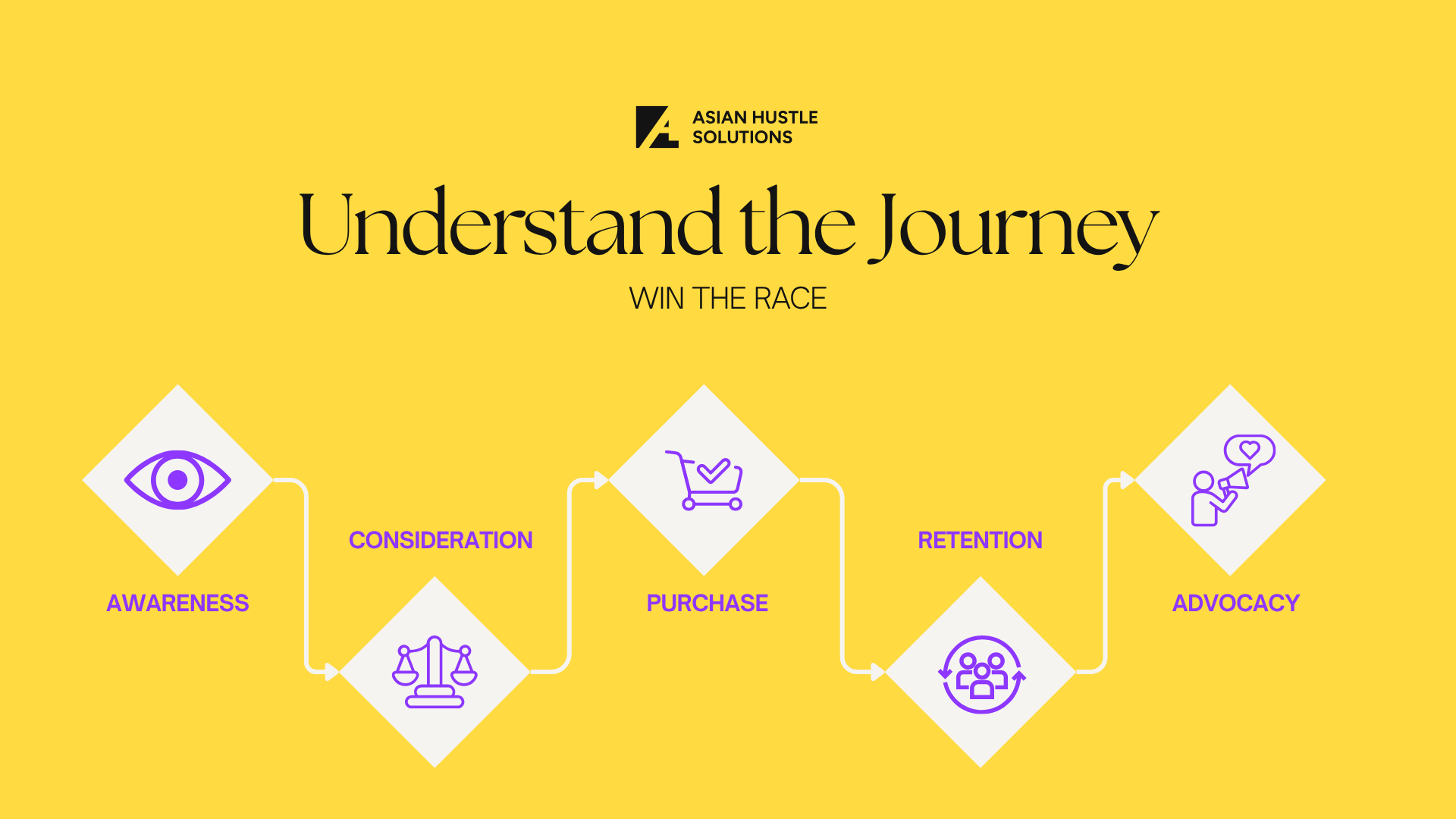
Before becoming a loyal customer, a lead has to interact with your product/service at various stages. This entire process is summarized in the customer journey, divided into 5 main stages:

  • Awareness: The customer becomes aware of your brand and your product, usually through search engines when searching for a solution to their problem.
  • Consideration: The customer is aware of your brands but also your competitors’;, they start wondering which of the options they should choose from.
  • Purchase: The customer makes a buying decision, either from your brand or your competitors’.
  • Retention: After the purchase, you need to consider how to get them to repurchase many more times, since retaining is cheaper than recruiting.
  • Advocacy: At this stage, the customer is basically your brand ambassador., Tthey love your product;, they tell their acquaintances about your product.

Understanding the journey and what stage the audience is at can help you understand their needs and adjust accordingly. Each stage has a different touchpoint as well, so adjusting to said touchpoint makes it more effective and less costly. Understanding the journey can help you win the race.

Why Asian Hustle Solutions?

At AHS, we specialize in helping brands capture attention and inspire action — whether you’re launching a new product or scaling your business, we’ll guide you to marketing that resonates and delivers results.

If you want to learn more about our services, visit the Asian Hustle Solutions website at asianhustlenetwork.com/services/