News, Stories

August 22, 2022

SHARE:

Jeremiah Abraham, the founder and CEO of Tremendous Communications, had bumps in the road in getting to where he is today. Starting his business right before the pandemic, he doubted the path that he created and considered quitting everything that he was doing. But with mentors along his side and his determination to uplift the AAPI community, his company has contributed to protecting and celebrating the Asian American and Pacific Islander communities when they needed it the most.

Working at renowned companies like Disney and Warner Bros., Jeremiah has spent years hustling at the intersection of technology and entertainment. Using his talent in marketing, he has constantly shed light on the AAPI community by promoting films such as Everything Everywhere All At Once and co-producing the Filipino American musical drama film Yellow Rose. He still finds ways to balance work and life by tearing down the systematically ingrained notion of working from 9 to 5.

In this one hour interview, Jeremiah lays out his story of how he entered this industry, experiencing ignorant approaches to different cultures in a white dominant workplace, and his immense passion for AAPI representation.

Blend of Tech and Entertainment

I got my degree in computer engineering from UC Irvine and that was when I needed to decide what I wanted to do in life. I wanted to make a difference in technology back then, so I got that degree. One of my first jobs was in the aerospace industry. I was working there and I realized that I was just really bad at math. I didn’t think I could realistically pursue this as a long-term career. It was one of those moments where you had to have this introspective, realization, or catharsis about what you thought you were going to be and what you want in life.

Then I found this blend of tech and entertainment, which I was always interested in. I ended up being a front-end developer for Disney, which was a nice blend of the programming skills that I learned from school and the entertainment brands that I’ve always admired. Social media was still fairly new at these companies. This was back in 2007, and I would say that the biggest leap from this tech world to this communications world was when I discovered a Master’s program for Digital Social Media and Online Communities at USC. So I worked at Disney full-time, and at night I tried to get my master’s degree. I knew in my head what I wanted to build for myself and that was this intersection.

An intersection of my interest in engineering and social dynamics is interesting because a lot of people didn’t know why I even majored in computer engineering and minored in sociology. Engineers build societies, but you can’t build it without understanding it first. I ended up pursuing this even more and realized that I had a knack for marketing which I ended up pursuing after receiving my degree at USC.

Uplifting the Filipino Community

After I got my master’s degree, I decided to pursue my thesis project as a full-on business venture, which was an online community and editorial group for Filipino Americans called BakitWhy.com. Uplifting the Filipino community has always been a constant in my life. Since high school, I was part of a Filipino club where we celebrated our culture and volunteered for Filipino community organizations. I knew that whatever I did, whether it was engineering or marketing, was in the service of our people.

So I started this website and it was one of the first, if not the first, Filipino American digital destinations for editorial and news content. We were covering events and a new emerging digital identity among the Filipino American community. I called this the golden age of Filipino YouTubers back in 2007. These were the days of HappySlip, NinjaDrops, ndtitanlady, and more. We were able to rally this community both on the digital side and also offline to develop not just a thriving company and brand, but a lifestyle destination that people could relate to. I wanted to create something wonderful for us.

One of the things that I pride Tremendous on is that we’re not just there to engage the AAPI community as a business, but we primarily want to instill genuine progress and impact. We are immersed in our Asian American community. We don’t clock out after a certain time and say “Sorry we’re done today Asians, it’s five o’clock and we’re not going to do anything anymore.” No, this is our life. This is what fulfills us and I think it helps set our campaigns apart. The way we communicate and interact with our clients also influences the strategy we give to them because we’re not just looking at numbers, we’re looking at people. We are all about uplifting authentic Asian American experiences, diasporas, stories and narratives. For us not to be authentic with that presence in our daily lives would be hypocritical.

One of the things that I pride Tremendous on is that we’re not just there to engage the AAPI community as a business, but we primarily want to instill genuine progress and impact

– Jeremiah Abraham

Marketing in a White Dominant Setting

There was one instance where I was the only person of color in the room at a large entertainment company, still very green and inexperienced. I didn’t feel like I had the authority and the voice to chime in and redirect these senior leaders of this space. And they’re sitting around going like, “Hey, it’s February next month. It’s almost Black History Month. What can we do?” And then someone just started listing off all the movies in their catalog that had some resemblance of Black narrative. And I’m just like, “All right, well, that’s very top-level. But what more can we do? Can we bring in more people who actually represent this community in the room and have a conversation about it?” That situation really helped me realize that we needed to be part of that room of decision-makers. Being there that day sparked a drive in me that I’ll never forget.

One of the things that I had issues with while leading the publicity and marketing for Yellow Rose before we got acquired by Sony Pictures, was that people didn’t understand what Filipinos were, that our stories were relatable to all moviegoers, and that we were equally as valuable in Hollywood. People couldn’t wrap their brains around this and asked “Why is a Filipino family living in Texas? Do they really sing country music like that? Will non-Filipinos even relate to this?” They were seeing the Filipino diaspora within one specific lens instead of embracing the spectrum of the Filipino experience. They didn’t realize that there are mechanisms that historically pushed us to these areas that we’re thriving in, to these places where they may not think that there is a large thriving Filipino community. The lead characters are Filipino American, but the story is universal. If you took the lead characters out and made them Latinx or Black, for example, you would still have the same emotion. You’d still have the same humanity. You’d still have the same story. It just so happened that these people are Filipino. This is one of the things that Jo Koy discusses during his  interviews for Easter Sunday. The movie isn’t about Filipinos, it’s a movie about his family and his mom. That’s one of the biggest things I appreciated about this film. It’s a story for everyone.

The first movie that I ever saw when I moved to the United States was Superman 2 with my dad and that’s always ingrained in my head. I was in such awe of this superhero and I’ve always wondered how impactful it would have been if Superman was Filipino. That would have made such a big difference for me growing up. I love Christopher Reeve as Superman, but imagine if it was a Christopher Santos or a Christopher Dela Cruz in that heroic cape instead! Today I’m so happy that our next generation can enjoy seeing themselves as heroes with films like Shang-Chi and people like Iman Vellani as Kamala Kahn making a difference.

I think it’s incredibly important for us to make these decisions on how we are portrayed and valued for ourselves, with representation across every part of the process –  behind the camera, in front of the camera, in business and below the line. We can bring these little nuances of authenticity to these stories that are so important and help shape the next generation of folks who want to do this work. 

They were seeing the Filipino diaspora within one specific lens instead of embracing the spectrum of the Filipino experience. They didn’t realize that there are mechanisms that historically pushed us to these areas that we’re thriving in, to these places where they may not think that there is a large thriving Filipino community.

– Jeremiah Abraham

A Chronicle of Starting a Business Right Before a Pandemic

Starting a business at the cusp of a global pandemic was a big lesson in resilience. There is a lot of strategy, planning, introspection and decisions that need to be made behind the scenes. I had been planning Tremendous for years. I spent so much time creating the structure of it, the business strategy, forecasting our trajectory and all those things that you need to help lay the foundation of a business… then the pandemic hit and I needed to shift very quickly.

Tremendous incorporated in 2019 and started to plant the seeds of studio partnerships. When we were ready to sign a couple of contracts, all the major movie studios suddenly shut down. I had to take a step back and I realized the mission of Tremendous is not rooted in movies and entertainment, but it exists to uplift the visibility of Asian Americans as a whole. We couldn’t work in entertainment at the time but that didn’t stop us from working within the community. That’s when we helped support Racism is a Virus, and co-founded Unapologetically Asian and CollaborAzian. We used our expertise to help uplift Stop AAPI Hate. We were able to leverage our network and our skills and our desire to make change in this very crucial moment of the Asian American community.

There certainly were many surprises along the way. I pitched this movie that was supposed to come out on January 2021. We were ready! We put this beautiful deck together, we brainstormed, we strategized. And then they told me, “Hey, we’re going to make an announcement today that this movie is going to be pushed to January 2022.” I was like, “What am I going to do for a year?” It’s a lot of those things that I learned as an entrepreneur that it doesn’t necessarily go how you forecast, even though you spend so much time strategizing and pulling numbers. And that’s fine because that will push you to be more dynamic as a business and help you imagine new, creative avenues for yourself. But for me, it was a lesson in resilience, being flexible, and not beating yourself up too much for things that are outside of your control.

I had to take a step back and I realized the mission of Tremendous is not rooted in movies and entertainment, but it exists to uplift the visibility of Asian Americans as a whole.

– Jeremiah Abraham

Confinements that Pull us Back

There were many moments where that lingering voice of doubt made me wonder if this was the right path for me. Should I go back to a safe, stable job with benefits and a retirement plan? What if I end up losing all my money in this venture? Is it okay that I decided not to work today?

Even now, I can make my own schedule. I can wake up at noon if I wanted to and keep working until 2:00 am or just take a random afternoon off. And that’s my choice to make. But because I’ve been so conditioned to think that the limits of my brain power need to be confined between nine to five, having this new freedom came with a sense of guilt.

I have such a hard time realizing that you don’t need to operate within those confines to be productive and successful and fulfilled. I just have to keep reminding myself that it’s okay to permit yourself to watch Netflix for an hour at 2:00 pm for you to refocus and recenter. It’s okay that you’re sleeping in until 11:00 am or 12:00 pm today because you worked until 1:00 am last night. I have to keep reminding myself that nobody is telling you what you need to do except for yourself. That’s the life of an entrepreneur and I’m still learning how to adjust to this new level of control, even today.

Shining Leadership Skills for Better Productivity

Throughout the years, I have applied my learning lessons in leadership – especially with how I lead my team and how I conduct business. Sometimes we have many projects to work on at the same time, sometimes we have less. I’ve always told my team, as long as you get your stuff done and you are communicative and responsive, then I’m good with that.

I really encourage them to explore their interests, experience life and bring those experiences back to the company. This helps bring fresh, new ideas during our brainstorms and campaigns. One of the things that I took away from working as a Marketing Director at Condé Nast is that they encouraged you to go travel. Travel changes you, it opens up your mind. It allows you to experience new things so you can bring that experience back into your editorial piece or your marketing strategy.

I’ve never liked the idea that you need to clock in at 9:00 am every day or else you’re considered a bad employee. Just because I’m sitting there physically doesn’t mean I’m mentally there. I’ve never understood that kind of leadership where it’s more important to appease other people and make them feel better about themselves because of your presence. It’s those antiquated expectations and older ways of doing business that I’m constantly reshaping for Tremendous. As long as we get our projects done, we don’t miss meetings, and our clients are happy… who cares if you sleep in an extra hour that day?

Travel changes you, it opens up your mind. It allows you to experience new things so you can bring that experience back into your editorial piece or your marketing strategy.

– Jeremiah Abraham

People that helped along the way

I never had one specific mentor during my career. Instead, I’ve had some amazing senior executives who have taught me different aspects of my leadership skills. One of them taught me negotiation skills, another taught me how to properly communicate my ideas in a meeting, another pushed me to be more assertive with what I need to succeed in a business setting. I’ve really taken these lessons and made them my own.

One of these executives is Terra Potts, who is the Executive Vice President of Worldwide Marketing at Warner Bros. Pictures. We kind of grew up at WB together back in the day. She taught me how to stand up for your worth in situations where people may not immediately see it. I take that into every negotiation that I am part of. Teal Newland, my Senior Vice President at Condé Nast Entertainment helped me hone my creative eye and incorporate different perspectives in my marketing campaigns. Diane Paragas, who is the director of Yellow Rose, mentored me in the filmmaking process. These are just some of the people who empowered me in my journey and I’m happy to give back to others who are working with me today.

Another friend of mine is Jose Antonio Vargas, who is the Founder of Define American. We had many check-ins during the pandemic and I told him straight up once that I was thinking about quitting because I didn’t know if I was doing the right thing. No studios hired me, no movies went out, the movies that were supposed to be in theaters were going out into streaming services. And it was hard for me to see what was coming down the line and the larger picture of it all. He gave me some tough love and said “Jeremiah, you’re building something that doesn’t currently exist. Obviously you’re going to run into these situations where the solution isn’t immediately there because you have to make it up for yourself.” I never thought about it that way. If the path has not always been taken, obviously you have the flexibility and the responsibility to forge a new one to create something that never existed before. That conversation inspired me to realize that I can’t hold myself to the same standard that I had before because I’m creating new standards for myself now. That helped shift my thinking and my perspective about it and, honestly, helped shape the development of Tremendous. I could have easily quit because of the pandemic, but I would have regretted it the rest of my life.

I would encourage people to pursue multiple avenues of mentorship. It was very valuable to me to learn from many very skilled individuals, not just one. And you never know where your new life lesson is going to come from or which experience you’re going to value for years to come. For me, it was the guidance of many people that helped me get to where I am today.

I can’t hold myself to the same standard that I had before because I’m creating new standards for myself now.

– Jeremiah Abraham

How to reach out

I am @jerabraham on Instagram and Twitter, and Tremendous is @tremendous_comm on all those platforms as well.

Interviewed by Tiff Soga

Related Articles

Duolingo Shares Climb 7% as Users Swarm to App to Learn Mandarin-png

News

Love, Bonito x Asian American Girl Club Present the ‘TrailBlazer’ Collaboration

Love, Bonito and Asian American Girl Club have joined forces to launch the TrailBlazer Collaboration—a tribute to Asian American women breaking barriers, redefining leadership, and inspiring future generations. This campaign celebrates five extraordinary women, each donning a unique limited-edition Love, Bonito x Asian American Girl Club blazer that serves as a true reflection of their confidence, resilience, and identity.

Meet the Trailblazers:

  • Ally Maki – Actress, Advocate, and Founder of Asian American Girl Club, Ally embodies power and purpose in the RuchedReady® Rachel Blazer—made for the woman who rolls up her sleeves and gets things done
  • Sherry Cola – Comedian, Actress, and Storyteller, Sherry embodies authenticity in the Alya Boxy Crop Blazer, a reflection of her bold humor and vibrant energy.
  • Amanda Nguyen – Astronaut and Founder of Rise, Amanda exudes resilience and advocacy in the RuchedReady® Lapelles Soft Blazer, a symbol of strength and justice.
  • Michelle Kwan – Olympic Figure Skater and Diplomat, Michelle showcases her grace and determination in the RuchedReady® Classic Regular Fit Blazer, a nod to her unwavering spirit both on and off the ice.
  • Paravi – Popstar and Actress, Paravi brings her dreamy vibes and fearless creativity to the RuchedReady® Aera Slim Blazer—because bold artistry deserves a bold fit.
The Trailblazers (from left to right): Michelle Kwan, Ally Maki, Sherry Cola, Amanda Nguyen, Paravi

A Mission-Driven Collaboration

“At Love, Bonito, we share a common mission with Asian American Girl Club—to champion and uplift Asian American women in spaces where they have long been underrepresented,” said Dione Song, CEO of Love, Bonito. “This Trailblazers collaboration is a tribute to the trailblazers shaping industries, breaking barriers, and inspiring communities worldwide.”

A Pin with Purpose

Every detail in this collection carries a deeper meaning. Each blazer from the collaboration comes with a custom pin set representing a trailblazer’s journey:

  • The Phoenix – A symbol of resilience and rebirth, reminding women of their power to rise after every challenge.
  • The Sakura – Representing renewal and growth, celebrating transformation and new beginnings.
  • The Ginkgo – A timeless emblem of endurance and strength, honoring those who stand firm in adversity.

Now More Than Ever

“Asian American women have always driven powerful change, though our stories have often gone untold,” said Ally Maki, Founder of Asian American Girl Club. “Through Trailblazers, we’re affirming that our impact and leadership across all industries has always been—and will continue to be—undeniable.”

Join the Movement

Discover the TrailBlazer Collection at https://www.lovebonito.com/us/global/trailblazers-aagc 

About Love, Bonito: 

Love, Bonito is the leading female-founded fashion brand in Southeast Asia, dedicated to empowering women through thoughtful, versatile designs. With a deep understanding of the modern woman’s needs, Love, Bonito creates timeless and functional pieces that blend style with confidence. More than just a fashion brand, Love, Bonito is committed to fostering a strong, supportive community—championing women in every stage of their journey through representation, storytelling, and purpose-driven initiatives.

About Asian American Girl Club: 

Asian American Girl Club (AAGC) is a cultural force and community-driven brand dedicated to amplifying the voices and experiences of Asian and Asian American women. Founded by actress Ally Maki, AAGC creates space for connection and representation through fashion, media, and storytelling. With a mission to break stereotypes and celebrate identity, AAGC is more than a brand—it’s a movement empowering the next generation to be seen, heard, and unapologetically themselves.

Credits: Love, Bonito x Asian American Girl Club

SGV2N5MGRBP33CZ56U2JGAY3RE-jpg

News

Tariffs Hit Home: How Asian American Communities Bear the Brunt

While Trump claims tariffs will significantly impact the countries they target, experts argue that consumers and businesses will bear the brunt of the consequences.

Research by The Budget Lab at Yale University estimates that price levels may rise to 2% this year, equivalent to $3,000 per average household. Another report from D.C. stated that the new tariffs on China affect about 14% of U.S. imports and may raise costs to $25 billion annually. As the tariff war escalates, everyday consumers will face even higher prices.

Asian American communities and businesses are particularly vulnerable. In New York’s Chinatown, 28% of residents already live below the poverty line. With many companies relying on imports from Asia, owners are uncertain about their survival.

Mott Street in Manhattan's Chinatown (Image source: NBC News)
Mott Street in Manhattan’s Chinatown (Image source: NBC News)

“Here in Chinatown, especially, we have many elderly residents on fixed incomes,” says Edward Lau, owner of a traditional medicine shop in San Francisco’s Chinatown. With 90% of his stock sourced from Hong Kong and China, he worries, “If it gets very expensive, their spending power will be lower. Chinese immigrants will ultimately be harmed the most.”

Taylor Chow, owner of American Tai Wah Trading Corp, adds, “The Chinese community in Chinatown has been hit hard most because we consume a lot of imported ingredients. A lot of products only come from China. Even if manufacturers try to move their production line to Vietnam, to Malaysia, to Singapore, it’s not that easy.”

Supply chain disruptions and rising costs are straining small Asian American businesses. Since the community depends on these shops for cultural goods, they, too, will feel the pressure.

Mei Lum, owner of Lum’s Store, the longest-operating business in Manhattan’s Chinatown, explains, “Our working-class community here in Chinatown is definitely, in these circumstances, always being hit the hardest. And a lot of them have told me that their solution to mitigating these circumstances has been to eat those costs and only raise those prices by a smidgen, just to make sure they’re affordable for the people that frequent their establishments. How long can they sustain that?”

Mandy Lau helping a customer pick ginseng (Image Source: The Chronicle)

The erosion of these businesses could lead to cultural loss, impacting food, traditions, and ceremonial products. Lucas Li, whose family runs Lion Trading in San Francisco, specializing in feng shui and spiritual supplies, says, “When they get expensive, it makes it harder for Chinese people, for their families to maintain those traditions and do it at the proper steps. When customers shop at local businesses and small businesses, they’re not just buying a product, they’re basically investing in the community, supporting families, and protecting our traditions.”

Large online retailers like Shein, Temu, and AliExpress are also affected. While it is unclear how much product prices will rise on these e-commerce platforms, experts predict delivery delays and price hikes due to tariffs. Youssef Squali, an analyst at Truist Financial, notes, “The vast majority of these orders are valued less than $800, which means all or virtually all of them are going to get caught in that.”

Ultimately, Asian Americans may feel the greatest impact. As Linda Chao, a resident of Oceanview, states, “When there are tariffs, it won’t fall on China, it’ll fall on us. It can’t be helped. I also don’t have time to go and protest. I feel there’s nothing we can do.”

Sources: NBC News, The Chronicle, AP News, University of Virginia, The Guardian

Midjourney AI in UI design-jpg

Design

How to use Midjourney AI in UI design

As AI increasingly makes its way into the UI designer’s toolkit, Midjourney is fast becoming one of the most popular image generators. 

With a simple text prompt, you can use Midjourney AI to create custom digital artworks, whip up an app screen, design individual UI elements, and generate colour palettes—all in a matter of seconds.

For UI designers, this can really accelerate the ideation process and help you expand your own creativity. 

So how does Midjourney AI work? And how can you leverage it in the UI design process? Let’s take a look. 

What is Midjourney AI and how does it work?

Midjourney is a generative AI tool created by Midjourney, Inc.—an independent research lab based in San Francisco.

Midjourney AI generates images and digital artworks based on text prompts. If you enter a prompt asking for an image of a mermaid swimming underwater surrounded by marine life, Midjourney will generate four versions for you to choose from. The more specific your prompts, the better—but we’ll get to the art of prompt-writing for Midjourney in a later section. 

Midjourney works within the Discord platform. Discord is an instant messaging app, commonly used to create communities where users can chat via text, voice, and video. Discord essentially facilitates communication between the user and the Midjourney bot.

Midjourney uses two key machine learning technologies:

  • Large Language Models (LLM): this is how Midjourney understands and interprets the text prompts provided by the user.
  • Diffusion Models (DM): in very simple terms, this technology converts random visual noise into a meaningful image. You enter a text prompt, which sparks a field of visual noise. The AI then progressively removes that noise in incremental steps, eventually resulting in an image that resembles what you’ve asked for. 

Now we know what Midjourney is and how it works, let’s drill down to some key functions and features. 

What can Midjourney AI do? Key features

Midjourney’s core function is to convert text prompts into images. This allows you to generate unique digital artworks and graphics in a range of styles. 

You can guide the image generation process by applying custom parameters to your prompts. You might specify a certain aspect ratio, for example, or a particular style such as ‘watercolour’ or ‘flat design’. 

You can also customise the quality of your images by specifying, within your prompt, a value for the rendering quality. You might specify ‘q 1’ (that’s the default quality level) or request that images be rendered to a higher quality by specifying ‘q 2’ in your prompt. 

Once you’ve entered your prompt, Midjourney will give you four different image versions. You can choose to upscale a particular version, which will increase the size/dimensions of the image and also improve the quality. 

Beyond image generation, Midjourney serves as a great source of community and inspiration. You can share your creations and browse images created by others, allowing you to see what’s possible with Midjourney and sparking ideas for your own work. 

How to get set up on Midjourney AI

To use Midjourney AI, you’ll need to create both a Discord account and a Midjourney account. 

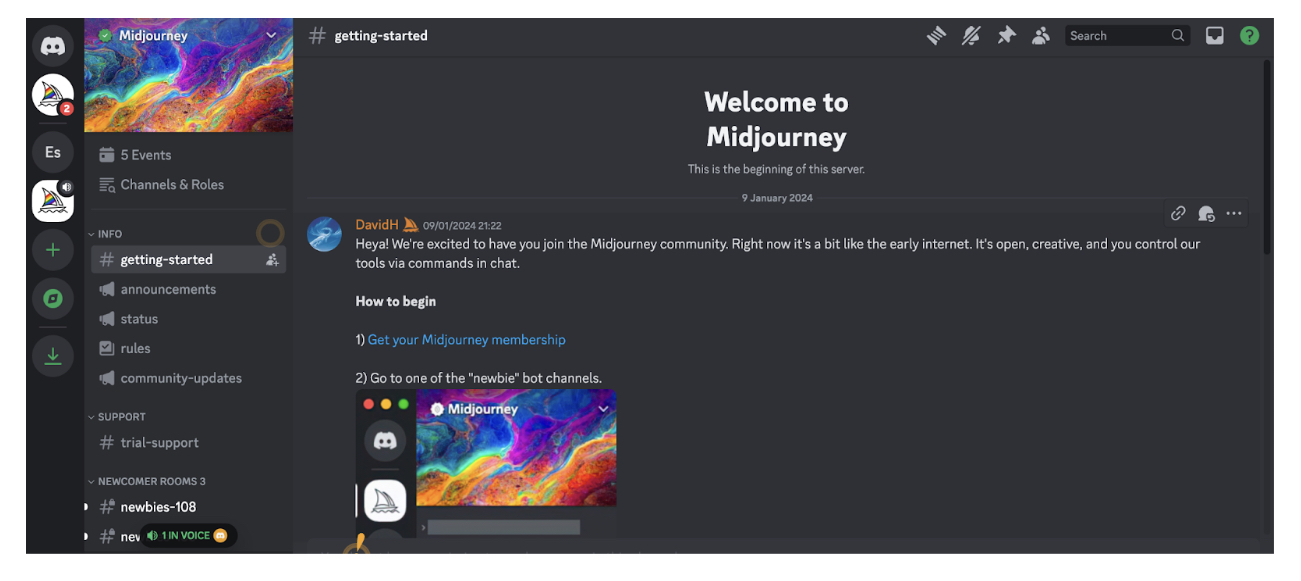
If you’re not already a member, first head over to the Discord platform and follow the instructions to create your account. Once you’re signed up, join the official Midjourney Discord server by clicking the ‘Accept invite’ button. 

You’ll then find yourself in the “Getting started” channel, where you can create your Midjourney account (if you haven’t already done so) by clicking “Get your Midjourney membership” (visible in the chat):

This will take you to a separate page, the Midjourney showcase, where you can click “Sign up” in the bottom left corner to create your Midjourney account. 

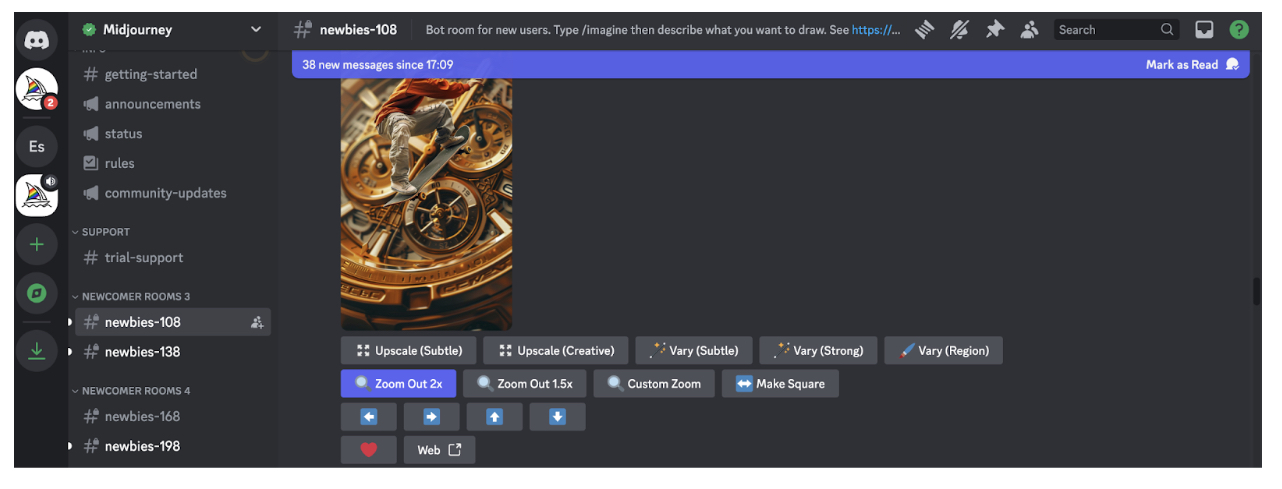
Once you’re signed up and logged in to Midjourney, you can navigate back to the Midjourney Discord server and enter one of the so-called “newbie” bot channels. You’ll find available newbie channels on the left-hand side.

You can then enter your own prompts into the chat box to start generating images. 

At the time of writing, Midjourney is no longer offering a free trial for new users. If you want to start prompting, you’ll need to sign up for a paid subscription. 

How much does Midjourney AI cost?

Midjourney offers four price tiers:

  • Basic Plan for $10 per month or $96 per year with an annual subscription (that’s around €9 per month / €89 per year)
  • Standard Plan for $30 per month or $288 per year with an annual subscription (that’s around €28 per month / €267 per year)
  • Pro Plan for $60 per month or $576 per year with an annual subscription (that’s around €55 per month / €533 per year)
  • Mega Plan for $120 per month or $1,152 per year with an annual subscription (that’s around €111 per month / €1,066 per year). 

For more information about each price tier and what’s included, visit the official Midjourney pricing page.

How to use Midjourney AI in UI design (with example prompts)

Midjourney can generate custom visuals in a matter of seconds—making it an incredibly interesting tool for UI designers. You can use Midjourney to quickly create screens and individual UI components, come up with themes, styles, and colour palettes, and generate unique digital artwork. 

Note, however, that the graphics you create with Midjourney won’t necessarily be directly usable—and working with Midjourney doesn’t eliminate the need to create your own screens and elements using the usual UI tools like Sketch and Figma. If you generate an app screen with Midjourney, for example, you’ll still need to actually create that screen from scratch yourself. 

Where Midjourney really comes in useful is helping you to explore different ideas and concepts and gather inspiration. You might use your AI-generated artwork to inspire mood boards, kick-start an ideation session, or serve as a guide for certain layouts or colour schemes. 

With that, let’s consider some examples of how to use Midjourney for UI design. 

Use Midjourney AI to generate app screens 

If you’re designing for mobile, Midjourney can help you ideate layouts and designs for various app screens. If you’re designing a dating app, for example, you might try the following Midjourney prompts:

  • /imagine a vibrant and fun login screen for a dating app, with an eye-catching background, username and password fields, and buttons for login and social media sign-ins
  • /imagine a user profile screen for a dating app, featuring a large profile picture at the top, user bio, interests, and match percentage displayed in a clean layout
  • /imagine a match screen for a dating app, showing potential matches with profile pictures, a brief bio, and buttons to like, dislike, or super like
  • /imagine a chat screen for a dating app with a clean interface, message bubbles, timestamps, and an input field at the bottom

Create UI components such as icons, buttons, and logos 

Perhaps you want inspiration for the finer details of your app or website. In that case, try using Midjourney AI to create individual UI components such as icons, buttons, and logos. Here are some prompt examples to guide you:

  • /imagine a set of modern buttons for a mobile app, including primary, secondary, and disabled states, using a black and white colour scheme
  • /imagine a collection of minimalist icons for a mobile app, including icons for home, search, messages, settings, and notifications
  • /imagine a sleek and modern logo for a dating app, incorporating elements of connection and love, with a vibrant colour scheme

Generate theme and style concepts 

In the early stages of the design process, you might focus on coming up with an overall visual style for your website or app—and Midjourney can help with this, too. Specify your vision or initial ideas and let Midjourney bring them to life. 

Consider the following prompt examples:

  • /imagine a light mode theme for a productivity app, featuring white backgrounds, soft grey UI elements, and navy blue highlights
  • /imagine a dark mode theme for a music app, with black backgrounds, dark grey UI elements, and neon pink highlights
  • /imagine a vibrant and colourful theme for a creative design app, with bold colours like orange, pink, and teal, playful typography, and dynamic UI elements

Create custom website imagery 

Imagery plays an important role in UI design, helping to reinforce brand identity and enhance the visual appeal of your website or app. 

Whether you want to create cartoon-style illustrations, abstract artwork, or realistic images of products, places, or people, Midjourney can generate custom imagery that reflects your brand and vision. 

Here are some examples of how you might prompt Midjourney to generate images for different use cases:

  • /imagine a stunning hero image for a tech startup website, featuring abstract technology elements and a modern cityscape in the background
  • /imagine a set of custom illustrations for a health and wellness website, featuring people doing yoga, eating healthy, and meditating
  • /imagine a unique background image for a creative agency website, with abstract shapes and vibrant colours

Generate colour palettes 

Perhaps you want help coming up with the perfect colour palette, or you’ve already got a colour scheme in mind and want to see how it looks in practice. Again, Midjourney is an excellent source of inspiration here. Simply specify the kind of look and feel you’re aiming for and Midjourney can generate multiple colour palettes accordingly.

Consider the following prompt examples to guide you:

  • /imagine a pastel colour palette for a wellness app, featuring soft shades of mint green, blush pink, lavender, and light grey
  • /imagine a bold, split-complementary colour palette for a fitness app, comprising three colours
  • /imagine a monochromatic colour palette for a finance app

How to write effective prompts for Midjourney AI

As with all generative AI tools, the quality of the output depends on the quality of the input. In other words, it’s up to you to tell the AI what you want—and to master the art of prompt-writing for the specific tool you’re using. 

Here are some tips to help you write effective prompts for Midjourney AI:

  • Start each prompt with the /imagine command, followed by a description of what you want the AI to create.
  • Keep it simple and specific. To quote the official Midjourney guidelines for prompt-writing: “The Midjourney Bot works best with simple short phrases that describe what you want to see. Avoid long lists of requests and instructions.”
  • Specify what you want the image to include, rather than what you don’t want it to include. Even if you specify “no flowers” in your prompt, the AI will likely only focus on the word “flowers” and therefore create an image that does indeed contain flowers. If you absolutely want to exclude something from the image, use the “no” parameter. For example: – – no flowers.
  • If necessary, specify your desired aspect ratio using the following parameter: – – ar [value]. If you wanted to generate an app screen, you could specify – – ar 16:9.
  • Use the stylize parameter to control the level of artistic flair that Midjourney injects into each image. If you imagine that the default level, 2500, gives you a medium level of stylization, you can dial it up or down by specifying values higher or lower than 2500. If you wanted to generate an image of a garden that’s more realistic than artistic, you might specify – – stylize 500. If you wanted to create an image of a garden that looks magical and fantastical, you might specify – – stylize 3500.
  • Use the quality parameter to adjust the level of quality and detail in the image. – – q 1 is the default, so work from that value to dial the quality up or down. 

Most importantly, be prepared to experiment. The more you use Midjourney, the more intuitive the art of prompt-writing will become. You’ll start to get a feel for what works and see how different words, phrases, and parameters influence the output. 

Ethical considerations when using Midjourney AI

If you’re using Midjourney AI (or indeed any AI tools) throughout the design process, you must take care to use it responsibly. Here are some of the most important ethical considerations to bear in mind.

Intellectual property and copyright

When generating images with AI, be careful about replicating existing images or artworks created by other artists or designers. You might use a famous logo for inspiration, for example, but you wouldn’t want to emulate the style too closely to the point of copying. 

Deceptive and misleading content

This is like the visual equivalent of fake news—creating image-based content that deliberately deceives, misleads, manipulates, or spreads misinformation. Don’t do it!

Stereotypes and bias

It’s well-documented that AI can and does perpetuate harmful stereotypes and biases. As a human user, you must be diligent about actively looking out for such biases and taking steps to mitigate them.

Strive to generate images that are inclusive and representative of diverse groups. If you generate an image that doesn’t feel inclusive or could potentially exclude or harm certain people, don’t use it. You can learn more about the importance of designing inclusive content in this guide. 

As a general rule: always review AI-generated content with a critical eye, and use your better judgement. As a human user, it’s your responsibility to consider the impact of any content you create—and to ultimately decide what makes it into the public domain. 

The takeaway

Midjourney AI can generate custom images in seconds, making it an excellent tool for gathering inspiration, sparking your own creativity, and ideating and exploring different design concepts, layouts, and styles. 

Whether you use it to generate fully-fledged app screens, individual UI elements, impressive artworks, or colour palettes: Midjourney AI is a powerful addition to your UI design toolkit. 

Ready to get started with Midjourney AI? Experiment with different prompts and use cases, explore other Midjourney users’ creations, and be mindful of the ethical considerations we’ve laid out in this guide. You’ll soon be generating images like a pro! 

What is UX

Design

What is UX design?

What does UX stand for? Learn more about what UX means, why it’s so important and what defines good UX.

“UX” stands for “user experience.” It describes the quality of the experience an end user has with a specific product, service, company or brand.

Although it’s often talked about in relation to digital products, like apps and websites, UX can relate to anything that an end user can interact with or encounter.

Take the example of going into your local bank to open a new account. If the process is quick and simple with clear instructions, easy-to-find information and friendly customer service, you’d come away feeling like you had a good user experience.

The same goes for ordering something online or using an app on your phone. If you’re able to accomplish your desired tasks with minimal effort, you’ll find the user experience to be a pleasant one.

UX doesn’t relate to one specific thing. It’s the sum of all the smaller parts that determines whether the overall encounter between the product/service and the user is a positive one. You can think of it as the impression the user leaves with and whether or not they’d be keen to repeat the experience. To learn more, keep reading.

What is user experience (UX) design?

If UX describes the quality of a user’s encounter with a particular product or service, UX design is the process of creating and shaping these experiences, with the goal of making them positive, pleasant and valuable for the end user.

UX design isn’t about how a product looks; that’s just one aspect of the overall user experience. It’s about ensuring that the product is logical, functional, easy to navigate and generally user-friendly.

There are 5 elements of UX design to consider:

  1. Strategy: Deciding which objectives the product should meet, including both end user goals and client/business stakeholder objectives.
  2. Scope: Fleshing out the details of the product, determining which features and functionality it should offer.
  3. Structure: Mapping out the structure of the product, considering how users will navigate from one point to the next and what information they’ll need to move around the product and accomplish their goals.
  4. Skeleton: Drilling down to the finer details of how each page should be structured and which elements (buttons, menus and other content) will go where.
  5. Surface: Considering the user’s sensory experience of the product, defining how the product will look in terms of colors, imagery, spacing, typography and so on. This is where UI design comes in.

Where does the term “UX” come from?

The term “UX” was invented by Donald Norman, a cognitive psychologist who started working at Apple in the early 1990s. He took on the role of User Experience Architect, making him the first (known) person in history to have UX in their job title.

Explaining the origins of UX, Donald Norman said:

“I invented the term because I thought human interface and usability were too narrow. I wanted to cover all aspects of the person’s experience with a system, including industrial design, graphics, the interface, the physical interaction and the manual.”

What is the difference between UX and UI?

If you’ve heard of UX, you’ve probably also heard of UI. The terms are often used together but it’s important to be clear on the difference between them.

UX is a much broader term, covering everything that influences how a user feels when they use a product or service. It’s a comprehensive discipline that involves research, analysis, and understanding user needs. 

UI stands for “user interface”, which is the point of interaction between an end user and a digital product. It’s a more narrow discipline that involves the visual design of the screens, buttons and other touchpoints you might use to navigate an app or a website. 

The way the user interface (UI) is designed has an impact on the overall user experience, so UI is an important part of UX.

UXUI
Stands for “user experience”Stands for “user interface”
A broad disciplineA narrow discipline
Involves the quality of the experience as a wholeInvolves the design of the user interface
Concerned with research, analysis, and understanding user needsConcerned with visual design

You can learn more about the difference between the two, as well as how they go hand-in-hand, in this guide to UX vs. UI.

Why is UX important?

UX is important for two reasons: business value and human value. Let’s look at both.

The business value of UX design

If you have a positive experience with a product or service, you’re more likely to use it again and become a loyal customer. You might even recommend it to friends and family. That’s great for the brand reputation, which ultimately determines whether or not the product or service is successful and profitable.

On the flip side, a negative user experience leaves a bad impression of the product, service or brand. If it’s less than satisfactory, you’ll be inclined to go elsewhere, like a competitor with better UX.

Wherever there are two similar products or services offering the same functionality, the one with the best UX will always win out. UX is therefore crucial for winning and keeping customers, developing a positive brand reputation and, ultimately, for driving profit and business growth.

In sum, the business value of UX design includes:

  • A competitive edge in the market
  • Increased sales and revenue
  • Higher conversion rates
  • Better word-of-mouth marketing
  • A strong brand reputation
  • Improved customer loyalty and retention

We compiled some interesting statistics about the business value of UX, like the fact that 66% of customers are willing to pay more for a great user experience. 

The human value of UX design

In addition to being valuable to businesses, end users also value good UX even if they don’t know it. UX influences whether we enjoy an experience or not and whether products and services are efficient and easy or frustrating and difficult. 

In addition, UX determines whether products are accessible and inclusive for as many users as possible. Whether they are disabled, come from a different place with different needs, or have different requirements, good UX make products and services accessible for all.

What defines good UX? The fundamental principles of UX design

Defining good UX can be tricky. It’s not down to one specific thing. There are seven principles of UX design that all designers should follow. They are:

  • User-centricity — Design products and services in a way that centres the user’s needs and helps to solve their problems.
  • Consistency — This can mean keeping your designs consistent across all pages, screens, and products within the same product family. It can also mean meeting the user’s expectations for the kind of product you’re designing.
  • Hierarchy — This includes putting more important elements in more prominent positions in both a site’s information architecture and in the visual hierarchy. 
  • Context — Consider the circumstances in which your products of services will be used and how that will effect the user experience.
  • User control — Give the user the right amount of control over their interactions with a product, such as being able to reverse or undo errors to a text message without throwing the whole user experience into disarray.
  • Accessibility — Ensure your product or service is accessible to as many users as possible, including people with disabilities or in other environments.
  • Usability — Usability relates to how easy a given product is to use and it’s influenced by things like:
    • Learnability – how easy it is for a user to learn how to use the product for the first time.
    • Efficiency – how quickly and seamlessly the user is able to complete their goals and tasks.
    • Memorability – how easy it is for the user to jump back into the product after not using it for a while.
    • Errors – how many errors does a user typically make when using the product.
    • Satisfaction – how pleasant or enjoyable is the product to use.

What is the UX design process?

The UX design process focuses on identifying and solving a problem for a specific target audience. It includes:

  • Conducting user research to understand who you’re designing the experience for and what problems they need solving.
  • Narrowing it down to one problem and coming up with potential solutions.
  • Designing the chosen solution.
  • Making prototypes to test and validate the design, i.e. to make sure it will actually solve the user’s problem.
  • Developing the prototypes into a fully-fledged product or service which people can use.
  • Continuously improving the product/service (and thus the user experience) based on continuous testing and feedback.