Winning The Race by Understanding Customer Journey
Development
July 25, 2025
SHARE:
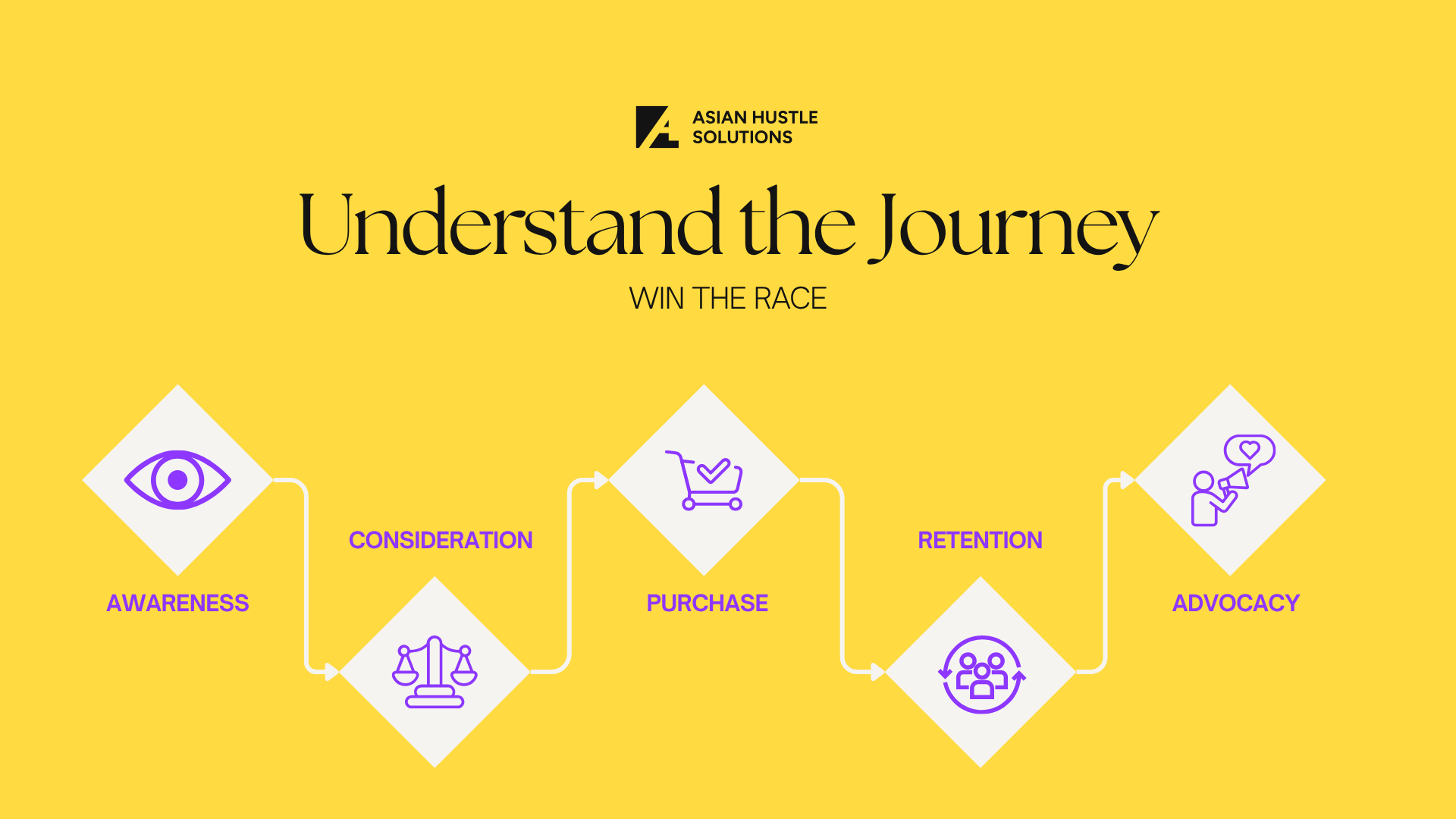
Before becoming a loyal customer, a lead has to interact with your product/service at various stages. This entire process is summarized in the customer journey, divided into 5 main stages:
Awareness: The customer becomes aware of your brand and your product, usually through search engines when searching for a solution to their problem.
Consideration: The customer is aware of your brands but also your competitors’;, they start wondering which of the options they should choose from.
Purchase: The customer makes a buying decision, either from your brand or your competitors’.
Retention: After the purchase, you need to consider how to get them to repurchase many more times, since retaining is cheaper than recruiting.
Advocacy: At this stage, the customer is basically your brand ambassador., Tthey love your product;, they tell their acquaintances about your product.
Understanding the journey and what stage the audience is at can help you understand their needs and adjust accordingly. Each stage has a different touchpoint as well, so adjusting to said touchpoint makes it more effective and less costly. Understanding the journey can help you win the race.
Why Asian Hustle Solutions?
At AHS, we specialize in helping brands capture attention and inspire action — whether you’re launching a new product or scaling your business, we’ll guide you to marketing that resonates and delivers results.
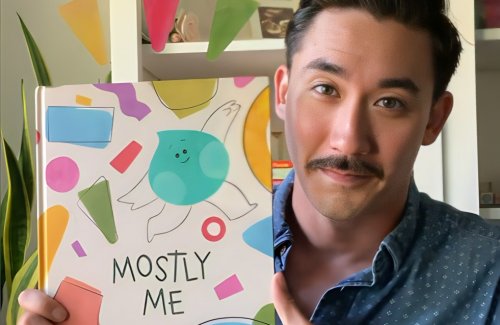
In a world where the narrative of identity often falls into predefined categories, Mostly Me by Collin Hall emerges as a refreshing beacon of self-discovery.
Released on September 18 by Gloo Books, this picture book takes readers on a captivating journey, skillfully illustrating the complexities of biracial identity.
Author and Illustrator
Written by Collin Hall and beautifully illustrated by Crystal Dawn Chaffee, both of whom share a biracial heritage, Mostly Me is a heartfelt project born from personal experiences. Collin embarked on this creative journey shortly after the birth of his first daughter, driven by a powerful desire to equip her with the tools to embrace her multiracial identity.
Collin Hall is a proud biracial Korean/American based in Austin, TX, offering a voice that resonates deeply with those navigating the intricate terrain of identity.
Diverse Representation
According to the *Cooperative Children’s Book Center’s 2022 Diversity Statistics database, only 0.7% of children’s books published in 2022 were authored by multiracial individuals and focused on multiracial characters.
Collin’s Personal Journey
Collin Hall shares, “The biggest hurdle for this project was the internal identity-wrestling before words were even on paper. Having to re-engage with a part of myself I had avoided for a long time was hard, and typically paired with a good dose of uncertainty and guilt. Finding my own footing was, and is, a process, but one that put me in a much better spot to discuss multiracial identity with my own kids in the future.”
He also shared how re-learning Korean nursery rhymes was also a challenge and that it took longer than he expected.
Embracing In-Between Spaces
Mostly Me may be short and whimsical, but it carries a profound message—it’s entirely acceptable to exist within the fluid spaces of identity. It encourages individuals to wholeheartedly embrace all aspects of their heritage, irrespective of societal expectations.
I’ve got some green, I’ve got some blue.
Some have asked, “So what are you?”
Not quite blue, not fully green.
I’m something new. I’m in-between.
Affirmation and Unity
Mostly Me serves as an affirmation, resonating with Collin and Crystal’s own experiences and the experiences of every multiracial child navigating the intricate landscape of identity. It instills the confidence to boldly claim one’s space in the world, reminding us all that there is no universal guidebook for this journey. Instead, it offers the comfort of shared emotions, questions, and experiences.
Within the pages of Mostly Me, Collin Hall extends an invitation to readers to embark on a profound journey of self-discovery. This remarkable book celebrates the beauty of embracing multiracial identities, encourages us to revel in the uniqueness of our individual narratives, and, above all, empowers us to find the strength to assert our presence in a wonderfully diverse world.
As we eagerly anticipate its release, Mostly Me promises to inspire and resonate with readers of all backgrounds, young and old, seeking to understand the rich tapestry of identity that defines us all.
*Independent analysis of data accessed on 07/02/2023 by Gloo Books using the Cooperative Children’s Book Center (CCBC), School of Education, University of Wisconsin-Madison Diversity Statistics Book Search (https://ccbc.education.wisc.edu/diversity-statistics-book-search/). Permission to publish granted by the CCBC 07/13/2023.
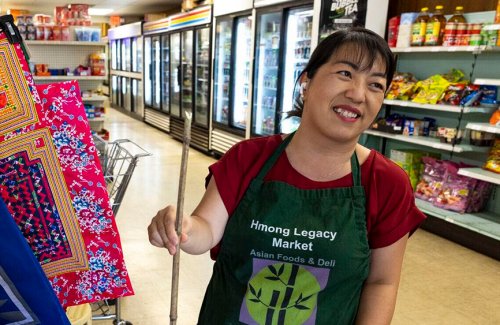
At Hmong Legacy Market, located on Madison’s South Side, you’ll discover a treasure trove of homemade Asian cuisine. From steaming bowls of beef pho to whole roasted tilapia seasoned with herbs and chili, and delightful sesame rice balls filled with mung beans and coconut, this independent Asian grocery store offers a culinary journey.
Ze Yang, one of the owners, can often be found expertly preparing dishes like squash curry. To her, food is more than sustenance; it’s a connector, a storyteller, and a unifying force that brings people together.
As a young child in the 1980s, Ze Yang lived in a refugee camp in Thailand with her family, having fled Laos during the aftermath of the Vietnam War. In 1991, Ze Yang’s family received the opportunity to immigrate to the United States, sponsored by a distant uncle who had settled in California. Their early days in the U.S. were marked by challenges—language barriers, cultural shock, and financial difficulties. However, their farming skills from Laos allowed them to grow crops like green beans, tomatoes, and peppers, which they sold to support their family.
After six years in California, Ze Yang’s family decided to move to Wisconsin, drawn by the promise of better public schools and economic opportunities. Ze Yang’s parents worked tirelessly, holding multiple jobs to make ends meet. This experience inspired Ze Yang to become a teacher, focusing on helping immigrant children adapt to the American education system.
Ze Yang’s family thrived. They bought a house, built a family, the kids went to school, but they also wanted to pursue their entrepreneurial dream. They longed to create a space where people from diverse backgrounds could gather, savor homemade dishes, and access pantry staples from across Asia. This is why they opened Hmong Legacy Market, offering an extensive array of products, from giant spring roll skins to bamboo shoot chili oil, and from mango mochi to traditional Hmong celebratory clothing.
More than just a grocery store, Hmong Legacy Market is committed to the well-being of the community. In 2021, it partnered with Public Health Madison and Dane County to serve as a mobile COVID vaccination clinic. Looking ahead, Ze Yang envisions the store’s legacy continuing to thrive, driven by the spirit of family and the desire to improve and grow.
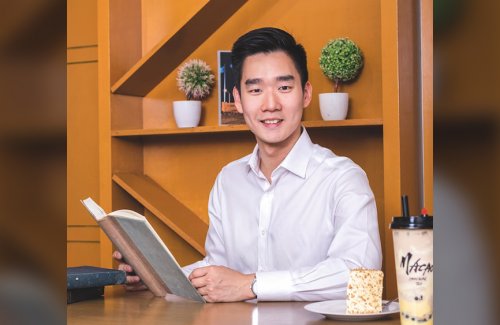
Avin Ong, the visionary behind Macao Imperial Tea and CEO of The Fredley Group of Companies, has carved a remarkable path to success in the world of food and beverage. His journey, from humble beginnings to leading a multi-million-dollar empire, reflects his belief that opportunities are abundant for those willing to seize them.
Growing up in a blue-collar family with limited resources, Ong’s early life was far from extravagant. His family’s livelihood revolved around assembling hangers and selling them in the bustling streets of Divisoria, Metro Manila.
Today, Ong oversees a diverse portfolio of businesses, including New York Fries and Dips (NYFD), Nabe Japanese Izakaya and Hot Pot, Café Kitsuné, and the immensely popular Macao Imperial Tea. His recipe for entrepreneurial success is built on several key principles.
Firstly, Ong emphasizes the importance of seizing opportunities when they arise. Having experienced financial hardship in his past, he has become adept at embracing opportunities without hesitation, even if he feels unprepared.
Secondly, Ong stresses the significance of understanding your target market intimately. He recognizes that different consumer segments require tailored approaches. For instance, Café Kitsuné caters to a more upscale audience, while Macao Imperial Tea targets a younger demographic through social media influencers like TikTok.
Furthermore, Ong emphasizes the scalability of his brands, which has allowed for rapid expansion. Starting with less capital-intensive concepts like NYFD and Macao Imperial Tea, he has achieved impressive milestones, such as opening 13 new stores in a single day.
Innovation and adaptability are also cornerstones of Ong’s success. During the pandemic, while some of his ventures struggled, Macao Imperial Tea’s sales surged by over 300 percent.
Lastly, Ong’s humility shines through in his readiness to admit failures and setbacks. While he had to close some branches, he prioritized retaining his loyal team members by reallocating them to more successful establishments. He shared with Tatler Asia how he acknowledges that surprises are inevitable in life, as exemplified by his initial failure to gain admission to De La Salle University. However, his determination led him to eventually fulfill his dream of attending the esteemed institution.
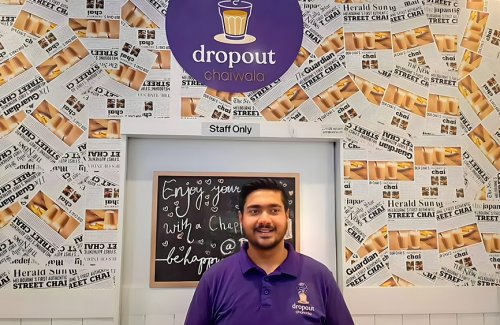
Sanjith Konda House, an 18-year-old from Bengaluru, India, set off on a conventional journey to Australia to pursue a Business Studies degree at La Trobe University in Melbourne. However, he made an unconventional turn, abandoning his studies in pursuit of an entrepreneurial dream that would later become a successful enterprise, ‘Dropout Chaiwala.’
Sanjith’s bold decision to step away from academia during his fifth semester in exchange for a tea business venture demonstrated exceptional courage, a trait deeply ingrained by his upbringing.
Supported by his parents—a father employed as a mechanical engineer at a Saudi Arabian oil company and a homemaker mother—Sanjith had always been instilled with the values of responsibility and independence beyond his years.
With an initial investment of $120,000, Sanjith, alongside his friends Asar Ahmed Syed, Preetam Akula, and Arun P. Singh, set up their first ‘Dropout Chaiwala’ outlet on Elizabeth Street. Their menu started simple, offering just five varieties of chai, but they gradually began to catch the attention of students and office-goers alike.
Despite facing initial obstacles, Sanjith’s unwavering determination was the driving force behind the business’s growth. By March, they had a mobile chai truck in operation, catering to university events, festivals, and weddings. Another significant milestone came in August with the opening of a third store on La Trobe Street.
Under Sanjith’s dynamic leadership and with the dedication of his team, which included Apoorva Singla overseeing the Elizabeth store, Dropout Chaiwala expanded its menu to include light snacks. Within a year, the business generated $600,000 in sales and provided employment to 40 individuals, turning Sanjith’s bold leap of faith into a thriving success.