Design

March 13, 2025

SHARE:

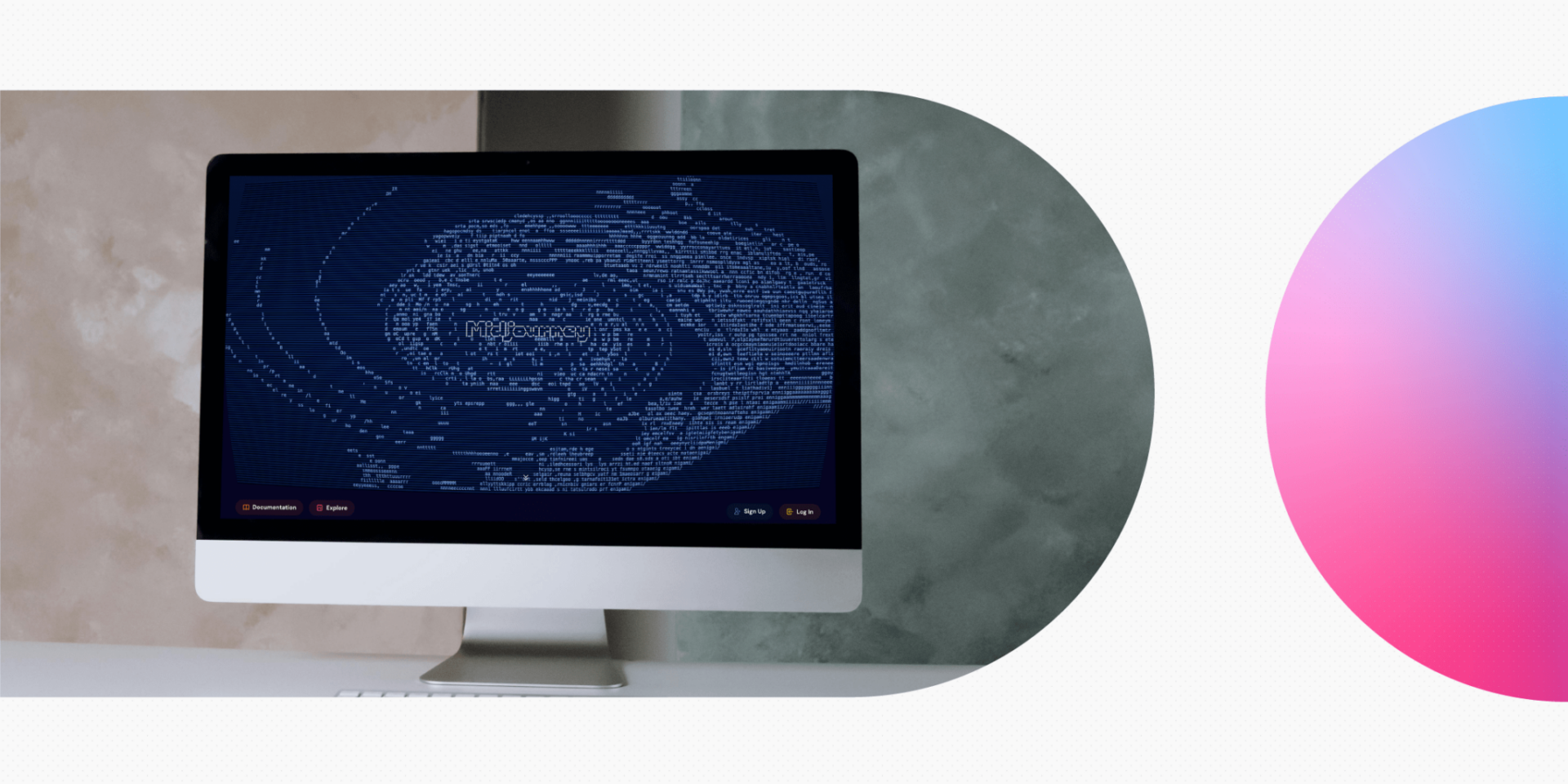
As AI increasingly makes its way into the UI designer’s toolkit, Midjourney is fast becoming one of the most popular image generators. 

With a simple text prompt, you can use Midjourney AI to create custom digital artworks, whip up an app screen, design individual UI elements, and generate colour palettes—all in a matter of seconds.

For UI designers, this can really accelerate the ideation process and help you expand your own creativity. 

So how does Midjourney AI work? And how can you leverage it in the UI design process? Let’s take a look. 

What is Midjourney AI and how does it work?

Midjourney is a generative AI tool created by Midjourney, Inc.—an independent research lab based in San Francisco.

Midjourney AI generates images and digital artworks based on text prompts. If you enter a prompt asking for an image of a mermaid swimming underwater surrounded by marine life, Midjourney will generate four versions for you to choose from. The more specific your prompts, the better—but we’ll get to the art of prompt-writing for Midjourney in a later section. 

Midjourney works within the Discord platform. Discord is an instant messaging app, commonly used to create communities where users can chat via text, voice, and video. Discord essentially facilitates communication between the user and the Midjourney bot.

Midjourney uses two key machine learning technologies:

  • Large Language Models (LLM): this is how Midjourney understands and interprets the text prompts provided by the user.
  • Diffusion Models (DM): in very simple terms, this technology converts random visual noise into a meaningful image. You enter a text prompt, which sparks a field of visual noise. The AI then progressively removes that noise in incremental steps, eventually resulting in an image that resembles what you’ve asked for. 

Now we know what Midjourney is and how it works, let’s drill down to some key functions and features. 

What can Midjourney AI do? Key features

Midjourney’s core function is to convert text prompts into images. This allows you to generate unique digital artworks and graphics in a range of styles. 

You can guide the image generation process by applying custom parameters to your prompts. You might specify a certain aspect ratio, for example, or a particular style such as ‘watercolour’ or ‘flat design’. 

You can also customise the quality of your images by specifying, within your prompt, a value for the rendering quality. You might specify ‘q 1’ (that’s the default quality level) or request that images be rendered to a higher quality by specifying ‘q 2’ in your prompt. 

Once you’ve entered your prompt, Midjourney will give you four different image versions. You can choose to upscale a particular version, which will increase the size/dimensions of the image and also improve the quality. 

Beyond image generation, Midjourney serves as a great source of community and inspiration. You can share your creations and browse images created by others, allowing you to see what’s possible with Midjourney and sparking ideas for your own work. 

How to get set up on Midjourney AI

To use Midjourney AI, you’ll need to create both a Discord account and a Midjourney account. 

If you’re not already a member, first head over to the Discord platform and follow the instructions to create your account. Once you’re signed up, join the official Midjourney Discord server by clicking the ‘Accept invite’ button. 
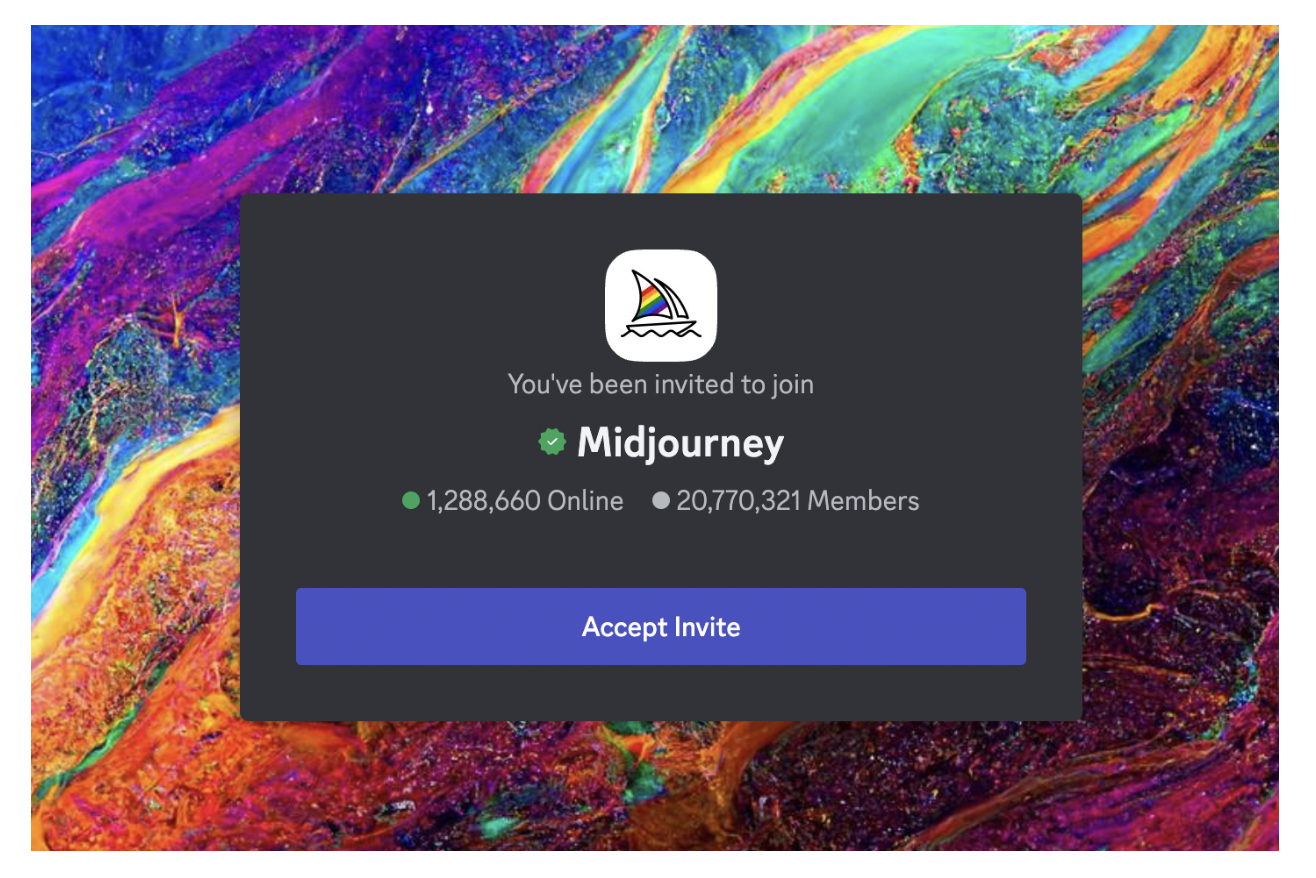
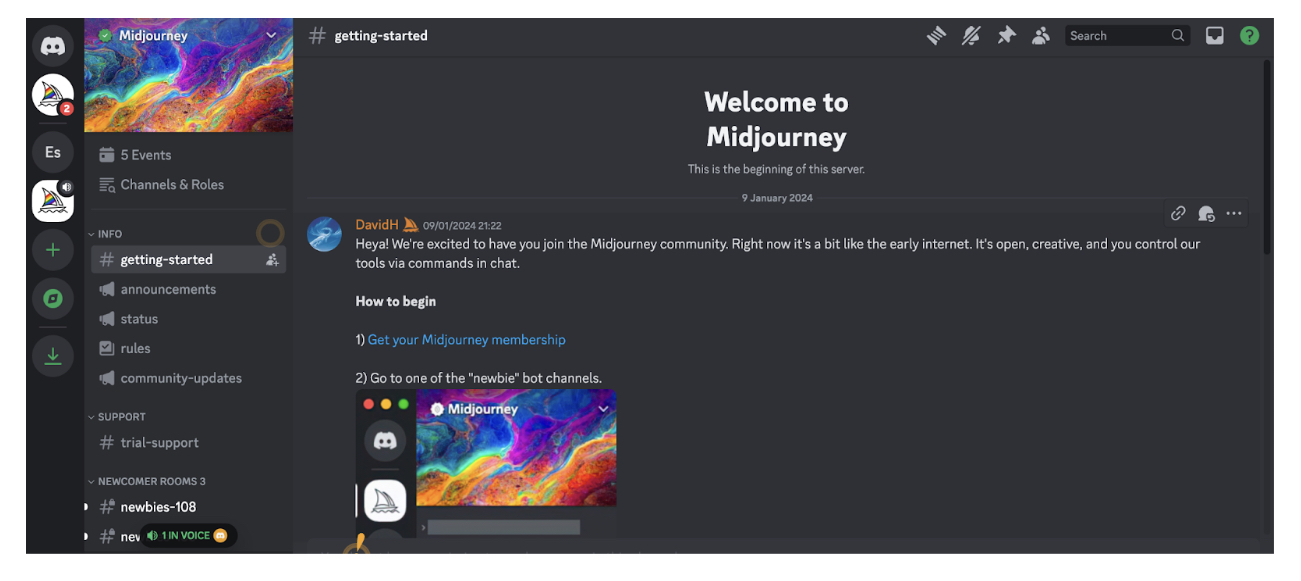
You’ll then find yourself in the “Getting started” channel, where you can create your Midjourney account (if you haven’t already done so) by clicking “Get your Midjourney membership” (visible in the chat):
This will take you to a separate page, the Midjourney showcase, where you can click “Sign up” in the bottom left corner to create your Midjourney account. 

Once you’re signed up and logged in to Midjourney, you can navigate back to the Midjourney Discord server and enter one of the so-called “newbie” bot channels. You’ll find available newbie channels on the left-hand side.
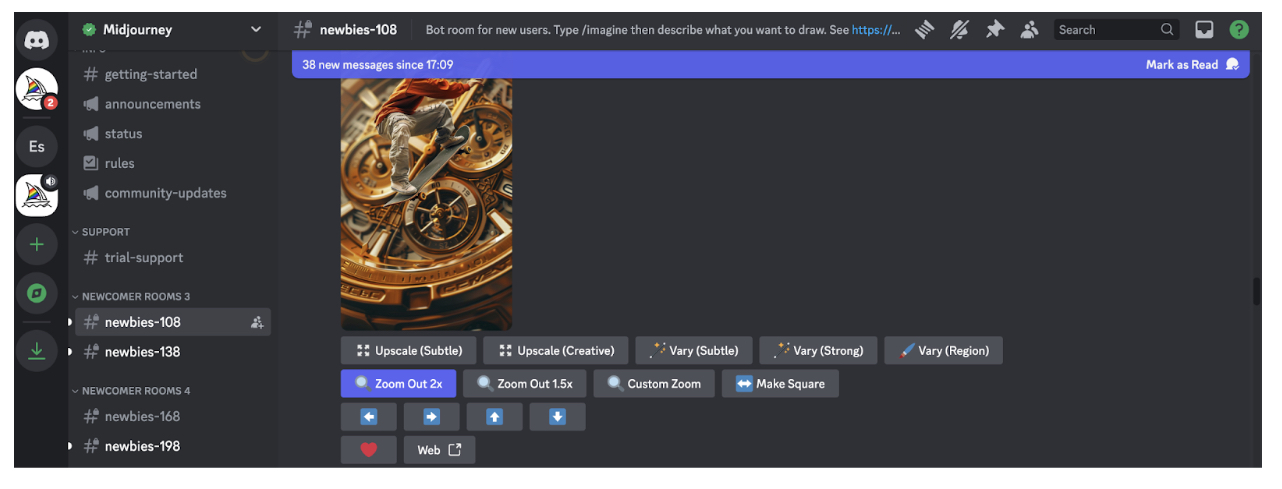
You can then enter your own prompts into the chat box to start generating images. 

At the time of writing, Midjourney is no longer offering a free trial for new users. If you want to start prompting, you’ll need to sign up for a paid subscription. 

How much does Midjourney AI cost?

Midjourney offers four price tiers:

  • Basic Plan for $10 per month or $96 per year with an annual subscription (that’s around €9 per month / €89 per year)
  • Standard Plan for $30 per month or $288 per year with an annual subscription (that’s around €28 per month / €267 per year)
  • Pro Plan for $60 per month or $576 per year with an annual subscription (that’s around €55 per month / €533 per year)
  • Mega Plan for $120 per month or $1,152 per year with an annual subscription (that’s around €111 per month / €1,066 per year). 

For more information about each price tier and what’s included, visit the official Midjourney pricing page.

How to use Midjourney AI in UI design (with example prompts)

Midjourney can generate custom visuals in a matter of seconds—making it an incredibly interesting tool for UI designers. You can use Midjourney to quickly create screens and individual UI components, come up with themes, styles, and colour palettes, and generate unique digital artwork. 

Note, however, that the graphics you create with Midjourney won’t necessarily be directly usable—and working with Midjourney doesn’t eliminate the need to create your own screens and elements using the usual UI tools like Sketch and Figma. If you generate an app screen with Midjourney, for example, you’ll still need to actually create that screen from scratch yourself. 

Where Midjourney really comes in useful is helping you to explore different ideas and concepts and gather inspiration. You might use your AI-generated artwork to inspire mood boards, kick-start an ideation session, or serve as a guide for certain layouts or colour schemes. 

With that, let’s consider some examples of how to use Midjourney for UI design. 

Use Midjourney AI to generate app screens 

If you’re designing for mobile, Midjourney can help you ideate layouts and designs for various app screens. If you’re designing a dating app, for example, you might try the following Midjourney prompts:

  • /imagine a vibrant and fun login screen for a dating app, with an eye-catching background, username and password fields, and buttons for login and social media sign-ins
  • /imagine a user profile screen for a dating app, featuring a large profile picture at the top, user bio, interests, and match percentage displayed in a clean layout
  • /imagine a match screen for a dating app, showing potential matches with profile pictures, a brief bio, and buttons to like, dislike, or super like
  • /imagine a chat screen for a dating app with a clean interface, message bubbles, timestamps, and an input field at the bottom

Create UI components such as icons, buttons, and logos 

Perhaps you want inspiration for the finer details of your app or website. In that case, try using Midjourney AI to create individual UI components such as icons, buttons, and logos. Here are some prompt examples to guide you:

  • /imagine a set of modern buttons for a mobile app, including primary, secondary, and disabled states, using a black and white colour scheme
  • /imagine a collection of minimalist icons for a mobile app, including icons for home, search, messages, settings, and notifications
  • /imagine a sleek and modern logo for a dating app, incorporating elements of connection and love, with a vibrant colour scheme

Generate theme and style concepts 

In the early stages of the design process, you might focus on coming up with an overall visual style for your website or app—and Midjourney can help with this, too. Specify your vision or initial ideas and let Midjourney bring them to life. 

Consider the following prompt examples:

  • /imagine a light mode theme for a productivity app, featuring white backgrounds, soft grey UI elements, and navy blue highlights
  • /imagine a dark mode theme for a music app, with black backgrounds, dark grey UI elements, and neon pink highlights
  • /imagine a vibrant and colourful theme for a creative design app, with bold colours like orange, pink, and teal, playful typography, and dynamic UI elements

Create custom website imagery 

Imagery plays an important role in UI design, helping to reinforce brand identity and enhance the visual appeal of your website or app. 

Whether you want to create cartoon-style illustrations, abstract artwork, or realistic images of products, places, or people, Midjourney can generate custom imagery that reflects your brand and vision. 

Here are some examples of how you might prompt Midjourney to generate images for different use cases:

  • /imagine a stunning hero image for a tech startup website, featuring abstract technology elements and a modern cityscape in the background
  • /imagine a set of custom illustrations for a health and wellness website, featuring people doing yoga, eating healthy, and meditating
  • /imagine a unique background image for a creative agency website, with abstract shapes and vibrant colours

Generate colour palettes 

Perhaps you want help coming up with the perfect colour palette, or you’ve already got a colour scheme in mind and want to see how it looks in practice. Again, Midjourney is an excellent source of inspiration here. Simply specify the kind of look and feel you’re aiming for and Midjourney can generate multiple colour palettes accordingly.

Consider the following prompt examples to guide you:

  • /imagine a pastel colour palette for a wellness app, featuring soft shades of mint green, blush pink, lavender, and light grey
  • /imagine a bold, split-complementary colour palette for a fitness app, comprising three colours
  • /imagine a monochromatic colour palette for a finance app

How to write effective prompts for Midjourney AI

As with all generative AI tools, the quality of the output depends on the quality of the input. In other words, it’s up to you to tell the AI what you want—and to master the art of prompt-writing for the specific tool you’re using. 

Here are some tips to help you write effective prompts for Midjourney AI:

  • Start each prompt with the /imagine command, followed by a description of what you want the AI to create.
  • Keep it simple and specific. To quote the official Midjourney guidelines for prompt-writing: “The Midjourney Bot works best with simple short phrases that describe what you want to see. Avoid long lists of requests and instructions.”
  • Specify what you want the image to include, rather than what you don’t want it to include. Even if you specify “no flowers” in your prompt, the AI will likely only focus on the word “flowers” and therefore create an image that does indeed contain flowers. If you absolutely want to exclude something from the image, use the “no” parameter. For example: – – no flowers.
  • If necessary, specify your desired aspect ratio using the following parameter: – – ar [value]. If you wanted to generate an app screen, you could specify – – ar 16:9.
  • Use the stylize parameter to control the level of artistic flair that Midjourney injects into each image. If you imagine that the default level, 2500, gives you a medium level of stylization, you can dial it up or down by specifying values higher or lower than 2500. If you wanted to generate an image of a garden that’s more realistic than artistic, you might specify – – stylize 500. If you wanted to create an image of a garden that looks magical and fantastical, you might specify – – stylize 3500.
  • Use the quality parameter to adjust the level of quality and detail in the image. – – q 1 is the default, so work from that value to dial the quality up or down. 

Most importantly, be prepared to experiment. The more you use Midjourney, the more intuitive the art of prompt-writing will become. You’ll start to get a feel for what works and see how different words, phrases, and parameters influence the output. 

Ethical considerations when using Midjourney AI

If you’re using Midjourney AI (or indeed any AI tools) throughout the design process, you must take care to use it responsibly. Here are some of the most important ethical considerations to bear in mind.

Intellectual property and copyright

When generating images with AI, be careful about replicating existing images or artworks created by other artists or designers. You might use a famous logo for inspiration, for example, but you wouldn’t want to emulate the style too closely to the point of copying. 

Deceptive and misleading content

This is like the visual equivalent of fake news—creating image-based content that deliberately deceives, misleads, manipulates, or spreads misinformation. Don’t do it!

Stereotypes and bias

It’s well-documented that AI can and does perpetuate harmful stereotypes and biases. As a human user, you must be diligent about actively looking out for such biases and taking steps to mitigate them.

Strive to generate images that are inclusive and representative of diverse groups. If you generate an image that doesn’t feel inclusive or could potentially exclude or harm certain people, don’t use it. You can learn more about the importance of designing inclusive content in this guide. 

As a general rule: always review AI-generated content with a critical eye, and use your better judgement. As a human user, it’s your responsibility to consider the impact of any content you create—and to ultimately decide what makes it into the public domain. 

The takeaway

Midjourney AI can generate custom images in seconds, making it an excellent tool for gathering inspiration, sparking your own creativity, and ideating and exploring different design concepts, layouts, and styles. 

Whether you use it to generate fully-fledged app screens, individual UI elements, impressive artworks, or colour palettes: Midjourney AI is a powerful addition to your UI design toolkit. 

Ready to get started with Midjourney AI? Experiment with different prompts and use cases, explore other Midjourney users’ creations, and be mindful of the ethical considerations we’ve laid out in this guide. You’ll soon be generating images like a pro! 
Related Articles

Image Source: Etsy.com

Uncategorized

Major Online Shops Including Etsy, Yelp, Uber Eats Boost Visibility Of Minority-Owned Businesses

The pandemic has devastated minority-owned businesses. Only 31% of Black-owned enterprises and 44% of Hispanic-owned businesses got Paycheck Protection Program aid, according to the Federal Reserve.

To raise awareness and support minority-owned companies across the country, major online shops and delivery systems are now showcasing Asian, Black, LGBTQ, and female entrepreneurs.

Amazon Launchpad enables vendors to identify on their “seller credentials” page if they are Black-owned, Latinx-owned, or women-owned.

DoorDash allows you to search for Black-owned restaurants in numerous US cities with “Black-owned” and “women-owned” tags on all company profiles. DoorDash Merchant Support can add the tag to a business’s profile.

Etsy lets shoppers search for Asian, AAPI, Black, handicapped, Jewish, Latinx, Native, female, LGBTQ, as well as veteran and military family-run businesses.

Google Business Profiles that are verified can add “Black-owned,” “women-led,” and “LGBTQ-owned” attributes to Google Search, Shopping, and Maps.

Macy’s Diverse Owned Brands section of its website features hundreds of items from minority-helmed brands, including those manufactured by AAPI, Blacks, Latinos and Hispanics, LGBTQ persons, and women.

The Intentionalist sorts for Asian-owned, Black-owned, Latino-owned, LGBTQ-owned, Native-owned, veteran-owned and woman-owned companies.

Uber Eats has partnered with the EatOkra app, which connects diners to Black-owned eateries, restaurants and food trucks in cities of Atlanta, Chicago, Los Angeles, Miami and Seattle.

Yelp allows businesses to self-identify as Black-owned. Yelp’s Ones to Watch series also spotlights top Asian-, Black-, Latinx-, LGBTQ- and women-owned businesses around the country. Businesses can also categorize themselves as “open to all,” which means that they welcome anyone regardless of race, ethnicity, national origin, sex, sexual orientation, gender identity and expression, immigration status, religion or disability.

Olivia_headshot

Uncategorized

Twrl Milk Tea Co-Founder & CMO Olivia Chen Shares Essential Lessons On Setting Foot In Famed Retailer Costco

Two mom-friends and milk tea lovers Olivia Chen and Pauline Ang have capitalized on the early success of their milk tea company by sending samples to the head office in Costco which lead to launching their product with the retail giant in just three and a half months.

“We are still pinching ourselves that our Twrl’s Taiwan-Style Black Milk Tea is now in Southern California Costco!” Olivia says, “We’re starting with 3 locations: Irvine, Monterey Park, and Tustin (2700 Park Avenue).” 

Pauline (left) and Olivia (right)

They overcame it without calling in a broker to help them. It wasn’t easy at all, however, this exemplifies the importance of hard work and perseverance of the duo to learn every step of the way for their small business to set foot in one of the world’s largest retail stores.

Olivia enthusiastically shares with Asian Hustle Network the timeline of how their plant-based Twrl Milk Tea made it into Costco to help entrepreneurs navigate the highly competitive food and beverage space. 

Roadshow Or Small Rotation

We met our buyer at Expo West (Think Super Bowl for the Food & Beverage industry where retailers and manufacturers meet up. Super worth doing if you are in CPG. We even landed our 1st TV interview).

After Expo West, we sent more samples to the office and began negotiations for placement. We were offered two ways of being at Costco:

Roadshow

  • 4 days of selling on consignment. We could control costs by using our own people and decide the volume of product we wanted to bring in.
  • Typically, this is how small brands enter Costco. If it does well, you are offered a rotation. If you don’t do well, then it’s really hard to get into the regular set.

Small Rotation

  • We started with a number of stores and the item is part of the regular set.
  • This is harder to secure because Costco is paying for the inventory and the buyer has to believe in your product.

In both situations, it is critical that Twrl Milk Tea sells well and ideally sells out. Why is this important?

It proves to the Costco Buyer that there is a market for our better-for-you plant-based milk teas. More importantly, companies owned by Asian American small business owners like ours are proven to be great partners worth investing time in and onboarding.

Reasons For Opting for Small Rotation

After a few weeks of due diligence on our end, we decided to go with a small rotation. Our reasons were simple:

  • Our manufacturer could produce the volumes needed and in the time we needed. Not always the case in this crazy supply chain. We are made in the USA so it makes a huge difference in our speed for delivery.
  • We could handle the financial obligations to fund the inventory. It’s a lot of money upfront so it’s not a light decision for a smaller company like ours. And, there is still a chance you can be sitting on inventory if it does not sell through.
  • We are committed to Costco and wanted to be part of the regular set and did not want to take the chance that with Roadshow which is only 4 days could be a bust due to so many variables that we may not be able to control.
  • We love Costco ourselves and shop there regularly so we saw our consumers there! Did you know the typical Costco shopper is 35-44 years old, an Asian female making $125,000 and the average trip is $114?!

Roadshow which is only 4 days could be a bust due to so many variables that we may not be able to control.

-Olivia Chen

Decisions, Decisions, Decisions

What flavor to sell?

Out of our 3 flavors, we selected Taiwan-Style Black Milk Tea to launch because it’s one of our best sellers and our Taiwan-Style Black Milk Tea flavor is really unique. Our single-origin loose-leaf black tea is a one-of-a-kind varietal, sourced from a small multi-generational family farm on a misty slope, fed by sweet mountain spring water.

Our tea flavor, aroma, and health benefits are un-parallel to anything on the market. We use pea milk and lightly sweetened our teas with organic agave so our tea flavors really come through. Only 45 calories & 6g of sugar per can.

What would the packaging look like?

Packaging design and sourcing begin for Costco. Luckily for us, Pauline Ang is a seasoned graphic design guru (with 15+ years in the food and beverage packaging for Fortune 500 companies) and designs all our packaging in-house so we could save costs and time here!

How to onboard?

Mountains of paperwork for our two-person team begin. We didn’t use a broker and did everything ourselves. Yes, a broker would have been so incredibly helpful to answer all the questions that we didn’t know the answers to and definitely would have saved us some headaches.

Big Takeaways

  • Don’t be afraid to chase the account you want to be in. Don’t be shy about sharing your vision of where you see the company. Special thanks to Ryan Sung of Honolulu Cookie Company and Vincent Kitirattragarn of Dang Foods for talking to us about their journey with Costco and encouraging us to go for it.
  • It can be done without a broker but not without headaches and some huge learning curves and we did make some mistakes along the way.
  • Have an advocate. We have been super lucky that our buyer has been so incredible to work with and it’s important to have such an advocate in the company. Cannot over-emphasize this enough!
  • Your team matters. Grateful to share this journey with Pauline Ang who is such an amazing friend and business partner. We are two moms that love Milk Tea and simply wanted to make milk tea —a quintessential Asian drink that we love—even better.

Don’t be shy about sharing your vision of where you see the company.

-Olivia chen

Connect with Olivia and Pauline

Your support would mean the world to our small business and the small family farms that use sustainable practices for a tea that’s better for you, and better for the planet. Follow our journey: Instagram, Facebook, TikTok, Twitter

Twrl Warehouse

Uncategorized

From Refugee To Legendary: The Roller Coaster Hustling of Serial Entrepreneur Tony Lam

“I want to tell everyone it is NOT EASY. For all the folks in the restaurant/food business, I respect you and take my hat off to you.”

Tony’s current passion projects include helping to bring popularity to Vietnamese coffee in the United States and guiding the next generation of young, ambitious entrepreneurs to realize their full potential. 

He is married to his lovely wife Van Lam and has two sons named Damon and Andy. His son Andy is on the spectrum (ASD), “Raising an autistic child has many challenges and requires a lot of patience. These kids have a special place in my heart.” Because of this, he is currently working closely with Linda Nguyen, founder Laugh Out Loud with Autism Foundation (LOLA) whom he got connected through the Asian Hustle Network (AHN), “Much respect for this beautiful human being for having a BIG heart. We need more compassionate leaders like her in this world.” he said. 

Known for being a successful serial entrepreneur, Tony shared his successes and his humble beginnings and challenges that made him the hustler he is today. 

Escaping Vietnam

My story began 45 years ago from today. During the Fall of Saigon (April 30th, 1975), I was only 3 months old when my family fled on a tiny boat to the US. My father was one of the Naval captains of the South Vietnam government. 

My mother had just given birth to me and they had to make the difficult decision: Should they stay, or should they go with a 3-month-old baby and risk death by the communist government? They made the decision to drop everything they had and took a chance on a better life into the unknown. 

My grandma, aunts, uncles, and cousins left everything behind and boarded the boat. My father to this day still has nightmares of the harrowing escape.

My mother had just given birth to me and they had to make the difficult decision: Should they stay, or should they go with a 3-month-old baby and risk death by the communist government?

-Tony Lam
3 year-old Tony

A Fresh Start

My family was refugees in the Philippines for about 6 months. Not knowing what would happen, my family prayed hard and God answered our prayers. We were sponsored by an American family through Catholic Charities.

This American family took in a total of 6 of us, gave us a roof over our heads, put food on the table, and gave my family support for a couple of years to survive. My “sponsored grandparents” are now angels in heaven, but their kids whom I called Aunt Kim and Uncle John still live in southern California and we still communicate every so often. My family is grateful to their parents’ kindness and open heart to take in complete strangers into their homes.

My family would move to the Bay Area a few years later for a fresh start. My brother and sister were born, and we quickly became a family of 5. My father got his AA degree from San Jose City College and his trade was being a technician fixing medical devices for hospitals while my mother worked as an assembly worker.

Building Blocks That Lead To Success

I remember growing up in a poor neighborhood, teased by classmates for being Asian. Racism did exist at an early age for me but I did not let it bother me.

I remember my parents giving me a $100 allowance to buy enough clothes every year during my middle and high school years. So no, I did not grow up with a silver spoon in my mouth, but I was grateful for what I had. I got decent grades but was not smart by all means in high school.

I attended California Polytechnic State University (Cal Poly) where I got my business degree. My dream was to open a business one day but I didn’t know at the time what it would be. My first job out of college was at Cisco Systems (’97). I worked for corporate for way too long (14 years). I was a workaholic working 60-70 hr. weeks to save up money to start a family one day.

I should mention that this all would not have been possible without the love and support of my wife. I met my beautiful wife Van Lam through a college friend. We chatted for 3 months via Yahoo Messenger, fell in love, and married her one year later in Vietnam. We have two boys (Damon – 10 yrs. old and Andy – 7 yrs. old)

While I was working at Cisco, I discovered my first hustle (Wingstop) and the many more that would follow after leaving the company.

I was a workaholic working 60-70 hr. weeks to save up money to start a family one day.

-TONY LAM

The Serial Entrepreneur

Wingstop Franchisee — for 5 Locations (San Jose, Milpitas, Fremont, Union City) in the Bay Area for over 3 decades.

COOP Marketing President — for 50 Wingstop in the Bay Area instrumental in inking the deal with the GS Warriors and becoming “The Official Wings of the Golden State Warriors” since 2015

Omni Bev Co-founder — the first company to have an RTD (Ready to Drink) Vietnamese cold brew with condensed milk on the market with a shelf life of over 6 months. Its coffee beans are imported directly from Da Lat. They also serve nitro cold brew!

Omni Bev Co-Founders Tony Lam and Tammy Huynh

Mavens Creamery Shark Tank Winner — a macaron ice cream place that started in a 400 sq. ft. garage, expanded to 300 venues, and 4 years later struck a Shark Tank deal on TV with Barbara Corcoran. 

alaMar Kitchen & Bar Co-Owner — voted the Best Seafood Restaurant in Oakland by Oakland Magazine in 2020, was also featured in the Michelin Guide for 3 years, and on KQED

Okashi Fusion Co-Owner — with a 4.8/5 star rating on Yelp reviewed by 710 customers, is the  “BEST POKE in town with the BEST desserts” as Tony describes.

VitaBowl Board Advisor & Investor — a premium on-demand delivery brand that serves locally sourced, vegetarian, superfood meals and beverages. Tony teamed up with Charles Michael Yim through Asian Hustle Network, who also struck a deal on Shark Tank. Charles has assembled an A-team of talent, “I am honored to be working with these guys. Together, we have started a new company VitaBowl.” he expressed.

Enterprise Purchasing Group Co-Owner — a group purchasing organization that leverages the combined volume of many e-commerce businesses to secure exclusive programs with major shipping carriers (USPS, UPS, DHL, FEDEX) for both domestic and international destinations. “Our team has saved 10’s of millions for many customers spending in the range of $10K to $70M+ to date,” Tony added, “If you ship at least 50 orders a day domestically, we can surely help you with saving with our program.”

A Few Hurdles That Turned Into Bigger Opportunities

When IOS apps were just coming out in 2011, my partner and I created a booking app called Chimpped, which allows users to book with all your service providers (e.g. your dentist, doctor, kid’s activities, restaurant, etc.). One and a half years later, we closed down our business because we ran out of money and did not get enough traction. The “high tuition” I had to pay through this failure allowed me to consult with other app companies.

The apps KEA, Nextforce, and WorkStream have gone through Series-A funding and 1 Seed round. The seeds have been planted, just waiting on fruits to grow.

The “high tuition” I had to pay through this failure allowed me to consult with other app companies.

-Tony Lam

What Is Next For Tony Lam? 

Tony wants to dedicate his time to the special needs / autistic community and provide resources such as jobs and career-building services.

He is also planning on launching Andy’s cafe where a large portion of the staff hires will be from the special needs community. The plan is to launch this in 2023 in California. If successful, he would like to open 100 of these in the next 5 years to give the special needs community a safe place to work and be able to socialize with people

Lastly, Tony is planning on starting up a PE fund to invest in startup CPG companies.

Advice To Aspiring Entrepreneurs

  • Surround yourself with mentors and successful entrepreneurs. Join a support network of folks that bring positive energy
  • Write up a business plan so that you have done the research before venturing out
  • Have 18 months of the runway of savings to cover your expenses while you launch your company

You can reach Tony at tony@launchyourfirst.com

295546115_608626004055198_2005064705537423309_n

Uncategorized

“Life as an entrepreneur is tough” Is An Understatement For Vanessa Techapichetvanich

Some business owners spend years building a company only to see it fail before it even takes off. How are you going to survive and cope? Will you just give up that dream business?

We all know that life as an entrepreneur is complex, but once you hit it, everything falls into place. Following the example of 27-year-old Thai entrepreneur Vanessa Techapichetvanich as she trusted the process and waited for the right moment to reap the benefits of her efforts.

Read through as Vanessa shares her story with the AHN community about building her passion-driven business Jamulogy, a 100% plant-based Indonesian herbal tonic. She discusses her struggles that almost made her give up, and what kept her going in order to reach her successes today.

Hitting Rock Bottom At The Very Start

2 years ago, I poured all my life’s savings into building Jamulogy. I raised quite a significant amount of funding through families and angel investors, built my first factory from scratch, and lost over $1M, due to the pandemic and an over-prioritization of FoodTech R&D.

I was devastated. This tremendous loss was beyond tragic. I was at the point where I wondered whether it was stupid for me to leave my high pay corporate job only to lose all my savings along with a sum of money from my investors.

What am I going to feed myself tomorrow? What will my employees do when they lose their job? How will I regain all the money I’ve lost? How will it affect women founders’ reputation in the startup ecosystem?

These questions and my desperation kept me wide awake at night for months. I was distressed, depressed, and hopeless. It was one of the lowest moments of my life.  

It also made me realize that when someone says “life as an entrepreneur is tough”, it is very much an understatement. You’re pretty much living on the edge 24/7, giving your 10000% best while success isn’t guaranteed.

What am I going to feed myself tomorrow? What will my employees do when they lose their job? How will I regain all the money I’ve lost? How will it affect women founders’ reputation in the startup ecosystem?

-Vanessa Techapichetvanich

Shedding Some Light On Untapped Opportunities

I almost gave up. I would have.. had I not coincidentally connected with someone from AHN who is in the import and export business. One really good thing about this group is you have people from everywhere around the globe, and they are able to share insightful expertise on some stuff you’re not familiar with. 

I joined AHN more than a year ago when Facebook suggested the group to me. One day, I saw some people posted about expanding their food products to big retailers like Walmart, Wholefoods, and Costco, and from there, I got to connect with someone from San Francisco who works for a national distributor company in the US, and that’s how Jamulogy’s products entered the US market. 

This encounter shed some light on untapped opportunities and calls for a pivot in our business model. And I have been rebuilding since January. Despite the adversity I have been put through, this journey has been my greatest teacher yet.

I’m proud to share that Jamulogy is now available in 5 countries worldwide, including the US, Australia, Singapore, Hong Kong, and Thailand. Jamulogy has also recently “graduated” from Southeast Asia’s biggest FoodTech accelerator program. 

Despite the adversity I have been put through, this journey has been my greatest teacher yet.

-Vanessa Techapichetvanich

Transforming Traditional And Holistic Drinks Into Recipes Of Yummy 

Jamulogy was born out of my passion for a healthy lifestyle and my dream to bring Asian pride to the global stage. My mother is Indonesian, and I was introduced to Jamu when I was 5. The word “Jamu” itself means herbs in Indonesian. Sadly, our generation in Asia has overlooked these Indonesian herbal drinks that have over 1,300 years of history as they often associate herbal blends with older people.

Vanessa and her mother

Using modern food tech and all-natural non-GMO ingredients, we aim to recreate traditional Indonesian Jamu as a way to restore health to modern consumers. We are also committed to debunking the myth that healthy food tastes terrible.

Our concept is “From farm to bottle,” and we take every opportunity to support local farmers & growers around Asia. Each bottle contains only 40-80 calories without cane sugar or highly processed ingredients.

Going forward, we are also diverging our product offerings into herbal powder mix to cater to different consumer lifestyles across the world. 

Inspiration To Keep Going and Work Harder

What inspires me the most are our customers. I received all sorts of feedback from customers, both positive and negative. Whenever I hear our customers telling us how our products have created a value-adding impact on their health and life, I can’t help but smile to myself. 

But of course, we also received negative feedback and complaints, which I got a lot of value from as those have helped us improve, adjust, and create even better products for our customers. Truth be told, we have experimented with over 150 recipes. It was a struggle at the start, but “fall seven times, get up eight.” 

It’s the joy of being able to create a positive impact in society that keeps me going. 

It’s the joy of being able to create a positive impact in society that keeps me going. 

-Vanessa Techapichetvanich

Advice To Aspiring Entrepreneurs

  1. Don’t be afraid to ask for help when you need it. 
  2. Do not let your failures define who you are, but do learn from them. Every successful person I know has gone through several major failures before they get to where they are today.
  3. Surround yourself with like-minded people. I can’t stress enough the importance of this. 

For me, the most important traits of being an entrepreneur are a growth mindset and adaptability. It’s not about who has the most brilliant ideas or who has the highest IQ, but more so who adapts the quickest to fit the market’s needs and customers’ expectations. 

Connect With Vanessa

You may check out our IG/FB at @drinkjamulogy.

If you’re just starting an F&B business or planning on exporting to Asia and want some advice, feel free to reach out as well. I’ll try my best to answer ⭐