Stories

July 4, 2023

SHARE:

The world of home decor is a place where creativity and self-expression know no bounds. It’s a space where artists and makers come together to craft unique and meaningful designs that add a personal touch to people’s homes.

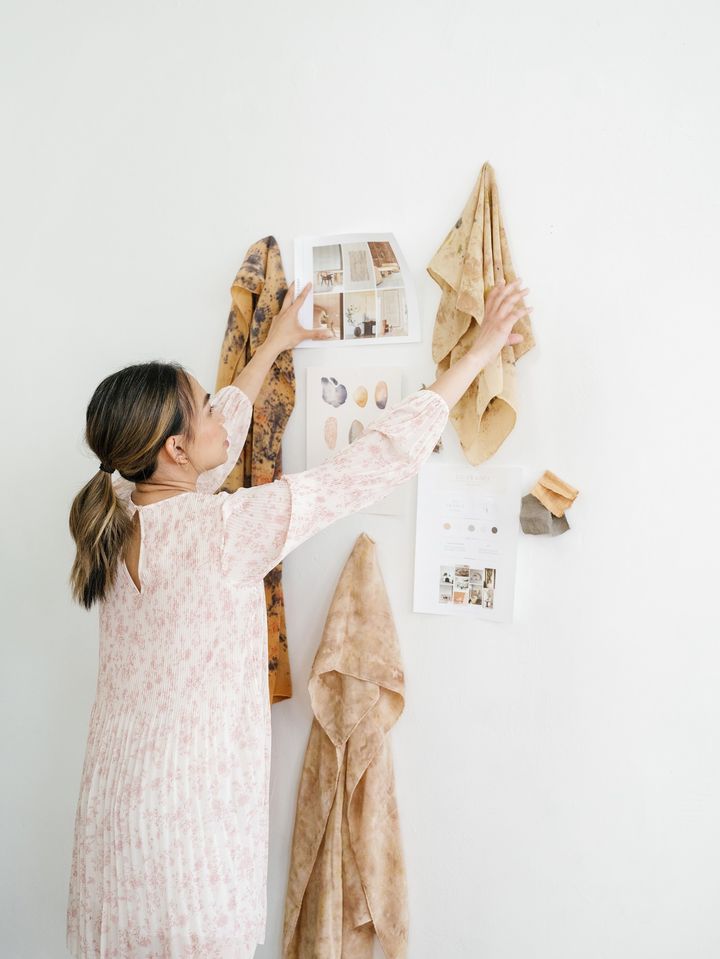
In the heart of San Diego, California is France Malvar. Her story is one of hope, passion, and self-discovery. After 14 years as an early childhood educator, France took a leap of faith and pivoted her career to become a natural dye artist and create Lu France Interiors, a home decor brand for intentional design. For the past two years, she’s been pouring her heart and soul into her work, crafting pieces that are as beautiful as they are sustainable.

France carefully chooses the businesses and artisans that her brand partners with. Her previous collections were made in collaboration with small businesses all over the world, mostly in the Philippines, to support the local weavers and artisans in her homeland.

I HOLD FOND MEMORIES GROWING UP IN THE PHILIPPINES

I’m pretty blessed to have had a childhood full of memorable experiences and surrounded by people who have in one way or another shaped me.

I grew up in my Papa’s ancestral house in the Philippines before my parents eventually built their own, which became our home, and I have nothing but good memories of both. Summers and Christmas breaks were spent with my cousins and we would spend weeks at our Lola’s house, or at our Tita and Tito’s home, or somewhere exploring a new place together.

As my parents got settled in their respective careers, we progressed to traveling more or going out — driving up to Tagaytay, spending Sundays at the park, exploring all sorts of shops and markets, or eating out. They also gave us the opportunity to explore different sorts of activities and I took a special interest in ballet, starting classes at the age of 3 and then continuing through the start of high school before moving to other forms of dance through college. A lot of my memories involve recitals and shows and having my family there to support me. 

I don’t know what defines a typical childhood. But I do know that I hold fond memories growing up in the Philippines. Even to this day, there are moments that I get so nostalgic for every time, and I am grateful for all of them.

TRANSITIONS CAN BE SCARY, PIVOTS AT LEAST TO ME ARE TERRIFYING

Much of my young adulthood has always been about pivots.

Growing up, a career in medicine is what I’ve always been exposed to. A lot of times I’d tag along with my sisters to our Papa’s clinic or I’d wait for Mama in hospital break rooms and offices. Whether those instances were by design or simply out of necessity, I always thought I’d just follow along and take a science course to eventually pursue a career in medicine in one form or another.

So I studied Sports Science in college. During an Adapted Physical Education class, I realized that I liked teaching children. It gave me so much joy seeing how even the smallest actions you make and the lessons you share, impact their days and eventually their lives. After graduation, I applied for teaching jobs with a focus on music and movement, and fitness for young children. I figured I could take my Sports Science degree, my love for dance and movement, and use it to pivot to a career teaching children.

My first job offer out of college was from a school in Singapore, but I chose to stay in the Philippines and worked for a year there before moving to the US. I eventually took a certificate in early childhood education and spent 14 years in that industry working both in the US and the Philippines. It was a career I loved (and honestly actually miss). While I continued to teach, I also kept dabbling in the different art forms I’ve taken a liking to. I took design workshops to relieve my stress – styling, floral arrangement, natural dyes, etc.

When the pandemic happened and schools shut down, I enrolled in Interior Design online and started honing my love for all things design, leaving a career I’ve known for 14 years and taking my love for natural dyes and design a step further by launching my business.

Transitions can be scary, pivots at least to me are terrifying. I’m the type of person who is constantly planning. I need to know where I will be, and what I will do at certain points in my life. When changes happen and I need to adjust, that throws me off and my anxiety kicks in. But I think for the most part it is exactly because I am a planner and because I willingly chose these pivots from Sports Science to early childhood to now, a natural dye artist and small business owner, there was more excitement than anxiety as I took every transition. 

LU FRANCE INTERIORS IS AN EXTENSION OF MYSELF

Much of who I am as a designer and artist are rooted deeply in my being Filipino and more specifically, my experiences and memories I have growing up in the Philippines. That’s true for the things that catch my eye whether it be handcrafted wood pieces, ceramics, or the spaces I gravitate to, I crave rooms and spaces that are “maaliwalas,” full of warmth with a lived-in look, calming, and organic.

The stories that shape my collections are all stories from home. The candle scents I have in collaboration with Terra, a Filipino-American brand, are inspired by my life growing up in the Philippines. Every single scent has a story, a distinct memory attached to it.

The stories that guide and serve as the foundation for my naturally dyed pieces are all inspired by memories from the Philippines too. Sometimes a moment from years ago inspires me or a Filipino word that resonates with me moves me to make a tangible piece of art. Or sometimes an event back in the Philippines moves me to create a whole collection of naturally dyed textiles. I previously dropped a whole collection inspired by the campaign of former Vice President Leni Robredo! What I can’t articulate, I translate in the form of my naturally dyed textiles, always hoping to share a piece of my being Filipino with others. 

My values also play an important role in the people I choose to work with. I have a collaboration collection with Anthill, a social enterprise based in Cebu, Philippines. My thrust for love of community, sustainability, amplifying the work of Filipino artisans, and sharing their stories are some of the values I found in Anthill too. 

And while I proudly work with non-Filipino makers too and curate pieces from artisans and businesses around the globe, the same design influences from my life in the Philippines and the same values guide me in choosing what to pick and who to work with no matter where they come from. I say this often, Lu France Interiors is an extension of myself. It’s me in brand form and while I do not constantly scream about my being Filipino, I think if you browse through my website or follow me on social media, you’ll see why I don’t have to — it’s just naturally, constantly, permanently, and beautifully a part of my identity. 

ALLOWING MYSELF TO ASK FOR HELP FROM OTHERS HELPED ME TO RIDE THE HICCUPS THAT USED TO KEEP ME UP AT NIGHT

As with any other small business, I think the financial uncertainty that comes with building and running a brand is the most challenging part of building a business. The design process comes easily to me (at least thankfully, for the most part, it does!).

My years of teaching children and dealing with difficult parents have also helped me in dealing with customers and suppliers. But navigating slow seasons, courier mishaps, and other unexpected issues that affect cash flow were challenges that really kept me up for nights at some point since I launched my brand. But I’m really lucky to have the constant support of family who all go above and beyond in helping me pursue and monetize this passion, the support of friends, and the support of a very loyal audience who all continue to spread the word about my brand. 

I also found comfort and strength in knowing that I am not the only small business owner who has had to deal with the hardships post-pandemic and I’ve learned much from my fellow makers, artists, and owners. I pivoted to pushing for more wholesale opportunities for my natural dye work so that they are stocked in more retail stores, I joined more pop-up markets to introduce my brand to audiences that social media doesn’t reach, and I adjusted in terms of collection batches and when and how I launch and restock pieces.

The brand is a continuous work in progress for sure as much as I am too as a person and I think changing my perspective on how I view these challenges and using them as learning curves and allowing myself to ask for help from others helped me to ride the hiccups that used to keep me up at night. It’s okay to ask for help and to admit when you need it! 

THE PHILIPPINES IS AND WILL ALWAYS BE MY HOME

That’s not to say that America isn’t because it is too and I’m super grateful for that. But I think wherever I go and whatever I do, the foundation on which my identity is anchored is firmly rooted in calling the Philippines my home. I feel like it has always been my comfort zone, most of my friends are there and I feel like I navigate everyday life more confidently over there.

I’m an introvert and I think that has been magnified so much more here in the US. But you know how situations force you to adjust and adapt? I think I’ve become much braver living here, I push myself to do things I wouldn’t have tried back in the Philippines. I know it sounds cliche but America has really opened doors for me in terms of providing an environment for me to explore and create opportunities for myself and for others. Moving here has been a journey of self-discovery and it still is. This adoptive country of mine has taught me that I am more than one thing and that it isn’t too late to try something else.

If you told me while living in the Philippines that I’d one day call myself a natural dye artist, own a home decor brand, have pop-ups at stores like Madewell, join markets and art exhibits at galleries, and connect with strangers turned customers turned friends through social media, I would have laughed and said you are crazy. Yet here I am surprising myself every single day, bravely going out of my comfort zone, opening myself up to people, and rediscovering a deep sense of love and immense gratitude for 2 countries that I proudly call home. 

CHANGING CAREERS SHOULDN’T BE TAKEN LIGHTLY

I’ll probably raise a few eyebrows in saying this but I don’t believe in the “Do what you love, love what you do” statement or advice. I think that doing a pivot and considering a major career change entails not only sacrifice but careful planning and much… so much patience.

Every situation is different, we all come from different paths and I recognize that it is a privilege to be able to pivot to a new career and explore a whole new industry without worrying about what to eat the next day or where to sleep. So I think before you make that leap you should thoroughly, carefully, consider your situation, your needs, and your goals. 

If you need to stick to doing something that you don’t love at the moment so that it gives you a little more cushion for the pivot you are planning then hang in there for a little bit longer and use your dream as your motivation. Changing careers, especially leaving a stable job with a stable, monthly income shouldn’t be taken lightly. But when you do, if you are able to, give it your all. Do it wholeheartedly, give it 110% of your time and effort, and stick to it. Stick to it long enough for as long as it makes you happy, for as long as the joy you get from it outweighs the sacrifices you make to make it work. And do not ever forget your WHY. Let your WHY guide you always.

CONNECT WITH FRANCE

Instagram: @lufranceinteriors

Website lufranceinteriors.com

Facebook @lufranceinteriors
Related Articles

Tammy Sun

Awaken* newsletter

This Founder Raised More Than $115 Million to Make Fertility Care Accessible

Fifty thousand dollars. That’s the average cost of in-vitro fertilization (IVF) treatment in the US. Although the number of employers covering fertility treatment has risen significantly over the past few years, the percentage of employers that provide fertility benefits is still around 40%. This has left many hopeful parents stranded, unable to afford the hefty price tags out-of-pocket.

The good news is that we have many talented people working on this issue. Tammy Sun is the CEO and co-founder of Carrot Fertility, a startup that has raised more than $115 million to help employers, health plans, and health systems provide comprehensive fertility care benefits to people globally. We sat down with Tammy to chat about her work with Carrot and reflections on her founder journey.

TLDR; Key Takeaways

If you only have a few minutes, here are a few golden nuggets from our conversation with Tammy:

  • Storytelling is a core component of innovation. Whether you’re pitching investors, engaging with potential hires, launching a new product, or closing new customers, it’s critical that you can clearly articulate and curate the value proposition to each of your stakeholders. Practicing this skill will naturally lead to new conversations about how your product/service could be improved. 
  • The best way to build something people want is to listen to your customers’ problems. When talking to potential customers, give them the breathing room to talk generally about problems they are facing. This can provide valuable insight into the meaningful problems that need solving.
  • Choose a problem you want to work on where you have a personal connection to the issue, especially in healthcare. If your startup succeeds, you will be working on the same problem for 10+ years. Choosing a problem that you will have a lifetime of curiosity about will keep you motivated.
  • In the early stages of fundraising, focus on discovering your early believers instead of convincing people to care. Your early backers should be people who are as visionary as you are about your problem. Don’t waste time convincing investors who can’t be convinced, move on quickly.
  • Different stages of company building can require different employees. It’s important to remember that very few people can support your company from day 1 to an exit because most don’t have that prior experience. As a founder, you want to assess if the team you have is able to help you reach your next few milestones and reassess the next key growth stage of your company.  
  • The CEO acts as a culture’s pacesetter. As simple as it may be, you need to reflect on the behavior and aura you would like to see within your company. Alignment around company culture starts with you. 

What made you decide that starting a company was the right answer to the lack of access to fertility care?

Before starting Carrot, I spent some time in government, policy, and political work. There’s definitely a huge opportunity through policy to make large-scale improvements and changes to healthcare and other areas that can impact millions of people, particularly around regulatory issues related to fertility care, pregnancy care, and menopause care. But, I think the private sector and companies have a unique sharpness that can impact people in direct ways that nonprofits, legislative efforts, or even judicial efforts can’t.

In this country, whether you like it or not, people get most of their healthcare through their jobs. Employers, health plans, and the partners within the healthcare ecosystem that work with them are very much the primary delivery and distribution mechanisms for healthcare. I really believe that lifelong fertility care–from preconception all the way through menopause, low testosterone, and midlife care–is a vital and fundamental part of human healthcare. In order to bring fertility care to the table as a first-class citizen within the healthcare stack of work, we committed ourselves to making it easy for employers of any size, anywhere in the US and around the world, to customize their products and deliver fertility benefits to their employees in a way that is easy and seamless, and really elevates the experience for those employees.

There’s a place for all different types of work and activity that can impact this space, including nonprofits and public sector work at the federal and state levels. For us, we felt that the private sector and the company vehicle specifically were going to be the most impactful for the change we wanted to see in the world.

What valuable skills did you learn during your time in the public sector that are transferable to what you’re doing now?

In both the public and private sectors, as well as the nonprofit sector, the ability to clearly articulate your ideas with strong and compelling stories is really important. Whether you are in the public sector arguing for a piece of legislation or a specific law, or you’re in the private sector raising capital, launching products, or even recruiting talent and hiring people, it really depends on how good you are at telling your story and articulating an idea about the future. That’s something I was really able to bring with me in that transition.

We know that you played around with a few other ideas including some D2C ideas before committing to your current idea. How did you land on your current business?

It’s a great question. I’m an avid consumer of B2C-type healthcare products. I wear all the wearables and things like that. But as I said, if you’re really talking about healthcare with a capital H, you have to figure out a way to integrate with plans, payers, and employers. We tried many different ideas in the first year and a half of the company. Some of them were direct-to-consumer. We tried to make it really easy for people to access loans and financing. Ultimately, we shut that part down because we didn’t really want to be in the business of financing as the single solution. Medical debt is the number one reason that Americans file for bankruptcy, and we didn’t want to contribute to that. It’s great for some people, but at scale, it’s not a worthwhile solution. We tried all sorts of direct-to-consumer things. I didn’t know anything about benefits, employers, or the many acronyms in the space like ERISA, HIPAA, HRA, or HSA. But what I knew in the early days was that when I started talking to potential customers, all they wanted to do was talk about their problems and what kind of product they would be interested in if we were to build it. The enthusiasm and desire for a product that would make it easy for HR leaders and benefit leaders to meet their needs within their employee population was striking from day one. As soon as we pursued that avenue, we never stopped.

Within the fertility care industry, what do you think founders and other innovators should be focusing on?

I feel like the right match between the founder and the problem is as important as the match between the product and the market. What you want to do if you’re a founder thinking about starting a company is to make sure you have an almost never-ending well of curiosity about the problem you’re trying to solve. You don’t really need to have a clear solution in the early days, but you must have unending curiosity and empathy, particularly in healthcare. You need to understand who is impacted by the problem, who is hurt by it, and who feels pain as a result. Spend a lot of time understanding what that looks like even before you think about trying different MVPs and ways to solve it. If you have a personal connection to the issue, especially in healthcare, it contributes to a lifelong curiosity about how people experience the problem you’re trying to solve. This continuous curiosity allows you to keep innovating even two, three, five, or ten years later, building products and services that add value to people’s lives.

Given that fertility care has only recently seen an influx of venture capital, what do you think are potential exit options for fertility companies?

There are lots of ways along the journey to create liquidity for investors, shareholders, early employees, etc. As the category matures, those opportunities will increase, and we’ll see a lot more diverse outcomes across the category. That’s a good thing; it’s a sign of progress and market maturity. I’m excited about that because I think it’s coming. For early-stage founders, it’s less important to spend time mapping corporate strategy and how you are going to get to an exit. Instead, be maniacal about serving customers and the rest will generally sort itself out. But to your point, this category has been ignored for a long time, so it’s exciting to see how this area of healthcare is getting attention and being prioritized as an area of opportunity for investment.

When you were choosing an idea, was the total addressable market something that you thought about? 

Certainly, in the earlier days, it’s almost a conversation that doesn’t really need to be had. Generally, you want to try to solve a very specific thing really well out of the gate and then use that as a wedge and leverage to expand from there. But I did spend a lot of time evangelizing and educating different people, particularly investors, to address questions about how big the TAM would be. I had to explain why egg freezing was not a niche problem and all the things that, in retrospect, I’m sure you could appreciate as well. It’s very clear now and it’s part of the mainstream conventional wisdom that this is a very large area of healthcare. It affects almost every human being—people who are pregnant, and people who are not pregnant. We were the first to launch a menopause product into the employer market a few years ago, and we really think about that as both reproductive and post-reproductive fertility care. If we were to talk about menopause care five years ago, the category hadn’t matured enough where people would even take that seriously. 

If you’re new to fundraising, it’s a little bit jarring in the early days to get so many rejections, particularly if you’re generally a high-achieving person. I wouldn’t think about fundraising as convincing. I would think about it more as discovering, especially in the early days. It’s less about trying to convince a lot of people about your TAM and more about moving on quickly from people who you sense can’t be convinced and finding people who are as visionary and evangelical about your problem set as you are. 

How did you think about making your first few hires? Why did you hire them, and what lessons did you learn from those first few hires?

The first few hires generally are partially a function of who’s around you. What’s your current community like, whether it’s college or whether you’re in New York or Silicon Valley? What is your immediate vicinity, and who’s in your personal network? An important thing about your first few hires is understanding how to discern when the first few hires have hit their ceiling. You’ll have your first few hires, and then you’ll have your first few fires. The latter is probably as important as the former. 

Very few people can scale a company from zero to 100 million and be able to excel for that entire journey. More people will be particularly excellent at a particular stage of the company, whether it’s zero to a million, a million to 10, or 10 to 30. As a founder, you want to be able to hire and understand what the business needs, not just in this moment, but in the next few moments that are coming. And then, regardless of your personal relationships, you have to be able to shake your team up if needed and build it for the next phase. Sometimes that means you stick with some folks from your founding team. Sometimes that means you separate, and that’s okay. They’ll always be part of the story, but hiring and firing is probably one of the most challenging aspects of early-stage company building.

How did you think about culture-building? 

The thing that was most important for me was that the people in the early team were as obsessed as I was with customers, users, the product, and the problem. We knew very early on that the product would change and it would change very quickly. You want to be surrounded by people who are just as curious as you are about all the things that really matter. I was very lucky that I had a lot of people around me in those early days where our curiosity matched each other. Our level of intensity and our level of passion were all well-calibrated with each other.

Where you find problems, especially in early-stage company culture, is if that calibration is off and some people are running at different speeds. You want your initial team to be extremely aligned, running at the same speed. Everyone should be equally passionate, curious, and taking advantage of the fact that you are early and minimal; so information, knowledge, and insights can travel very fast within the team. As a CEO, you are generally the pacesetter when it comes to progress and culture. I would encourage early-stage founders to think of themselves as pacesetters and examples so that others can see what kind of behavior comprises the culture of a company.

How has your identity as an Asian impacted your founder journey?

The area where it has impacted me is representation, meaning I didn’t have that many Asian role models coming up. That absence has really emphasized the need for empathy, not just for other founders, but also for users and members. For example, considering where our users come from. Where do they feel like there are no role models? Where do they feel like there is no precedent? Where do they feel like it’s lonely? I think my own experience has enlarged and augmented my sense of empathy in all directions with other founders, but also within my customer base and my membership base as well.

Can you share more about the policy-related work Carrot has been doing or that you’ve personally been doing in Alabama to expand and protect access to IVF and other fertility benefits?

What happened in Alabama was bad. We anticipated it and moved very quickly to make sure that our members who were impacted in Alabama were supported. While the change didn’t affect a huge number of members, it was significant from a cultural and media perspective. We made sure that members were communicated with, that customers who were impacted felt supported, and that we were able to answer lots of questions from our partners within our ecosystem.

A silver lining of the Alabama situation is that a strong bipartisan consensus emerged in favor of access to IVF. You saw Democrats, Republicans, and independents all speak up in favor of IVF and fertility care as a fundamental part of healthcare. This is medical care. I saw almost no voices trying to restrict access to it from a political or policy perspective. That is a significant silver lining and an area where we’ve tried to center ourselves and expand the consensus in favor of support. We believe that anything that prohibits or decelerates access to care is bad, and the Alabama event was certainly in that category.

Lastly, is there anything that you’d like to shout out or promote?

My friend April Koh. She’s the founder and CEO of Spring Health, which is a mental health company. She and I have known each other for a long time. She’s done such a phenomenal job in the mental health space with Spring, so I’d like to shout out April.

MIKO Eyewear

Stories

A Mom’s Struggle Led to MIKO Eyewear: Finally Glasses for Low-Bridge Kids

Have you ever struggled to find glasses that fit just right? If you have a low-bridge nose, this challenge might be all too familiar.

For many people, especially in the Asian community, finding eyewear that stays comfortably in place without constant adjustment is a common struggle.

Megan Miyamoto, founder of MIKO Eyewear, knows this experience all too well, and it’s what inspired her to create a brand that finally addresses this issue head-on.

The Inspiration Behind MIKO

Growing up, Megan often faced difficulties in finding glasses that fit well. She felt frustrated by the lack of options that accommodated her facial features.

“I was often told to ‘just shop the rack,’ which left me feeling like I needed to fit in or that there was something wrong with my facial features,” Megan shared with AHN.

When she became a mother, she was determined to give the best for her daughter, including the right eyewear. She didn’t want her daughter to go through the same difficulties that she did.

Through her research, Megan discovered that up to 80% of lifetime UV exposure occurs before the age of 18, leading to serious eye health concerns like cataracts and eyelid cancer. Yet, when she went searching for suitable eyewear for her daughter, she found the options disappointingly limited, especially for children with low bridges.

After trying countless samples, including private label options that didn’t meet her standards, Megan decided to give it a go and design a product using high-quality materials that she could feel good about. And that’s how MIKO was born.

Overcoming Challenges with Community Support

One of the toughest challenges that Megan faced as an entrepreneur is the sense of isolation that can come with building something from the ground up. 

“There were moments when doubt would creep in, and it was easy to feel overwhelmed by the sheer amount of work and decisions needing to be made,” she said.

Megan found strength in the community that rallied around her. She pushed herself out of her comfort zone, connecting with mentors, fellow entrepreneurs, and communities like Authentic Asian.

“If you took the time to connect with me, spread the word about MIKO, or made a purchase, sincerely thank you for being a part of our MIKO journey.”

The Creative Process

Seeing her idea turn into a tangible product that her daughter and neighborhood kids genuinely love is one of the milestones that Megan is most proud of. What started as a quest to fill a gap in the market for low-bridge kids’ eyewear has evolved into a brand that brings confidence and joy to its young wearers.

The design process was particularly special for Megan, as it was a collaborative effort involving her daughter and the neighborhood kids, and turning her kitchen island into a mini design studio.

During these sessions, Megan paid close attention to the kids’ feedback, particularly when it came to the fit of the glasses. They tried on various prototypes, providing insights into what felt comfortable and what didn’t. They also got to select the colors for the frames, giving a fresh perspective and opening Megan’s eyes to combinations she probably wouldn’t have considered on her own.

Seeing the kids’ faces light up when they tried on glasses that fit perfectly was incredibly rewarding for Megan. Their creative process reinforced the idea that MIKO isn’t just eyewear made for kids—it’s made with them.

MIKO’s Mission and Vision

MIKO Eyewear is dedicated to empowering the next generation by providing inclusive, stylish, and functional eyewear specifically designed for children with low bridges.

Megan’s vision is to redefine what it means to wear glasses, turning them from a mere necessity into a source of pride and confidence for kids. By addressing the unique needs of low-bridge children, MIKO not only fills a gap in the market but also celebrates the diversity of facial features, empowering the Asian community and beyond.

Connect with MIKO

Instagram: @miko_eyewear

Website: mikoeyewear.com

Get a complimentary eyeglass strap with your MIKO Eyewear sunglasses purchase! It will be automatically added to your cart. Available for the first 100 customers only!

Kun Gao

Awaken* newsletter

From Founder to Founder with Kun Gao, Former CEO and Co-founder of Crunchyroll: 7 Hidden Ways for Startups to Succeed 

This article was co-written by Edwin Ong from the AHN Ventures team and Lennie Zhu, who is the Founder of 01 Labs, a product studio that builds products with early-stage software companies serving creators (media, entertainment, social), small businesses and independents. She has worked with startups such as HIFI (acquired by Block), F*** You Pay Me, and more. One of AHN Ventures’ portfolio founders, Amartya Jha, was the lead interviewer. Amartya is the Co-founder & CEO of CodeAnt AI, a DevTool that helps companies find and auto-fix code issues and security vulnerabilities used by small teams all the way to large unicorns.

In this edition, we had the honor of hosting an exclusive advisory session between Kun Gao, co-founder and former CEO of Crunchyroll, and Amartya Jha of Codeant AI. For those who don’t know, Crunchyroll is the leading anime streaming service with over 13 million subscribers as of 2024, and was last valued at $1.5 billion when it was sold to Sony in 2020. Nowadays, Kun works on two new companies that he co-founded: GGWP, an AI-powered game moderation platform; and Forge, which rewards gamers within and out-of-game prizes for the data they generate through gaming.

We are excited to share 7 hidden lessons for founders from our conversation with Kun.

1. The consumer products that succeed are the ones that go viral – and that can be hard to predict

One of Kun’s early insights was that consumer apps with baked-in virality tend to be the ones that work out. Examples of built-in viral features are share buttons, “invite a friend/collaborator features,” or content that can be easily reposted. 

However, consumer behavior can be notoriously difficult to predict. Unless you have superior product sense like Steve Jobs, your best bet is to take your best guess, then ship quickly and avoid getting caught up in minute details. If your product truly has value, people will use it even if it isn’t polished. Need proof? Check out the screenshot below of what Crunchyroll looked like in 2006. 

Kun: “One of the lessons I learned from that experience is that you really don’t know what the consumer mindset is. You can have a guess, but with pure consumer experiences, it’s better to just try something, throw it against the wall, and see if it sticks. Then, you can collect the data, iterate, and see what works and what doesn’t.

We developed the first version of Crunchyroll in about a month. We put it out there and shared it with our friends. They started using it, and pretty soon we had hundreds, then thousands of users. At the end of the day, it’s about making something really engaging that can capture an audience and get them to virally spread it. Those kinds of consumer products just inherently grow. So my advice would be to think about how to build products that inherently have virality built in.”

2. Build something that solves your own problems

The advantage of building something for yourself is that you will have at least one user out of the gate, and likely a few others since you likely have some friends with similar issues. Furthermore, you’ll be able to understand the customers’ needs because *you* are the customer. For Crunchyroll, this allowed them to cut out hiring product people and only hire engineers at the start

Kun: “With Crunchyroll, we were trying to solve a problem that we personally had. Every Thursday, Naruto would come out on TV in Japan, and it would be only accessible in the US on unreliable torrent websites. We just wanted a place where we could watch Naruto at 6 p.m. every Thursday after work. 

We knew we could get at least a starting set of users because we had that problem, and we were our own consumers…. We also knew we could get all of our friends to use it because we knew they were experiencing the same problem. And so we built Crunchyroll.”

3. Experiment relentlessly until you perfect your conversion funnel

What is often talked about when monetization is on the agenda is “What monetization model makes sense for my company?” Subscriptions, one-time purchases, ad revenue, freemium…the list goes on. But what gets less airtime yet is arguably even more important is how to optimize your conversion funnel. While there is no glory in experimenting with things like button placement, CTA copy, and 1 vs. 3-step payment flows, those kinds of nitty-gritty decisions are exactly what separate “businesses with potential” from the real moneymakers. 

Kun: “Before [we started offering paid subscriptions], we already had a decent amount of users, around a few million. When we flipped the switch to premium content, around 10,000 people converted to paid, which is really low. We thought we would get 50,000, but we only got 10,000 people to convert to paid. The rest stayed on as free users. So then we had to figure out why more people weren’t converting.

We ran some tests on alternative business models. We tested charging per episode, and even some rental models. Those tests didn’t perform that well, so we decided to double down and optimize our subscription model. 

To tackle [conversion], we basically annotated everything on the site and figured out what users were clicking, what they were looking at, and which buttons converted better. Should we start with a free trial? If it’s a free trial, should it be seven days or four? The size of the icons—we basically tested everything, especially in the first year… Over time, we were able to convert the majority of the audience to become paid subscribers.”

4. Ride societal waves in culture and technology

It’s important for every company to have an answer to the question “Why now?” What was not true before, that is now true and enables the product to succeed? This could be something technological or societal. In the case of Crunchyroll, Twitch, and YouTube, the explosion of video streaming was a major driver for those platforms to reach the dizzying levels of success they have today. 

Kun: “Part of what separated us was that we were in the right place at the right time. If you look at all the successful video platforms today—YouTube, Twitch, Crunchyroll—they all started at basically the same time, around the 2004 to 2006 period. You kind of needed to start during that time to be successful. 

Within that time frame, there were also a lot of competitors we were competing with. Platforms like Stage Six, Veoh, and Joost were trying to go after the same space and opportunity. Speed was really important because there was a land grab for distribution at that time. When I say distribution, I mean the proliferation of consumer devices besides the PC from 2006 to 2007, all the way until the early 2010s. Because of our speed, we were able to build these platforms before everyone else and ride that wave of device growth. We were one of the first launch partners on PlayStation alongside Netflix. Being able to build on new platforms with a product engineering focus first allowed us to outgrow and out-distribute others in the space.”

5. The best companies expand their markets or create new ones

Today, Crunchyroll has over 13 million subscribers. There were a lot of external factors that drove the massive growth in the popularity of anime, including the pandemic, but Crunchyroll itself played a major part in making anime more mainstream because it made it accessible to Western audiences. 

Kun: “The thing that surprised me most was that our TAM (Total Addressable Market) ended up being much bigger than we expected. I would project that we would maybe hit 200,000 subscribers. That’s it. Then when we actually reached 200,000 subscribers, we thought maybe we’d get to a million. And then when we got to a million, we thought maybe we’d get to 3 million. The growth itself has really surprised even us. Today, it’s the largest pure vertical play among all the content verticals out there. Initially, because we didn’t expect our TAM to be so big, our approach was to super-serve our audience and do way more than just streaming, which we eventually did, but it just continued to grow even beyond our expectations.”

6. Get creative about how to finance your startup

Many founders’ minds jump immediately to venture funding when they consider how to support their companies. But raising venture money can be a long and difficult path, and it’s not always the right choice for every startup. Timing is everything, and bringing in outside capital before establishing product-market fit can be a mistake, driving founders to pivot into oblivion. Kun gave us a look behind the curtain at how Crunchyroll funded itself before venture money, which included user donations, partner investments, and- yes, credit cards. While taking on significant credit card debt may not be recommended, staying open-minded about where your financing could come from is.

Kun: [Before we were profitable, we financed Crunchyroll with] venture money, and maxed out our credit cards before that. For a period of time, we also accepted donations. Before we raised VC funding, we had pretty hefty bandwidth bills because video streaming was very expensive. At some point, we realized that we couldn’t sustain the site. At the same time, we couldn’t directly charge users because we didn’t own the content. That was the motivation behind accepting donations. To give the users some incentive to donate, we built a very sticky social product where users could create an account, participate in forums, and chat with other anime fans. Anyone who donated would get a star next to their name so people would know that the person donated. It was an appeal to social status and social proof. That was enough to offset some of the bandwidth bills in the early days before we had venture funding.

I [also went to one of] our biggest content partners, the folks who license the content to us, and asked if they wanted to own a piece of the business. It made a lot of sense because if they invested, they would also have a vested interest in the platform and could capture more of the value that their shows were generating. It was a win-win. We took in about a million dollars, which was enough to bridge us to the break-even point.

7. As an Asian founder, take advantage of your inherent cultural strengths

Asian founders starting businesses in Western countries should not underestimate their ability to globalize their businesses by capitalizing on Asian markets, which they may be much better positioned to do than their non-Asian counterparts. Fundamental cultural context that you may not even acknowledge your grasp can help you succeed overseas.

Kun: “With Crunchyroll, we obviously worked a lot with Japan. I think that because I’m Asian, they trusted me more. At the end of the day, it was also about understanding and appreciating their value system, which is very different from the US. In the US, it’s really about the value proposition. In Asia, it’s much more about relationships and trust, so we really leaned into that. Maybe part of that was influenced by our upbringing. You can’t just show up and expect deals immediately. You need to be around, be persistent, and show them that you’re committed. But that might be a bit of a unique situation for us.”

Conclusion

Thank you to Kun Gao for the interview! If you are a gaming company looking for moderation tools, please consider checking out GGWP, and if you are a gamer wondering why you aren’t being rewarded for the mountains of data you are generating, please check out Forge!

Written by Edwin Ong and Lennie Zhu

unnamed-jpg

Stories

John D. Tran Overcomes Industry Barriers to Empower Startups 

Navigating the world of law and order as an Asian American can be convoluted. However, as John D. Tran Talks about working with start-ups like AHN, overcoming industry barriers, and the power of mentorship.

A fun fact that encapsulates John’s impact is that he was the trademark attorney who helped protect and register the ASIAN HUSTLE NETWORK name back in 2019—a contribution that underscores his dedication to empowering the Asian American community.

As a Partner at the Rhema Law Group®, John has spent over 20 years working as a Registered Patent Attorney, Intellectual Property Counsel & IP litigator, driven by a mission to aid startups & emerging companies navigating the complex business world. 

Finding Balance & Purpose in the Madness

In 2012, with the arrival of their boy-girl twins, John and his wife Rosalind Ong switched gears. Both seasoned lawyers at larger firms, the duo seized this joyful moment and joined forces to partner at a private law firm, Rhema Law Group, which specializes in intellectual property, business, and corporate law. While people may think being a lawyer trades much of one’s freedom for endless tedious readings into acts and regulations, John finds a nice work/life balance being a “cool” dad to twins (double the coolness), playing basketball, and being an avid sports fan, but finds ultimate enjoyment in spending time with friends and family.  

Protecting the Interests of Start-Ups & Emerging Businesses

Working as a lawyer for startups can be tough, considering how new and fragile they are in the market. While his work requires a focus on quality, integrity, and community, John treats startups with extreme care and attention, prioritizing personalization and case-by-case flexibility for each of his clients. He understands that these new businesses often operate on tight budgets, but also wants his clients to recognize the importance of investing in intellectual property protection right from the start. 

This is not just about legal protection—it’s an act of partnership, building relationships with the clients, getting to know who they are, and helping them grow. John said in an interview with AHN:

“With start-ups, even those backed by investors or venture capitalists, you’re usually dealing with a limited budget that needs to be responsibly allocated across various areas, such as R&D, marketing, sales, employment, and more. A good IP attorney will understand these constraints and focus on identifying the core IP of the start-up that needs to be protected from the outset while determining which IP can be addressed later.

Also, we find it important to conduct IP ‘think tank’ sessions, where we work closely with our clients to identify what protectable IP the company has and then develop an overall IP portfolio strategy. From trademarks, patents, copyrights and even trade secrets, approaching a business’s IP ensures that the start-up’s IP is properly protected at every stage of its growth. It’s incredibly rewarding to work with start-ups and emerging companies, watching them grow and mature over the years, and being a small part of their journey to success.”

John finds pride in working with primarily Vietnamese, Asian and minority-run companies.  His client list ranges from the small entrepreneur with an idea to multi-million dollar manufacturers with hundreds of employees working overseas. 

Building Leaders and Communities

His legal acumen has been shaped by mentorship, as he profoundly affirms his gratitude and advocacy for what mentorship has given him, “I think mentorship is so important, and I wouldn’t be where I am today without being fortunate enough to be mentored by some great people in my life, both professionally and personally.”

Above all, mentorship is not just a veteran-novice work of professional guidance, but, to John, it is a way of personal growth for everyone involved. This mindset coheres with his work ethic, where he hones his expertise (as startups can be quite a hard case to crack, your honor) while supporting their growth. 

“Mentoring builds up individuals, individuals build up communities, and communities raise families, support businesses, and can become the social networks that bring people together. For me, personally, mentorship has been a valued and rewarding part of my life. My wife and I have been fortunate to mentor several individuals for over 15 years, many of whom we met while volunteering at a leadership camp for foster care and at-risk teens.”

For John, mentorship is about time, consistency, and authenticity—qualities he embodies both professionally and personally.

“One particular mentee has become a little brother to me. We have mentored Salesi since he was 12, and then he served in the Army after high school and later worked at our law firm as a paralegal. Now, we’re proud to say that he has just been accepted to law school on scholarship! He was the first in his family to graduate from college and is now on his way to becoming a lawyer. Watching him grow and being there with him through the years has been such a rewarding experience, and it truly highlights the power of mentorship.”

A photo of John D. Tran (L) with his mentee who served in the Army and has just been accepted to law school on scholarship.

Navigating the Legal Landscape as an Asian American

Now, let’s get to the part where most Asian parents will be intrigued to see—being an Asian American attorney. There’s nothing that excites them more than when their kids come home and say “I want to be an attorney.” Respect, stability, and profitability—needless to say more. However, as an Asian American attorney in a predominantly white male-dominated industry, John has faced a sense of isolation and underrepresentation within the industry, forging the urge to always have to outperform himself. 

“I remember the first time I appeared in court on a case—the judge looked at me, smiled, and asked if I was still in law school because I looked so young (haha). It’s that Asian curse! But thinking back now, although there have been great strides made in recent times, the legal industry is still greatly underrepresented when it comes to Asian American attorneys. In my field of intellectual property law, I primarily practice before the federal courts, which are still largely dominated by older white males. That’s just the way it is, and as an Asian American attorney, you can sometimes feel like you’re the only one and feel pressure to prove that you belong in such a competitive space.”

John has overcome them by focusing on his craft and building a reputation for doing great work. John’s advice to aspiring legal professionals all comes down to self-awareness and passion, emphasizing the importance of choosing a practice area that aligns with one’s strengths and personality, as well as the value of giving back through mentorship and community service.

“Matching your personality and skill set to a particular area of law is often overlooked. For example, if you’re an extrovert who likes to be ‘in the action’ of things, becoming a transactional attorney who drafts contracts and agreements at your desk all day may not be the best fit for you. Conversely, if you’re more of an introvert, choosing to become a litigator where you’re in court frequently and presenting oral arguments to a judge or jury may not be a good fit either… Additionally, I think serving on some non-profit organizations and local organizations are things that help provide joy & fulfillment, including what we talked about earlier regarding the power of mentorship.”

Connect With John D. Tran / Rhema Law Group®

“One thing I love about the law is that, for the most part, it is impartial.  So, if you’re a good attorney doing great work, it doesn’t matter if you’re white, black, brown, or blue,, there’s no limits to what you can achieve and accomplish.”

X: @patentjt

Website: www.rhemalaw.com 

Contact:  jdt@rhemalaw.com | 949-852-4430