Awaken* newsletter

June 20, 2024

SHARE:

This edition was a collaboration with The Early Newsletter by Michaela Gordon. You can read her thoughts on our conversation with Patrick here. Thank you Michaela for collaborating and please go check out her article!

The startup ecosystem has gone through a lot of changes over the years. From the dot com era to the modern era of AI, Patrick Lee has seen it all. A stalwart of the startup ecosystem, Patrick has started seven different companies over the last 30 years, including everybody’s favorite movie review website: Rotten Tomatoes. Michaela and I had the chance to sit down with Patrick to talk about Rotten Tomatoes, advice for founders, and Patrick’s reflections on being Asian.

How did Rotten Tomatoes get started?

Rotten Tomatoes had three co-founders. I was the CEO. There’s Senh Duong, who was the creator of Rotten Tomatoes, and he was basically our chief product officer, and Stephen Wang, who was our CTO. I knew them all from my freshman year of college. Senh was down the hall from me in the dorms. 

Prior to Rotten Tomatoes, Stephen and I had founded a web design firm. We were doing a lot of work for the entertainment industry, a lot of work for Disney Channel, stuff for Warner Bros., Artisan Entertainment, MTV, VH1, and ABC. We even made the online flash game for Who Wants to Be a Millionaire. 

During that time, Senh was our creative director, and he came up with the idea on the side. He was a huge movie buff. He came up with it and launched it on his own. It was written in static HTML because he wasn’t able to code at the time. And we hosted it for him. After about a year of hosting, we were like, “maybe this should be the business?” So we actually merged our company with his company and became co-founders of both companies and had equity in both. I went out and raised a million in funding, then transitioned our design firm off to another group to take over. We kept an equity stake in that design firm, but then we basically passed our clients to another group to take over. They took over the name and everything so that we could focus on Rotten Tomatoes fully. 

What was your experience raising money like?

Rotten Tomatoes was my third company. In my first company, we put in our own savings. For the second company – the design firm – we took loans from our families. $10,000 from my mom and $20,000 from Stephen’s uncle. Once we started getting clients, we paid back the loan with interest. 

For Rotten Tomatoes, one of our clients raised some venture money, so they put us in touch with their VC who said they would lead the round. They put in half a million. The rest we actually raised from our old design firm clients. A number of them were tech companies and had successful exits. So they were totally open to investing, and they knew what we could do because they were our clients.

Why did you decide to raise venture capital for Rotten Tomatoes?

This was in late 1999, right before the dot-com crash, so there was a lot of money going around and a lot of investment into the internet. It’s kind of like what Web3 was like a few years ago or what AI is like now. Multiple companies we worked with had raised a lot of money and had successful exits. We were basically building for all these companies and realized that we were on the wrong side of the business. We decided to try to build something that was our own instead of being a services company. That’s why we went and approached the VC that we had contact with. It was a small VC out of Taiwan. I remember we had a couple of different ideas. The first one was Rotten Tomatoes, which already had traction. The other one we thought was interesting was making a portal for Asians and Asian Americans. We were doing the official Jet Li site. We were working with Yolk magazine at the time. I remember having a meeting with Jet Li and he was getting excited about that idea. He was saying he could bring on Jackie Chan. At that time, there were a couple of other Asian magazines that were within our reach. It was a very small community back then. Our thought was, what if we got the different magazines, the different Asian sites, some of the big Asian and Asian American celebrities, and brought them all together? I remember when we pitched these two ideas to our VC, they told us to do Rotten Tomatoes because movies were mainstream. At the time, only 3% of the population in the US was Asian. Even among Asians, there are many different types and they might identify separately as Chinese, Japanese, Korean, Filipino, etc. The investor felt it would be very difficult to have content that appeals to all of them. They recommended we do Rotten Tomatoes, which, looking back, was definitely the correct decision. The other idea would have probably been about 20 years too early. 
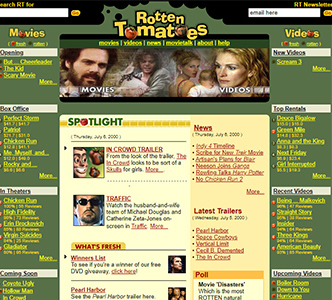
The first Rotten Tomatoes front page, published in 1998.

Rotten Tomatoes was launched in just two weeks. How did you navigate the tension between creating the perfect product versus getting it out as soon as possible?

Rotten Tomatoes was our creative director Senh Duong’s idea. He was a huge Jackie Chan fan. He wanted to know what everyone was saying about Rush Hour when the movie was coming out, so Senh went to the library and gathered reviews from magazines and newspapers–back then, very little was online. He decided that if he was putting all this work together, he might as well share it with other people. So he went home, built a page for Rush Hour and the other mainstream movies coming out that week, and put all the information up there. Because the scope was limited, he was able to go from idea to launch in about two weeks. He was gathering twenty to fifty reviews per movie for three or four movies. It was a lot of work, but doable by one person. 

It turns out that just having the new releases was still very useful because people were most interested in the movies coming out that week. He didn’t need to have tens of thousands of scores for the long tail of movies. He just focused on the head, the tippy top of the head. It was immediately useful, and instantly started getting traffic and attention. Then he just kept it up. He would work on the next week and the next week and the next week. It wasn’t until a year in that we said; “hey, maybe we should turn this into a business.” 

My advice for anyone is to launch quickly and test quickly. A lot of people, and I’ve made this mistake multiple times, spend six months to a year or two trying to make this perfect thing. They end up spending a lot of their own money or burning half or more of the funding that they raised trying to build this thing. The issue is you don’t know what perfect is until you actually get it out there.

You’ll see over and over, especially in consumers, folks put something out as a test and then it blows up. Twitter was a weekend project and then they just blew up. Twitch was Justin.tv in the beginning. They just messed around and put something out there. You just have to get the basic thing out there to see if people want it. Sometimes you don’t even have to build anything, you can literally just interview people or just do a mockup, and make a walkthrough of what the product would look like. It could literally be a napkin scribble and you can immediately start getting feedback. That feedback can actually give you a lot more information than putting something “perfect” out there. Go back to almost any consumer site or app and try to look up what version one looks like. Go look at the first versions of Facebook, eBay, Amazon, or whatever. They were ugly. But they solved something. That’s why they kept growing and taking off. I’m always recommending that. 

The other thing I say to people a lot of times is to really focus. It’s generally a single thing that people care about. For Rotten Tomatoes, it’s the TomatoMeter. We could get rid of the cast, crew, filmography, photos, movie showtimes, and almost everything else on the site. But really, as long as you have a score, that’s the critical thing that you need. 

If you think about fast food chains, every fast food chain specializes in a single type of food. The restaurants that offer multiple types of food are generally all mom-and-pop shops. The really big chains do one type of food. Every single one of them. When you look at social media, every social media platform started off with one unique singular feature. Like TikTok, Snapchat, Clubhouse, Twitter, YouTube, Instagram, and Substack, they all started as one thing. And again, as they got big, they started looking more like each other because they added more features. But they all started out as one thing. You find one thing that people actually care about. And you try to put that one thing out as fast as possible to see if they really care. 

How do you know when to give up on an idea?

Testing doesn’t have to be serial. You can actually do some stuff in parallel. As an analogy: if you have a kitchen, you can test a few different types of food concurrently. You could even do a survey before you start cooking to narrow down your options. Then, you can try each of them out and go forward with the best-performing one. It doesn’t have to be: Let’s try chicken, now let’s try hamburgers, now let’s try pizza. You can try all of them at once. 

In terms of knowing if an idea will work–you’ll know it when you see it. Rotten Tomatoes got the press instantly. It was getting noticed. USA Today was writing about it and Netscape was highlighting it at Yahoo. The day Pixar released A Bug’s Life, right around the time we released Rotten Tomatoes, we saw spiking traffic coming from Pixar. 

When you look at Asian Hustle Network, they just put something out there and it went crazy. Facebook and Twitter had the same thing. Especially with consumer products, when it works, it works. You’ll know when it doesn’t work because it’s crickets. You’ll be trying to tell everyone to go on, you’ll be telling your friends and family, and some of them will go on once and never come back. That’s normal. That’s actually what happens almost every time. 

Take an average YouTube video. You’d have a hard time getting even 100 views on it. Then every once in a while, for whatever reason, someone puts up a video and it gets millions of views and everyone’s sharing it like crazy. You kind of know it when you see it. If you’re begging everyone you can get, you’re trying to market in every way, you’re even buying ads and you’re having trouble getting a hundred views or a thousand views, you’re probably done. If it’s an app or a website, it’s probably not the right one. The way you know if you have product-market fit is if people tell other people about it without being asked to or incentivized to. Think about TV shows like The Queen’s Gambit a couple of years ago or Squid Game. People were sharing it with each other unprompted. They would just tell other people about it and it’s essentially free marketing.

Is it necessary to have startup experience or experience working for another company to execute and test ideas well? Or do you think the best experience to start a company is just to go and start it?

I would say that there is an optimal founder. That founder would be very bootstrappy. They would be able to launch things very quickly, iterate quickly, and without many resources. Also, they would have what I call irrational confidence. They just believe in themselves and what they’re trying to do with this insanely crazy confidence, and often based on nothing. 

“When we did Rotten Tomatoes, we didn’t know anything about movies. The Airbnb people weren’t hotel people. The Uber people were not taxi people. Industry disruption often comes from outsiders because disruption requires something out of the box and those people were never in the box to begin with. It’s rare that the disruption happens from within.”

I often speak to students and recent graduates. Some of them will come up and say, “Hey, I was thinking about doing a startup, but I wanted to go work in corporate or management consulting for a couple of years, get experience, and then start it.” There’s a 99% chance you’ll never leave once you’re in and you’re used to a salary, getting raises, promotions, and all that stuff. It’s going to get harder and harder to quit, especially if you get to a point where you’re in your early 30s, married, with kids and a mortgage. The chance of you risking all of that is pretty much zero.

These people, when they come up to me, they’re saying, “Look, I’m too scared. I’m too conservative to actually go out and do it.” The best ones just do it. Yahoo, and Google, they were grad students at Stanford and just left. Zuckerberg was an undergrad at Harvard. Steve Wozniak and Steve Jobs just left and did it. Most of them don’t even finish school because they’re not scared of leaving early. They have so much belief that they just have to do it. This has happened so many times.

In some ways, dropping out was a good sign. It’s not that they dropped out to bum at home playing video games, they believed in themselves so much they didn’t have that fear of failure. I absolutely think that founding a startup is not for everyone. I don’t recommend it if you’re someone who’s very conservative, and very scared. Go get a normal job, and do the safe thing. But there are people who just have to do it. Even if you have the confidence, you still have to have the ability to iterate, to bootstrap, to do those things properly. 

When you see that mix, it almost doesn’t matter what the idea is, assuming that they want to do something big. When you see that mix, that’s the right person. It doesn’t matter what their idea is, they’ll figure out something that’s going to work. 

They are sharp and bold – it doesn’t surprise me at all when they make it later on. Look at any of these great athletes or entertainers, and when they were young, they probably had that spark. There is an element of luck, but a lot of it is who they are as a person. The biggest thing when looking at young founders is their irrational confidence. This is true for athletes, entertainers, or anyone who takes that risk. Go back to the beginning and look at them, they have that spark. 

You’ve been founding startups for many years now. How have you seen the landscape for Asian American founders change since you started, particularly within tech and venture?

In tech and venture, we generally punch above our weight. At the highest levels, if you look at Nvidia, Yahoo back in the day, YouTube, Twitch, and Zoom, there are Asian founders. If you’re also counting South Asians, look at corporations such as Microsoft and Google, the heads are all Indian. 

A lot of Asians tend to lean towards engineering, so we tend to be weaker on the executive side. When people talk about diversity, they often don’t count Asians as diversity for tech and venture. 

Similar to college, it’s actually harder for Asians than anyone else. From when I started until now, it’s gotten better, but overall, we could use help on the executive side. In other industries like entertainment, it’s getting better but it’s still not great.

A lot of your business partners have been Asian. Is this intentional or coincidental?

Part of it is because I went to Berkeley. I wanted to go there because it was 40% Asian. I was born in LA but grew up in Maryland. There were only three Asians in my grade in elementary school, so I felt a little invisible sometimes. I later attended a magnet program for intermediate school and high school, where there were obviously more Asians. When college came around, I wanted to find a place that had more Asians so that I would find more people like me. After we sold Rotten Tomatoes, I went to China and then later on, I went to Hong Kong. What I realized was that when I went to China, they could tell I wasn’t like them just by looking at me. I realized that I’m actually a minority everywhere. The closest thing to people like me are Asian Americans, or even more specifically, Chinese Americans. 

My circle tends to be at the intersection of tech and entertainment, and it leans more heavily Asian. The folks I was working with, like Holly, Kun, and Kevin, they’re Asian but they also were all doing companies at the intersection of tech and entertainment. I did Rotten Tomatoes, Holly did Kabam, Kun did Crunchyroll, and Kevin did Twitch. With Kun and Holly, we also had a connection through Berkeley. I was also really into Chinese martial arts when I was at Berkeley. Because of Berkeley and martial arts, I naturally had a pretty Asian group. But for me, I’ve tried really hard to get good diversity across industry, race, and gender.

What have you been working on recently?

When I came back from Asia, I did another startup, a mobile gaming company. We raised a lot of money – five million – but it didn’t work. We made every mistake you could make, including not being focused. I took a break and then ended up doing PKO Investments with Holly, Kun, and Kevin. We made an investment syndicate, investing at the intersection of tech and entertainment. We had about 800 people in our syndicate, half of which invested in at least one company. From 2021 to 2022, we invested in 45 companies and raised $35 million for those companies. Around November 2022, there was a big market crash and a lot of our angels needed to take a break. At that point, no one in our syndicate was looking to invest. We talked about potentially doing a fund or doing something else and eventually, we decided to do another startup. 

That’s [Fanverse] what I’m currently working on full-time, and we’re basically doing a membership-driven community. We’re bringing together all the best builders, creators, and talent in the geek fandom space. Geek fandom being things like comic books, video games, anime, sci-fi, and fantasy. Geek fandom is something I’ve loved my whole life. We have founders of companies like Patreon and YouTube. We have gaming people: the CEO of Tetris, an ex-chairman of Midway Games, a board director from Roblox, and a board director from Atari. We have entertainment people, such as Adele Lim (a Malaysian director/writer), Shannon Lee, (Bruce Lee’s daughter who produced the TV series, Warrior), and Karen Gillen (Nebula in Guardians of the Galaxy). We have sci-fi authors like Neil Stevenson. This is a super cool group of people. There are about 80 people so far and it’s all community. We’re doing dinners, larger events featuring different speakers, a WhatsApp group, online Zoom stuff, all these things to try and get this community together. 

At a very high level, we want to be broad enough that you’re going to meet people outside of your lane that you don’t know, but narrow enough that they are people you should know and could potentially collaborate with in the future, especially since pop culture and geek fandom IPs often span multiple mediums. For example, you have The Last of Us, Halo, and Fallout which are games that became TV shows. You have One Piece, which was a manga that became an animated TV show that has become a live-action TV show. You have the Marvel and DC comics which have become TV shows, movies, and games. 

With all this crossover, our idea is to bring in people from each of those different mediums together, let them all meet socially, and then see what happens. We’re already seeing folks working together and investing in each other. Essentially, it’s a networking group of these nerdy folks.

Is there anything else you’d like to share?

For anyone who’s reading this, Asian or not, I would say that when you look historically, the biggest companies tend to form every time there’s a new wave of technology. Desktop computing gave us Apple, Microsoft, IBM, and Hewlett-Packard. The internet gave us Google, eBay, Amazon, and others. Mobile and cloud computing brought more. Today, I think AI is bigger than all of those combined times a thousand. It’s crazy what AI can do to change literally everything we know.

Rotten Tomatoes, for example, rode the wave of the internet. Most of these companies that are still around rode some wave. AI is the biggest wave ever and if you are interested in entrepreneurship and you are reading this article, get on that wave. When there’s such a massive wave, why wouldn’t you get on it? Why would you just go and get a normal job and do something boring and have this wave pass you by? Assuming you’re not too scared and you’re not too conservative, you should get on the wave, do something, and just survive and stick with it for a while. Everyone I know who got into entrepreneurship and stuck with it for ten years ended up doing something pretty interesting.

We at AHN Ventures are of the same mind as Patrick, and encourage our readers to go out there and start building! If you like what you read, you can follow Patrick @rottendoubt on all socials. Thank you for the interview, Patrick!


Related Articles

Larry Liu

Awaken* newsletter

Weee! Co-founder and CEO Larry Liu reflects on his underdog journey

Welcome to another edition of AHN awaken*! Apart from our guest, I’m excited to introduce a new member of our team, Han Yue Yin! Han Yue is a current Stanford GSB student and was my fellow jazz bandmate in college. Although this article was written by me (Edwin), Han Yue co-interviewed with me and will be taking the lead on writing some great articles in the future. Everyone, please welcome Han Yue!

Our guest for this edition is Larry Liu, co-founder and CEO of Weee! (exclamation mark included). Weee! is the leading online Asian supermarket in America, think Amazon but for Asian groceries. Larry is an exceptional founder, and his journey of immigrating to America without any connections into founding a company worth $4.1 billion truly exemplifies the American dream. As an aside, Han Yue and I were especially excited about this interview as avid users of Weee! ourselves. Without further ado:

The Origins of Weee!

Our first question for Larry was how the idea for Weee! first came about:

Originally, we started as a WeChat (Chinese messaging app popular with the American diaspora) group-buying company. I believe it was really an opportunity we observed around the 2014-2015 time frame. This was when WeChat became extremely popular among Chinese immigrants and many people formed WeChat groups to buy food together, among other things. We found this to be a very interesting business model. As you may know, I was an eBay seller for more than 10 years and was familiar with the traditional e-commerce model, which is search-based. So, when I saw the group buys, I thought it was a completely new model, not search-based, but recommendation-based. I believed it was very promising. That’s when we decided to quit our jobs and start the business. However, it turned out not to be the right model. We pivoted in 2017 because social buying was not what we thought it was. It was not the ultimate solution to solve the lack of service experienced by Asian Americans for their food needs. The delivery-to-home model is a much better model. So, we pivoted in 2017. I believe it’s one of the greatest pivots in history.

The reason we pivoted was because we couldn’t grow the original group buy model. We couldn’t raise money because we didn’t grow. This forced us to think very hard about the fundamentals. That’s when we realized that the reason most people used group buys was actually because they didn’t have easy, affordable access to the food they love. It wasn’t apparent in the beginning because people were group buying all kinds of things. But those were only distractions. When we thought deeper, it was about the food. That’s why we had to pivot. 

Following up, we asked Larry what lessons they were able to port over from their group-buying stage into their current business model:

We learned a lot during the group buying stage. We had already built some warehousing and delivery capability during the group buy era. Many vendors didn’t want to sell to the group leaders directly, so we had to build a warehouse to buy a lot of products from the vendors. We acted as the supplier to many of the group leaders. This already made us into the warehousing and delivery side of things. We also learned that people were willing to wait for great products that were hard to find. This gave us the confidence to not do same-day delivery or on-demand.

Obviously, we had to ask what were these products that people were willing to wait for:

It’s usually the products that are hard to find even at Asian supermarkets. For example, super fresh fish, very fresh produce, and fruits. In the early days of group buying, the Pacific Black Cod was very popular. People were buying pork bellies together because they were not easy to find in mainstream supermarkets. During winter time, a lot of Chinese immigrants make sausages themselves, so they buy a lot of pork bellies. 

One of our most popular items was Kyoho grapes. Kyoho grapes are not always available in Asian supermarkets. Additionally, Asian supermarkets have issues with consistent quality, the range of products, and the fact that a lot of people live far away from those supermarkets. That’s why those kinds of products were very attractive. During the group buy days, we would never do tofu, soy sauce, or green onions. Those kinds of products were not considered exciting for group buys. So we only would do, like I said, super fresh seafood or produce or restaurant food or things not so readily available.

The Business of Weee!

One of the big ongoing initiatives at Weee! is adding storefronts for more ethnicities, complete with their own goods. We asked Larry what opportunities and challenges they’ve experienced expanding into more ethnicities:

All of them are very underserved, which makes our business very attractive to all these ethnicities. If you look at U.S. history, there was a very important piece of legislation passed by Congress called the Immigration Act of 1965. It really started this whole demographic shift in this country. It’s a once-in-a-century shift. That’s when the Asian and Latino populations started to grow in the U.S. Right now, if you look at the Chinese population, five to six million people in the U.S., this group is still quite small, less than two percent of the U.S. population, so it’s very hard for mainstream supermarkets to try to serve the specific needs of Chinese Americans. It doesn’t make sense for them to focus on this two percent of the population and try to bring in thousands of products to serve them. That gave opportunities for offline Chinese supermarkets, but the offline model is not the ideal model to serve low-density populations. That’s why there aren’t that many such stores. 

Ranch 99 is the biggest Chinese supermarket chain. The biggest Korean chain is H Mart. It took them more than 40 years to build less than 100 stores. The reason is that the population density is not high enough for them to build thousands of stores. All the mainstream supermarkets have thousands of stores. But these ethnic ones can never achieve that, which means they will always be more inconvenient to access. And that’s physics. You just can’t have that many stores when the population is so low. The good thing for our business is that our model is a better model. You don’t have to drive to us, we deliver to you. We have very large warehouses and we can cover a very wide range. Another big advantage for us is that we can be authentic to multiple ethnicities. An offline Chinese supermarket can never be an Indian supermarket at the same time. An offline Korean supermarket can never be a Filipino supermarket at the same time. No matter how you design this, it’s impossible. But online, you go to us, the first thing we ask you to do is choose the store. You choose the Filipino store, it’s all Filipino. You choose the Vietnamese store, it’s all Vietnamese. We can really be authentic to multiple ethnicities, and that can only be done online.

One thing that caught our attention was Larry’s point about how sparse populations inhibit additional stores which inhibit accessible stores, which would make more people turn to online stores such as Weee! We were curious if the converse was true, whether or not customers use Weee! less in Asian-dense areas where there are accessible in-person stores, like in cities such as Cupertino, CA:

That’s actually not the case. We actually have a lot of customers in Cupertino. Here’s the reason: our assortment is not the same as offline Asian supermarkets. A lot of things we carry, they don’t carry, and a lot of things we carry consistently, they don’t carry consistently. The assortment of items is differentiated. We also have a third-party marketplace. Right now, we have more than 50,000 third-party marketplace products on Weee!, these are all products that brick-and-mortar stores don’t carry. We have sellers in Japan, Korea, and China. Some other sellers are local restaurants and local bakeries. For example, on Weee! you can buy a local bakery product at the same price you would pay in the local bakery, and that is just not available in other apps. You can go to DoorDash, you buy the same product, you pay 40 percent more, 50 percent more depending on what’s your total order value. We have a lot of products that actually aren’t available from Asian supermarkets. In fact, we have slightly better prices than Asian supermarkets because our supply chain is more efficient. Even if you live in Cupertino, we have a better selection and prices. Plus, you don’t have to go out. You don’t have to spend your entire Saturday afternoon grocery shopping. You have better things to do. I’m not saying offline supermarkets shouldn’t exist. That’s not what I mean. We actually don’t see them as competitors. I think that they will exist for a long time and a lot of people like shopping offline. That’s totally fine. We just try to serve underserved communities and we believe we have better products and services than anyone in the marketplace.

A common customer behavior in Asia that hasn’t quite made it to the US is browsing online stores. For instance, most people who go on Amazon already know what they want to buy and only search for that, you generally don’t wander a disparate tab and scroll through those listings. Given that Weee! targets people from Asia, we asked if Larry has noticed such behavior on Weee!

Our customers tend to browse more. With our design, we actually want people to browse more. There’s a common belief that grocery shopping is boring and repetitive. Almost every single website prominently features a ‘buy again’ option. Amazon does that because it makes sense. If you think of shopping as a chore, then it’s logical. However, we see grocery shopping, especially for immigrants, as an opportunity to discover exciting new things that they may not even know exist in the U.S. We always try to create that excitement. That’s why we want people to browse. These exciting products are also important for our user acquisition strategy. People tend to tell their friends about the exciting things they find on our site. If you buy things from Amazon or Safeway, you probably won’t tell your friends about it because it’s the same old thing. But our customers actually tell their friends a lot after they buy something from us because we offer a lot of exciting products.

For our readers (and ourselves!), we asked Larry for examples of some of these exciting products on Weee!:

Nowadays, we’re really strong at seasonal fruits. We really care about flavor because our customers do too. We carry things like the Ori Mandarin from Israel, which is very tasty. Our dragon fruits and coconuts are super popular. In fact, we’re America’s largest retailer of fresh coconuts.

It’s fascinating because this ties in with our multi-ethnicity strategy. We have a lot of customers from different ethnicities. People from Vietnam, China, the Philippines, Southeast Asia, and India all consume coconuts. We are the only place that aggregates so much demand for coconuts and our price is unbeatable. For instance, if you go to Whole Foods, a coconut costs $4.99 each. If you buy on Weee!, it’s $14 for nine. It’s the best price on the market and our volume is really big. We’re also strong in fruits, vegetables, and hot pot-related products. We have all kinds of sliced meat, lamb, beef, pork, and different sauces and vegetables.

Larry’s Personal Growth

Although Weee! is not Larry’s first venture (he did some dropshipping previously), it is the first business he has scaled. As such, we asked him about his process of learning how to be a leader:

It was not very natural. It was a very steep learning curve for me. I managed like two people before I started Weee! at my previous company where I worked in finance. So I had very limited management experience, but as a founder CEO, you just have to learn everything on the fly. Not just managing people, but also how to raise money, how to come up with business strategies, and how to communicate the strategies to your team. 

I read a lot of books. I like to read. So I guess I had some knowledge on paper. This was my opportunity to apply that knowledge to the real world. I also reflect a lot. I’m a huge believer in deliberate practice. So I think I approached the job as something I need to really break down into different areas. For each area, I try to have some mechanism to get feedback and to check whether I did well or not so well. One of the reasons I was really attracted to retail is because retail gives you a very fast feedback loop. If you do a B2B business or pharmaceutical, it can take years for you to get the feedback. But in retail, if you do something right, you can literally see the results in minutes.

Also, I later realized that my finance background gave me an unusual habit. I try to forecast everything. For a lot of people, if you ask them about their strategy, they can’t tell you the impact of that strategy. I think forecasting is important because it requires understanding the mechanism between the input and the output. It also gives you the chance to constantly compare your expectations to the actuals, allowing you to fine-tune your understanding of the business. That feedback is very beneficial for improvement. 

I also hired really good people and learned from them. Our COO is very experienced. When she joined us, she managed teams with hundreds of people. I learned a lot from her. A lot of our management practice is what she brought to us. It’s really a combination of learning from experienced leaders and your own curiosity to constantly get better, to seek feedback, and just a lot of hard work.

We followed up by asking Larry if wished that he had done anything differently in his journey:

I think everything that happened was necessary. If I went back and told myself 10 years ago the things I know today, I still wouldn’t learn from my own advice. There are so many management books, and so many wise people out there. They give talks. Can you really learn from that? Even this conversation, can you really learn from this? I don’t think so. I think it’s just one piece of information. When I read a book now, I see it as one data point, one piece of information. I have to actually do it or be in the process of doing it, then revisit the concept I learned on paper and try to connect that concept to my real experience to make it part of my own. But without the doing part, the information is just a piece of information, nothing more. I could go back and tell myself a lot of things, but it wouldn’t help me 10 years before.

I have the habit of reading certain books over and over again at different stages of my life. For example, one of my favorite books is Sam Walton’s autobiography, “Made in America”. It’s very interesting. Throughout my journey, every time I read it, I pick up different things. The book didn’t change, I changed. A lot of things I didn’t understand before, but now I can understand because my experience grew. Sam Walton, I think when he wrote the book, he was diagnosed with cancer already. He probably gave everything he knew and put it in the book, but unfortunately, most people don’t understand all those things. They have to experience it and then they can relate to that. That’s why I think reading a really good book over and over again is a good idea.

I had heard Larry talk about Sam Walton in other interviews before so I figured that Walton must be one of Larry’s favorite entrepreneurs. We asked Larry what draws him to Sam Walton:

There are a few things I really admire about him. Firstly, in his whole life, he only did this one thing. He started Walmart and then he just stuck to it. He spent his whole life working on that. I’m attracted to that kind of entrepreneur. I’m not attracted to so-called serial entrepreneurs. I admire people who just try to do one thing super well, the best in the world. Also, he’s kind of an underdog. He was in Arkansas, a Midwest town. For a long time, Walmart only served towns with less than 5,000 people. It’s like how we at Weee! focus on serving minorities.  But he, as an underdog, built a business against all the odds. He started in the late 40s, and early 50s. His company went public around 1980. It took him 30 years to bring the company public. But even going public was just the beginning. In the next 20 years, I think Walmart’s stock price grew like a thousand times. Now, I think it has the most revenue out of any U.S. company. He was the richest man in America, but he lived a very simple life. His values very much match my values. So, I do see the parallels with us. If you read his book, you will love him. He’s very simple. I like a simple life. I don’t want things to be so complicated. Just figure out one thing you want to do, and then go for it and spend the rest of your life pursuing it. 

Asian Representation and Identity

Given that Weee! is the largest platform selling ethnic foods, we asked Larry how he sees Weee!’s role in enhancing the representation of ethnic food in the broader American landscape: 

We actually have a lot of mainstream users, and they’re growing very rapidly. We are the top seller on TikTok Shop in the U.S. in the food and beverage category. Almost all our customers on TikTok are mainstream Americans. I think it’s a less intimidating way to shop for products from another ethnicity if you do it online. Let’s say it’s a Middle Eastern store. You just want this one thing, you really like the lamb, what do you have to do? You have to drive to the store, go in, and it’s very unfamiliar. The barrier for mainstream Americans to try Asian supermarkets is a lot higher if they try to do it offline. It’s a lot lower if they do it online.

Personally, I found this extremely insightful as I had never thought of that. When you go to ethnic grocers such as Ranch 99, the store employees sometimes don’t speak very much English. I never thought much of it since I can speak the language, but I can see how the experience could be a lot more intimidating than buying online. For our next question, we asked Larry how being an Asian immigrant has impacted your founder journey:

I’m a first-generation immigrant. I came to the U.S. 20 years ago. My experience really put me in the position to do this business. That’s why I want to be like Sam Walton. I think this is almost a perfect business for me, and I want to keep doing it for as long as I can. There are so many smart people in the world, but what you can accomplish has a lot to do with what position you are in to see and recognize a great opportunity. I just felt like I was at the right place at the right time and I had the right experience and I met the right people. I owe everything to my background as an Asian immigrant to do this business. There were a lot of challenges in the early days. It was very difficult to raise money because people in the VC industry, the mainstream investors, didn’t really understand this opportunity. They couldn’t relate to it. But we were lucky enough to find Asian partners from those investment firms in every round of financing. I think I counted eight or nine rounds. In every single round, there was at least one Asian partner in the deal. They understood what we were trying to do.

Shoutouts

If you ever find yourself looking for Asian groceries, please consider joining millions of other users and trying out Weee! You can order on the web at https://www.sayweee.com/en or through the app, which you can download from all major app stores.

Weee! is also looking to grow their exceptional team across all functions. If you would like to work at the fastest-growing ethnic e-grocer, please check out their available job openings at https://www.sayweee.com/company/careers.

Thank you Larry for joining us!

Stories

Creators Podcast: Chef Priyanka Naik Makes Waves in Vegan Cooking

AHN and Meta Prosper have partnered on a new podcast series highlighting API creators. Meta Prosper is dedicated to amplifying and supporting the API community and driving economic growth and equitable representation. The Creators Podcast series delivers stories on how creators achieved success and created impact through their platforms, serving as an inspiration for the community.

In the first installment of the Creators Podcast series, we shine a spotlight on Priyanka Naik, a first-generation Indian-American whose path took her from pre-med and economics to a career in media and tech, before going full-time into the culinary world.

Priyanka Naik is a self-taught award-winning vegan chef who grew up in New York, incorporating her family heritage into her plant-based cooking. But she didn’t stop there.


Drawing inspiration from her travels to over forty countries, Priyanka infuses each place she visited into her recipes while focusing on sustainability. She practices no-waste cooking and consciously sources ingredients to minimize her environmental impact, making her a leading advocate for eco-friendly culinary practices. 

Priyanka’s cooking skills have landed her on TV shows like The Today Show and The Kelly Clarkson Show, and have led her to become a Food Network champion, TV host, author of The Modern Tiffin, columnist for Ecokitchen in The Washington Post, pop-up restaurateur, and a TEDx speaker.

Listen to The Creators Podcast featuring Priyanka Naik here.

CONNECT WITH CHEF PRIYANKA NAIK

Instagram: @chefpriyanka

Facebook: Chef Priyanka Naik

Threads: @chefpriyanka

Anna Fang

Awaken* newsletter

Candid Conversations on Venture Capital and Entrepreneurship with Anna Fang

Anna Fang is the CEO of ZhenFund, an early-stage venture fund that has invested in over 600 startup companies, particularly in e-commerce and AI, with successful investments in unicorns like RED (XiaoHongShu), Perfect Diary, and Horizon Robotics. Anna began her career in investment banking at JPMorgan in New York City and later helped expand M&A efforts at GE China before joining ZhenFund in 2011.

In a recent interview with AHN Ventures, Anna shared insights about her venture capital journey, the high standards ZhenFund maintains for selecting founders, and the evolving landscape of early-stage investments. Read through to learn more:

HanYue: What inspired you to start Zhen Fund?

Anna: I began building Zhen Fund in 2011 after a significant tenure at GE. The catalyst was a conversation with a Graduate School of Business friend who was with Sequoia China about initiating a Y Combinator-like model in China. During this period, I met Mr. Xiaoping Xu, whose vision was truly inspiring. Additionally, the vast opportunities in China’s entrepreneurial landscape were too compelling to ignore.

HanYue: You are one of the pioneers in China’s venture capital industry. How has being an investor changed over the years?

Anna: Ten years ago, being a VC wasn’t as glamorous as being a private equity or angel investor. The scene was quieter. Entrepreneurship wasn’t as trendy, so it was easier to find thoughtful, high-caliber founders. Our first fund was $15 million, and we made 16 investments, including Xiao Hong Shu, which topped lifestyle app charts, and Huobi, HTX, which became China’s largest crypto exchange, and Deeplint, which went public. The VC scene entered a hype cycle from 2014 to 2020, with an overwhelming amount of money chasing deals. It felt wasteful to me. Now, with a ‘VC winter,’ I appreciate the slower pace that allows for more selective investments.

HanYue: Can you discuss the high standards Zhen Fund maintains when selecting founders?

Anna: There’s a high bar, especially for AI nowadays. Founders must deeply understand the technology. For example, we invested in Zhilin Yang, a renowned and famous PhD.  Zhilin Yang is the founder of Moonshot AI, with a ChatGPT-like product Kimmy Chat.When I was looking for interns, there are kids these days who would say ‘whoa, you invested in Dr. Yang? That’s so cool. I want to work for you.’ Interns want to work for us because we invested in Yang, that was really something special.

HanYue: Yodu achieved many significant successes with your first fund. What excites you currently?

Anna: Lately, I’m fascinated by AGI and the global integration of foundational models into robotics. There’s also a burgeoning interest in applications built on these models, alongside video and productivity apps like monaco.im and max.me. Observing how human and AI co-pilots can coexist and interact is particularly intriguing.

HanYue: You’ve invested in many successful founders. What traits do they share?

Anna: It all boils down to hustle – your organization’s name Asian Hustle Network really speaks volume by the way. Successful founders are not afraid to get out there and continue to network. They have an infectious enthusiasm. Even I had to do it once. When I was just getting started, I would put ‘send me deals’ directly in my email signature.

HanYue: What challenges do early-stage startups typically face, and what advice do you have for navigating these challenges?

Anna: All successful companies have experienced moments where they almost didn’t survive, be it due to regulatory issues, cash flow problems, or founder conflicts. My advice is not to be phased by difficulties. Believe that you will pull through. Having mentorship is also crucial as it provides support and helps solve problems together.

One thing I really love about angel investing is the thrill of being the first to adopt new and innovative ideas, always staying alert and aware of emerging trends. Emma and I often joke about not being the top students at Stanford, always admiring how incredibly smart our classmates are. 

Bob taught me the essentials: reviewing the team page – I often feel like an admissions officer searching for predictors of future success. It’s like trying to find Yao Ming among a crowd of tall people—a search for standout talent in a field of strong contenders. 

With everything changing so fast, I am more excited about looking for really thoughtful founders. For example, I am really excited about this one young man, who used to my intern, he could just sit there and talk about the macroeconomy trends forever. And the way he thinks about what might become popular among young people continues to impress me. For example: The younger generation embraces ‘YOLO’—living in the present. And as a founder, you will need to think about new hobbies and cultural shifts that might emerge, and find ways to take advantage of that. 

HanYue: As a lecturer at GSB and a seasoned investor, how do you differentiate in a crowded VC landscape?

Anna: Our differentiation lies in our founder-first approach and our simplified, transparent investment process. Even when we pass on an investment, we provide thoughtful feedback. Zhen Fund is not just about funding; it’s about fostering a community and offering programs like the EIR and Ostrich Club that systematically identify and support potential top founders. We want to build a supportive community. 

Edwin: What trends from China do you see influencing the US, and vice versa?

Anna: E-commerce platforms like Shein and Temu are leading trends, with TikTok’s integration of e-commerce being particularly noteworthy. We’re also seeing interest in replicating China’s online education model and infrastructure globally. Additionally, attempts to mimic the success of businesses like Luckin Coffee in various international markets highlight the growing influence of Chinese business models abroad.

Eric Wei and Will Kim

Awaken* newsletter

A Candid Conversation with Karat’s Co-Founders on Entrepreneurship and Authenticity

Karat Financial is a startup that provides banking services to content creators. At first glance, you may think this is a non-issue, but consider that popular chess streamer Alexandra Botez was rejected twice when applying for a business credit card, despite bringing in over $100,000 a year through her content. Clearly, investors also agree that this is an issue. Karat has raised over $100 million from top-tier investors such as SignalFire, USV, and GGV.

I had the honor to chat with Eric Wei and Will Kim, the co-founders of Karat. Eric and Will exemplify an ideal co-founder relationship, and I found them to be extremely thoughtful and insightful. Let’s get into it:

ENTREPRENEURIAL BEGINNINGS

Both Eric and Will have been entrepreneurs long before they had even thought up the idea for Karat. I asked them to talk about what their first entrepreneurial endeavors were:

Eric: I was going to say, Will was actually recognized in high school by President Obama for one of his early entrepreneurial efforts. Will, why not share?

Will: Sure. That was in high school. President Obama found out about this micro-lending organization I made, where I was lending money to high school students and underserved areas within the Bay, Oakland, Emeryville in particular, to high school entrepreneurs. I would say, “If I give you 500 bucks to start this business model that you have in mind, you’re going to pay me back after you make the money and we’re all going to be happy.” The lead up into that was just hearing about Kiva in an SAT prep book and thinking, “This is such a cool idea.” Kiva is a micro-lending platform that was taking off back in the early 2010s. I thought, “This is a cool idea. I’m going to intern for them.” I realized pretty quickly that interning for them is not as fun as just doing it myself. So I started my own micro-lending organization within the Bay. I saw the same wealth and equity problems that micro-lending is supposed to solve exist in the Bay, just as in these third-world countries. And I ran with it. What I quickly learned is that it’s actually very hard to execute well on what seems like a great idea. I found out the hard way. It’s easy to give money. It is a lot harder to get the money back. That was a kind of helpful testing ground for me. Eric, we’ve experimented with a number of ideas right before, haven’t we?

Eric: Yes, we have. I can share some quick context, too, from my side. One, just want to say, it’s pretty incredible that Will built a functioning company just as a high school student that continues to operate today. Even some of my Harvard classmates, actually, I remember there’s a guy I knew from Harvard. He graduated and he ended up working there. I was like, “Wow, this guy who was just a high school student built an institution that continues to perform and recruit quality people.” I’m not surprised Obama recognized him. It’s cool to build something that lasts and sustains, that’s trying to improve the financial system, but also something that’s just straight up helping people. I think that’s just really, really cool. I was reading about microfinance models like the Grameen Bank and such, and here Will was actually doing it. So I really, really just love how he did that. It’s one of the things I appreciated about him very early. On my side, similarly to Will, my early entrepreneurial efforts were also aimed at how we improve the financial system as it is. One of the very first things I worked with when I was at Harvard was on income share agreements. Now, they’ve become much more popular in the past, say, five, ten years. The concept is that you can fund your education or whatever vocational training you’d like, not just by taking out loans, but by promising to share a portion of your future income and revenue. And the whole thing is, in many cases, it’s going to be a more favorable repayment structure because, say, for whatever reason, you go through this training, this education, and you don’t end up getting a well-paying job afterwards. Well, it’s not really fair to put this burden, this onerous loan on you that you have to pay back. It might be easier if it’s just a percentage of whatever you did make. And my sophomore, and junior years at Harvard, I put together a team with JP Morgan bankers, and McKinsey consultants to go and pioneer this concept. We even pitched the president of Harvard, Drew Gilpin Faust, at the time. It didn’t work, mainly because it was extremely complicated from a regulatory point of view. Many of the companies also exploring educational ISAs at the time actually ended up pivoting. A great example is this company called Upstart which initially was also focused on this, and has since pivoted back to more traditional lending and just saying, hey, we have a better underwriting model, so we can give you better rates, but still loans rather than ISAs. That’s why, to my earlier point, similarly to Will, it gave me a glimpse into a lot of how this world works. It’s people deciding to give money to each other, where the rich have the most capital and they’re trying to get it to the people that ultimately need it the most. But for the people who need it the most, because they’ve gotten that money through so many layers, it’s so expensive for them. So you can try to improve that by building better underwriting mechanisms or by trying to go more directly from the people with money to those who don’t have it. 

Looking back, I think Will and I both had versions of that as some of our earliest entrepreneurial efforts, which I just think is really cool. And then to Will’s previous point, we worked together on a lot of products before Karat as well. I think it was a shared passion in not only wanting to start something of our own but also something along the lines of, hey, in life, there’s much more that matters than just money. When I met Will, he was coming off an internship at Goldman Sachs and was running a venture firm. I was coming from Blackstone and McKinsey and just starting a tech job. Both of us could have chosen to stay in finance and frankly, made much more on a risk-adjusted basis than any other occupation. And both of us saw something and, hey, but there’s some meaning that I can have in helping others. And what does that look like? So we started to work together, went through a lot of different projects, and ultimately decided to focus on working with creators and helping them navigate the financial system.

THE BUSINESS OF KARAT

I asked why Eric and Will decided to focus on creators and how they went about getting their first customers:

Will: In business, the best way to win is to play games that you make up. We’re trying to make up games in areas where they don’t exist because other people don’t know about them–it’s a secret. For us, that secret was that creators are businesses. And that was really, really compelling. It felt like everyone was writing off these creators as businesses back in 2017/2018 when we were first looking at creators; but, these were real businesses. 

Eric: Very early on, the most important thing was to go to where the creators were and just talk to them. So Will and I would go to conferences like VidCon and TwitchCon, and we just cold approached people and just asked them, hey, what are you most focused on these days? What’s the dream? What are the biggest problems that you’re facing? 

I think there’s an easy tendency to think a lot about overall strategy without just literally talking to people, right? No plan survives first contact with the enemy. And what I realized really early on was that creators are trying really, really hard to figure out how to make content, make money, and build a business.

The creator community has many individuals who are operating businesses, but they have no idea how to handle the business’ financial setup. Through these early insights, Will and I prototyped the first thoughts of what Karat could be. When we finally had actual products, we went back to many of the people we met and asked if they would try them. When they had a good experience, they would share it organically via word of mouth. One thing I’m proud about Karat is that we’ve never really done influencer marketing programs. It’s primarily just been organic and referral-focused. Creators especially are more likely to share because it’s what they do on a day-to-day basis.

Will: I remember Eric was wearing his Instagram shirt. He optimized every single element of this to make sure that we could make something out of nothing, which is incredibly difficult. Eric was pulling out all the tricks out of his bag. 

Eric: I used to work at Instagram. If you wear an Instagram shirt, people are more likely to chat with you. There are tons of hacks to this. For example, you go to a conference and a creator is speaking. At the end of that panel, run up and be the very first one to talk with them. Big creators, a lot of times, have fan meeting greets, where you wait in line. We would use that to pitch them. We would be absolutely shameless, asking very business-focused questions. Some people didn’t like the concepts we were going through. But that means you actually have a firm point of view. If you find something that some people don’t like, but some people actually really do, that’s promising. 

Edwin: I resonate with that. For some of the guests that I’ve had on the interview before, that’s what I had to do. Go to those events and say, hey, I sent you an email. You didn’t respond to it. 

Eric: Even if it rubs them the wrong way, in the end, you’re just trying to build something from scratch. It’s better to try than to not try at all. I greatly admire and respect the determination with which you followed up. When I had a free moment, I remembered and emailed back. And then to have you respond back instantly, I was very impressed. That’s a big reason why I was excited to share more for this newsletter and to build a relationship with you personally.

I really appreciate Eric’s endorsement of my tactics. As a side note, I also find it awkward and difficult to do this kind of cold pitching sometimes, it requires being very vulnerable. However, I have two thoughts about this. Firstly, cold outreach is like a muscle you train, the first time you go to the gym is going to be awkward, and the 100th time is second-nature. Secondly, if you really want to reach someone why wouldn’t you try multiple times, why wouldn’t you try every mode of contact you can find (email, phone call, mail)–this seems like table stakes. Though obviously, please stop if they aren’t interested, and don’t harass anyone.

I was also curious how Eric and Will came up with the business model for Karat, as the intersection of creators and fintech hadn’t been explored much before them:

Eric: From a people perspective, we worked with creators like Alexandra Botez, a top chess streamer who graduated from Stanford, started a company, and has over a million followers on Twitch. She was rejected for a business credit card multiple times because they just didn’t understand what she was doing. When you hear a problem like that, you start questioning if the current system is optimal. The answer is no because making a living as a creator is so new, that the existing financial system, which is built on traditional criteria, doesn’t evaluate it properly. From a systems POV, if everyone is thinking about making content going forward, everyone is learning how to be a creator, every business is learning how to use content, and getting to build the financial picks and shovels that facilitate money moving around could be a huge opportunity. We want every dollar in the creator economy to pass through Karat, whether it’s through our payment systems, credit cards, bank accounts, and more.

Will: When we first realized that creators are businesses, that felt like a secret. But the deeper secret that excites us is that we believe in the future, all businesses will have to have some kind of creator angle. This felt like a massive unlock. Procter & Gamble became a generational company because it capitalized on the advent of cable television. Now, creators own the airways and they have the cheapest distribution to their fanbase. They’re going to be able to out-compete Proctor & Gamble and make the new Proctor & Gambles. That’s very exciting. To Eric’s point, if we can sell the picks and shovels there–if we can be the financial rails, that’s going to crush.

Eric: A really good example of that, for instance, is if you’re familiar with Under the Influence and the seltzer brand Nectar. They’re an example of a company that developed a hard seltzer to compete against White Claw. To advertise it, they developed a podcast. The podcast has become so popular that its hosts were actually signed to an agency. Many of the people who watch the podcast think that the seltzer is just the brand sponsoring the podcast. It was actually the other way around. The podcast is the content marketing arm of a consumer packaged goods company because the founders grew up in social media. To Will’s point, the future Proctor & Gambles are going to be people who are building businesses with content built-in natively from day one.

RUNNING A STARTUP

The next question I asked the duo was how they deal with the mental stress of running a startup:

Will: First of all, I haven’t completely figured it out. I just have to deal with it. The quote I live by and come back to a lot is from Eddie Merckx, one of the world’s fastest cyclists ever. Reporters asked him how it felt to be so fast, and he said, “It doesn’t get easier. You just get faster.” That’s it. As we’ve scaled up, we’ve only run into more issues, and more challenges. Eric loves the quote, “The prize for eating humble pie is eating more humble pie.” I believe that’s true. So, it’s about accepting that’s the reality. Personally, I’ve been sticking to routines like simple stuff. Cold showers are nice. Waking up early is nice. Being able to meditate is nice. Reading Marcus Aurelius is nice. That works for me, and I stick to it. It’s pretty straightforward, but it works for me.

Eric: As founders, we obviously have to care a lot about financial runway, because presumably, we’re building something with a shot at being really big. Early on, it’s going to cost money. But what people forget is the emotional runway. Money is useless and pointless if you’re not in a place to be creative, brave, and determined to try and do things with it. In terms of how you maintain that emotional runway, it’s really different for everyone. For me, one of the things that really helps is my relationship with Will. There are many solo founders out there that I respect and think very highly of. I know confidently that I could not have done Karat without Will. We’re not only co-founders but also co-CEOs, which is why you get both of us here today instead of just one of us. We’ve found that if one of us is feeling very down, the other is usually not feeling as down. It’s very rare we both feel down at the same time, which is bad because then everything just kind of falls apart. But I’ve found him to be very helpful, not only from an emotional point of view, balancing when I’m sad and not sure if something’s going to work, but also when I’m really excited to sort of temper it because, at the start of the plan, everything changes so quickly. But also just to know that there’s someone else who cares just as much, if not more, than I do about this. I think that’s a relieving burden on a founder’s shoulders. Of course, it comes with its own consequences. To be clear, I think there’s also more complexities when you have a co-founder and co-CEO. Nothing in life is just a free lunch. Sure, you get to benefit from each other, but it also means you have to figure out what to do when you disagree.

The fact that Eric and Will were co-CEOs kind of blew my mind because I was taught at a young age that one person should be at the helm of the ship, obviously, I had to ask how they decided to be co-CEOs:

Will: It was pretty simple. We both want to build something cool. We both want to build something big. We have different personalities and skill sets, but we’re aligned on the general values. And why wouldn’t you want to have each other as equals? We’re not hierarchical. It’s not like one of us reports to the other, right? So why not just formalize it if it’s something you truly believe in from a title perspective and an equity perspective?

Edwin: That makes sense. I assume that you guys probably have different strengths. So is there some way that you guys divide the work? Or is it on a case-by-case basis?

Will: I think it’s just case-by-case because our strengths, as a founder, the most important thing is that you scale, that we grow with feedback, that we change with the environment. Stasis is death. And so it’s really, really important for us to always be responsive, not only to the business and the market, but to our own interests, desires, and strengths. For me, I really enjoy thinking about how we can build a system that last. The ideal business to me is one which doesn’t need me, one that already has a large market, that has a system in place, and a product that people want, where I am just icing on top rather than a core element. For me that’s really exciting, so that’s where I like to spend my time.

Eric: Will has always been a really good systems thinker. And again, these are generalities, because both of us have taken opposite approaches from what we’re describing to you now. But for me, there’s a certain satisfaction I get just from going and talking with someone and getting a quick sense if something is going to work or not. This speaks to the nature of a startup. You want to make sure that the people you’re building for actually care, and the fastest way of finding out is to literally go and interact with them. Also, for a venture-scale startup, you need to think about how those initial insights can potentially turn into a billion-dollar business. That needs to be something that can scale into a system.

BEING AUTHENTIC

When researching Eric and Will, one thing that stood out to me was how honest they were with their motivations behind building a company. In articles online, they were very transparent that ego and financial upside were partial motivations for building a company. I asked them how they reached this point of authenticity:

Eric: Something I’ve learned is that there’s literally no point doing anything if you can’t just be immediately straightforward and honest about it. Life’s too short to do things that you’re lying to yourself about or to others. If you care about yourself, you’ll be honest to yourself. If you care about others, you’ll be honest to them. It’s the very same reason I started this call up being like, one, I was super excited. Two, I was impressed by your dedication. And three, here’s something I didn’t love, and here’s why. Because if you want to invest in a relationship with each other, you have to be honest from the start. So, let’s extend this to why build a company. Obviously, Will and I would not be doing this if all we were optimizing for was the financial upside. He would have stayed at Goldman Sachs, I would have stayed at Blackstone. So, there’s a huge motivation around building something that’s better, that can help creators. And to your point, that doesn’t mean our other motivations aren’t real as well. Of course, Will and I are excited about the potential monetary upside of building a successful company, the ego that comes from, hey, we’re going to try to do something new and something of our own. Because from my perspective, that’s real. There’s no shame in that. And I’d much rather present myself as the whole set of motivations I am as a human and as a company. In fact, I don’t trust people who aren’t honest about why they do things. Those are the ones that I’m like, hmm, there’s something you’re hiding from me. If you’re hiding this from me, I don’t know if I can trust you.

Will: When Eric and I were getting close, I started realizing that when I’m talking with Eric, I can be pretty open. I remember at one moment, I just thought, “I can trust Eric with everything. This is the one guy that I can start a business with that would actually make sense.” When we started the business together, it became a really pivotal thing for me because Eric was so vulnerable and shared a lot. We had that kind of relationship that was fully open and transparent. I don’t know why you would ever start a business with someone you don’t trust entirely. In fact, I’d say it to people reading this and thinking about who they partner with: if you don’t trust them, don’t do it. I can say that from personal experience. It’s not worth it. 

Edwin: I think that’s really cool how you guys are very open. I think about how trusting and communicative your relationship is. I took a class in my last quarter at Stanford and basically, the whole point of the class is if people see models of really trusting relationships and open relationships, they’re probably more likely to mimic that and act that way. When you act that way, you’re showing other people to do that, and so on. So that’s really cool that you guys do that. I think there’s a benefit to everyone else beyond just you guys when you do that. 

Will: I hope it goes viral. Viral vulnerability would be very nice where we could all actually trust each other and make the world slightly better. It sucks when you have to always put up this defensive shield. I think frankly, before I met Eric, I walked around life with a defensive shield expecting that everyone’s out there to hurt me. Over time, I realized that if I open myself up, I invite far more excitement, joy in my life, and opportunity as well. 

Eric: I’ll add, if everyone seems to be a giant jerk to you, sometimes that can lead you to put your guard up. But in a weird way, that attracts more people who might not be the best to you because you yourself are not sharing. If you go around and you’re open to people, you’re more likely to find other people who are open. If someone’s open and honest, why would they want to interact with someone who’s hiding things? 

I asked Eric and Will how they extend their mindset around authentic relationships to their relationship with their employees:

Will: We are trying to continue to push this idea of appropriate authenticity in the workplace. The challenge that exists is that there is a power dynamic. Eric and I are peers and so we can be fully open, fully honest, fully transparent. With our team, there is an appropriate level of authenticity. Of course, we want to tell everything about the core business, but is it appropriate for me to say I feel really sad and pissed about all this stuff? Probably not. It creates fear because I’m ultimately their boss. In the beginning, I was fully authentic, expressing exactly how I feel, and that has been at times not the most well-received. So, finding the right balance, it’s a spectrum that we had to find. 

Eric: What I’d add is that in a workplace, if you’re the CEO, you do have managerial power over those you work with. So, in fact, you have to put in more work, you have even more responsibility to try and build safe spaces to receive that feedback. From a hierarchical perspective, they might not feel the same comfort sharing feedback with you that you feel with them. So, you actually have to do more work and shoulder more of a burden to try and make up for that. And again, that’s not to say we have done this super fantastic job. In fact, I think we’re still very much learning as managers. There are many things we have not done well. I say this more from a philosophical standpoint, what drives our intention, and how we think about it.

HOW TO FIND YOUR PURPOSE

I recently spoke to several Asian American high school and college students who don’t really know what they want to do with their lives and don’t really know what excites them, or how to find their passion. This seems to be a big problem among many youth, so I wanted to get Eric and Will’s perspective on what young people should be doing:

Eric: I think Will and I come from a fortunate place where we really followed those routes. Will was at Stanford, Goldman, and I was at Harvard, Blackstone. So, we have the luxury of sitting here and saying that’s really not all that it’s cracked up to be. A lot of that stuff is premised on prestige, wealth, and what other people want, and there’s a clear path on how to get there. It’s easy for me to sit here and say, forget all of that, and just do what you’re passionate about. But I’m saying this as someone who had the privilege of already going through these different experiences.

The most important thing is to feel emotionally in tune with yourself. A lot of what we do when we’re sad or frustrated leads to bad outcomes, and it’s even worse when you’re not even aware you’re sad or frustrated and that’s just fueling your actions and the choices you make. The sooner you accept that there are things you are scared about or insecure about, the sooner you’re going to be able to make decisions that are right for you. Whether that is, “Let me go work in the corporate world for x years and build up the credentials,” or “Now it’s time to leave and do something different,” 

Will: Everyone says “Be yourself” and I found that super frustrating because it’s not like  I’m masquerading as someone else. So, what goes into being yourself? I think it first comes from listening to yourself, even if you don’t trust yourself yet. Be honest about it. Even if it’s just about the prestige, go do it and do it wholeheartedly, and don’t feel any shame about it. Hopefully, that experience builds your trust in yourself. Like, “Oh, when I listened to myself and I followed my intuition, this didn’t work out so hot and that’s okay and this really worked out well so let me lean into that.” I think this is a part of the Asian upbringing. I love my parents a lot, but they didn’t know how to listen to me. They’re like, “You’re a child, I’m going to tell you what to do and you’re going to do it.” And so, I had to listen to my parents and I became my parents and I didn’t like it. In college, I had to unlearn so much of this, and Eric and I actually connected a lot over that unlearning process.

Edwin: I’m curious, I know you guys both use therapy. Has that been a big help in this journey?

Will: Eric is my therapy granddaddy, as in, I was inspired by Eric’s early experiences there and I was like, “Wow, you’re learning so much, you’re growing so much. I envy that, I want that.” I’m inspired by that and so it has been huge for my personal development and I think also my growth. So yes, it’s been crucial.

Eric: I think everyone who can afford therapy should do it. It’s unfortunate therapy is expensive but if not, I think everyone could benefit. In the same way that if you have no idea how to work out, you might have someone help teach you the ways to use your muscles. Guess what, the way you’ve lived your life, raised by your parents, surrounded by your friends and your environment, your mind has learned certain loops and ways in which it thinks. And if you want to be able to become more aware of them and try different ways of thinking, a therapist is really helpful for that.

BEING ASIAN AMERICAN

Eric: In Karat’s early days, to be honest, I wasn’t thinking about it much at all because I was focused on making the company work. Personally, I’ve only thought about it more as time has gone on and Karat’s grown bigger. Going to the Asian Hustle Network last year was super lovely because it helped me realize that I’m Asian American and that’s part of me.

Will: Eric and I used to talk about this quite a bit more in the very early days of our relationship back when we were working in corporate America. Now it’s become more about how we make the business succeed. In my lived experience, I’ve been focusing on things within my control. I really appreciated that about building a business. I just want to build something great, hire the best people, work with people I love, and serve the kind of users that I believe need the most help. That’s been exciting. 

Eric: It’s not like anything became more or less important, but in order to be an Asian American entrepreneur, you have to be an entrepreneur and your company needs to exist. There’s a certain hierarchy there of thinking about survival. 

Will: One thing that Eric and I talked a lot about in the early days was how we felt a lot of existential angst–“Is this the right thing for me?” but very little day-to-day anxiety. In the startup, it flipped. We felt a lot of day-to-day anxiety, but the existential angst vanished. That has been so freeing and so valuable that I wouldn’t want to ever go back. I wonder about the Asian American thing, perhaps that was part of the existential angst that was replaced with the day-to-day anxiety and excitement about how to make the company succeed.

SHOUTOUTS

If you are a creator looking to get a business credit card, please consider using Karat! Also, please go follow Karat on Instagram @trykarat, Eric @erictway, and Will @willikin. Thank you Eric and Will for the interview!

And finally, some parting advice from Eric: 

Advice is usually given to you from people who followed what they’re telling you now or wish they had followed what they’re telling you now. It’s not really based on you. So whenever you get advice, I’d say weigh it primarily based on the person who’s giving it, how much you actually think of yourself as similar to them or want to be them. That applies to the advice we’re giving as well.