Awaken* newsletter

May 30, 2024

SHARE:

Welcome to another edition of AHN awaken*! Apart from our guest, I’m excited to introduce a new member of our team, Han Yue Yin! Han Yue is a current Stanford GSB student and was my fellow jazz bandmate in college. Although this article was written by me (Edwin), Han Yue co-interviewed with me and will be taking the lead on writing some great articles in the future. Everyone, please welcome Han Yue!

Our guest for this edition is Larry Liu, co-founder and CEO of Weee! (exclamation mark included). Weee! is the leading online Asian supermarket in America, think Amazon but for Asian groceries. Larry is an exceptional founder, and his journey of immigrating to America without any connections into founding a company worth $4.1 billion truly exemplifies the American dream. As an aside, Han Yue and I were especially excited about this interview as avid users of Weee! ourselves. Without further ado:

The Origins of Weee!

Our first question for Larry was how the idea for Weee! first came about:

Originally, we started as a WeChat (Chinese messaging app popular with the American diaspora) group-buying company. I believe it was really an opportunity we observed around the 2014-2015 time frame. This was when WeChat became extremely popular among Chinese immigrants and many people formed WeChat groups to buy food together, among other things. We found this to be a very interesting business model. As you may know, I was an eBay seller for more than 10 years and was familiar with the traditional e-commerce model, which is search-based. So, when I saw the group buys, I thought it was a completely new model, not search-based, but recommendation-based. I believed it was very promising. That’s when we decided to quit our jobs and start the business. However, it turned out not to be the right model. We pivoted in 2017 because social buying was not what we thought it was. It was not the ultimate solution to solve the lack of service experienced by Asian Americans for their food needs. The delivery-to-home model is a much better model. So, we pivoted in 2017. I believe it’s one of the greatest pivots in history.

The reason we pivoted was because we couldn’t grow the original group buy model. We couldn’t raise money because we didn’t grow. This forced us to think very hard about the fundamentals. That’s when we realized that the reason most people used group buys was actually because they didn’t have easy, affordable access to the food they love. It wasn’t apparent in the beginning because people were group buying all kinds of things. But those were only distractions. When we thought deeper, it was about the food. That’s why we had to pivot. 

Following up, we asked Larry what lessons they were able to port over from their group-buying stage into their current business model:

We learned a lot during the group buying stage. We had already built some warehousing and delivery capability during the group buy era. Many vendors didn’t want to sell to the group leaders directly, so we had to build a warehouse to buy a lot of products from the vendors. We acted as the supplier to many of the group leaders. This already made us into the warehousing and delivery side of things. We also learned that people were willing to wait for great products that were hard to find. This gave us the confidence to not do same-day delivery or on-demand.

Obviously, we had to ask what were these products that people were willing to wait for:

It’s usually the products that are hard to find even at Asian supermarkets. For example, super fresh fish, very fresh produce, and fruits. In the early days of group buying, the Pacific Black Cod was very popular. People were buying pork bellies together because they were not easy to find in mainstream supermarkets. During winter time, a lot of Chinese immigrants make sausages themselves, so they buy a lot of pork bellies. 

One of our most popular items was Kyoho grapes. Kyoho grapes are not always available in Asian supermarkets. Additionally, Asian supermarkets have issues with consistent quality, the range of products, and the fact that a lot of people live far away from those supermarkets. That’s why those kinds of products were very attractive. During the group buy days, we would never do tofu, soy sauce, or green onions. Those kinds of products were not considered exciting for group buys. So we only would do, like I said, super fresh seafood or produce or restaurant food or things not so readily available.

The Business of Weee!

One of the big ongoing initiatives at Weee! is adding storefronts for more ethnicities, complete with their own goods. We asked Larry what opportunities and challenges they’ve experienced expanding into more ethnicities:

All of them are very underserved, which makes our business very attractive to all these ethnicities. If you look at U.S. history, there was a very important piece of legislation passed by Congress called the Immigration Act of 1965. It really started this whole demographic shift in this country. It’s a once-in-a-century shift. That’s when the Asian and Latino populations started to grow in the U.S. Right now, if you look at the Chinese population, five to six million people in the U.S., this group is still quite small, less than two percent of the U.S. population, so it’s very hard for mainstream supermarkets to try to serve the specific needs of Chinese Americans. It doesn’t make sense for them to focus on this two percent of the population and try to bring in thousands of products to serve them. That gave opportunities for offline Chinese supermarkets, but the offline model is not the ideal model to serve low-density populations. That’s why there aren’t that many such stores. 

Ranch 99 is the biggest Chinese supermarket chain. The biggest Korean chain is H Mart. It took them more than 40 years to build less than 100 stores. The reason is that the population density is not high enough for them to build thousands of stores. All the mainstream supermarkets have thousands of stores. But these ethnic ones can never achieve that, which means they will always be more inconvenient to access. And that’s physics. You just can’t have that many stores when the population is so low. The good thing for our business is that our model is a better model. You don’t have to drive to us, we deliver to you. We have very large warehouses and we can cover a very wide range. Another big advantage for us is that we can be authentic to multiple ethnicities. An offline Chinese supermarket can never be an Indian supermarket at the same time. An offline Korean supermarket can never be a Filipino supermarket at the same time. No matter how you design this, it’s impossible. But online, you go to us, the first thing we ask you to do is choose the store. You choose the Filipino store, it’s all Filipino. You choose the Vietnamese store, it’s all Vietnamese. We can really be authentic to multiple ethnicities, and that can only be done online.

One thing that caught our attention was Larry’s point about how sparse populations inhibit additional stores which inhibit accessible stores, which would make more people turn to online stores such as Weee! We were curious if the converse was true, whether or not customers use Weee! less in Asian-dense areas where there are accessible in-person stores, like in cities such as Cupertino, CA:

That’s actually not the case. We actually have a lot of customers in Cupertino. Here’s the reason: our assortment is not the same as offline Asian supermarkets. A lot of things we carry, they don’t carry, and a lot of things we carry consistently, they don’t carry consistently. The assortment of items is differentiated. We also have a third-party marketplace. Right now, we have more than 50,000 third-party marketplace products on Weee!, these are all products that brick-and-mortar stores don’t carry. We have sellers in Japan, Korea, and China. Some other sellers are local restaurants and local bakeries. For example, on Weee! you can buy a local bakery product at the same price you would pay in the local bakery, and that is just not available in other apps. You can go to DoorDash, you buy the same product, you pay 40 percent more, 50 percent more depending on what’s your total order value. We have a lot of products that actually aren’t available from Asian supermarkets. In fact, we have slightly better prices than Asian supermarkets because our supply chain is more efficient. Even if you live in Cupertino, we have a better selection and prices. Plus, you don’t have to go out. You don’t have to spend your entire Saturday afternoon grocery shopping. You have better things to do. I’m not saying offline supermarkets shouldn’t exist. That’s not what I mean. We actually don’t see them as competitors. I think that they will exist for a long time and a lot of people like shopping offline. That’s totally fine. We just try to serve underserved communities and we believe we have better products and services than anyone in the marketplace.

A common customer behavior in Asia that hasn’t quite made it to the US is browsing online stores. For instance, most people who go on Amazon already know what they want to buy and only search for that, you generally don’t wander a disparate tab and scroll through those listings. Given that Weee! targets people from Asia, we asked if Larry has noticed such behavior on Weee!

Our customers tend to browse more. With our design, we actually want people to browse more. There’s a common belief that grocery shopping is boring and repetitive. Almost every single website prominently features a ‘buy again’ option. Amazon does that because it makes sense. If you think of shopping as a chore, then it’s logical. However, we see grocery shopping, especially for immigrants, as an opportunity to discover exciting new things that they may not even know exist in the U.S. We always try to create that excitement. That’s why we want people to browse. These exciting products are also important for our user acquisition strategy. People tend to tell their friends about the exciting things they find on our site. If you buy things from Amazon or Safeway, you probably won’t tell your friends about it because it’s the same old thing. But our customers actually tell their friends a lot after they buy something from us because we offer a lot of exciting products.

For our readers (and ourselves!), we asked Larry for examples of some of these exciting products on Weee!:

Nowadays, we’re really strong at seasonal fruits. We really care about flavor because our customers do too. We carry things like the Ori Mandarin from Israel, which is very tasty. Our dragon fruits and coconuts are super popular. In fact, we’re America’s largest retailer of fresh coconuts.

It’s fascinating because this ties in with our multi-ethnicity strategy. We have a lot of customers from different ethnicities. People from Vietnam, China, the Philippines, Southeast Asia, and India all consume coconuts. We are the only place that aggregates so much demand for coconuts and our price is unbeatable. For instance, if you go to Whole Foods, a coconut costs $4.99 each. If you buy on Weee!, it’s $14 for nine. It’s the best price on the market and our volume is really big. We’re also strong in fruits, vegetables, and hot pot-related products. We have all kinds of sliced meat, lamb, beef, pork, and different sauces and vegetables.

Larry’s Personal Growth

Although Weee! is not Larry’s first venture (he did some dropshipping previously), it is the first business he has scaled. As such, we asked him about his process of learning how to be a leader:

It was not very natural. It was a very steep learning curve for me. I managed like two people before I started Weee! at my previous company where I worked in finance. So I had very limited management experience, but as a founder CEO, you just have to learn everything on the fly. Not just managing people, but also how to raise money, how to come up with business strategies, and how to communicate the strategies to your team. 

I read a lot of books. I like to read. So I guess I had some knowledge on paper. This was my opportunity to apply that knowledge to the real world. I also reflect a lot. I’m a huge believer in deliberate practice. So I think I approached the job as something I need to really break down into different areas. For each area, I try to have some mechanism to get feedback and to check whether I did well or not so well. One of the reasons I was really attracted to retail is because retail gives you a very fast feedback loop. If you do a B2B business or pharmaceutical, it can take years for you to get the feedback. But in retail, if you do something right, you can literally see the results in minutes.

Also, I later realized that my finance background gave me an unusual habit. I try to forecast everything. For a lot of people, if you ask them about their strategy, they can’t tell you the impact of that strategy. I think forecasting is important because it requires understanding the mechanism between the input and the output. It also gives you the chance to constantly compare your expectations to the actuals, allowing you to fine-tune your understanding of the business. That feedback is very beneficial for improvement. 

I also hired really good people and learned from them. Our COO is very experienced. When she joined us, she managed teams with hundreds of people. I learned a lot from her. A lot of our management practice is what she brought to us. It’s really a combination of learning from experienced leaders and your own curiosity to constantly get better, to seek feedback, and just a lot of hard work.

We followed up by asking Larry if wished that he had done anything differently in his journey:

I think everything that happened was necessary. If I went back and told myself 10 years ago the things I know today, I still wouldn’t learn from my own advice. There are so many management books, and so many wise people out there. They give talks. Can you really learn from that? Even this conversation, can you really learn from this? I don’t think so. I think it’s just one piece of information. When I read a book now, I see it as one data point, one piece of information. I have to actually do it or be in the process of doing it, then revisit the concept I learned on paper and try to connect that concept to my real experience to make it part of my own. But without the doing part, the information is just a piece of information, nothing more. I could go back and tell myself a lot of things, but it wouldn’t help me 10 years before.

I have the habit of reading certain books over and over again at different stages of my life. For example, one of my favorite books is Sam Walton’s autobiography, “Made in America”. It’s very interesting. Throughout my journey, every time I read it, I pick up different things. The book didn’t change, I changed. A lot of things I didn’t understand before, but now I can understand because my experience grew. Sam Walton, I think when he wrote the book, he was diagnosed with cancer already. He probably gave everything he knew and put it in the book, but unfortunately, most people don’t understand all those things. They have to experience it and then they can relate to that. That’s why I think reading a really good book over and over again is a good idea.

I had heard Larry talk about Sam Walton in other interviews before so I figured that Walton must be one of Larry’s favorite entrepreneurs. We asked Larry what draws him to Sam Walton:

There are a few things I really admire about him. Firstly, in his whole life, he only did this one thing. He started Walmart and then he just stuck to it. He spent his whole life working on that. I’m attracted to that kind of entrepreneur. I’m not attracted to so-called serial entrepreneurs. I admire people who just try to do one thing super well, the best in the world. Also, he’s kind of an underdog. He was in Arkansas, a Midwest town. For a long time, Walmart only served towns with less than 5,000 people. It’s like how we at Weee! focus on serving minorities.  But he, as an underdog, built a business against all the odds. He started in the late 40s, and early 50s. His company went public around 1980. It took him 30 years to bring the company public. But even going public was just the beginning. In the next 20 years, I think Walmart’s stock price grew like a thousand times. Now, I think it has the most revenue out of any U.S. company. He was the richest man in America, but he lived a very simple life. His values very much match my values. So, I do see the parallels with us. If you read his book, you will love him. He’s very simple. I like a simple life. I don’t want things to be so complicated. Just figure out one thing you want to do, and then go for it and spend the rest of your life pursuing it. 

Asian Representation and Identity

Given that Weee! is the largest platform selling ethnic foods, we asked Larry how he sees Weee!’s role in enhancing the representation of ethnic food in the broader American landscape: 

We actually have a lot of mainstream users, and they’re growing very rapidly. We are the top seller on TikTok Shop in the U.S. in the food and beverage category. Almost all our customers on TikTok are mainstream Americans. I think it’s a less intimidating way to shop for products from another ethnicity if you do it online. Let’s say it’s a Middle Eastern store. You just want this one thing, you really like the lamb, what do you have to do? You have to drive to the store, go in, and it’s very unfamiliar. The barrier for mainstream Americans to try Asian supermarkets is a lot higher if they try to do it offline. It’s a lot lower if they do it online.

Personally, I found this extremely insightful as I had never thought of that. When you go to ethnic grocers such as Ranch 99, the store employees sometimes don’t speak very much English. I never thought much of it since I can speak the language, but I can see how the experience could be a lot more intimidating than buying online. For our next question, we asked Larry how being an Asian immigrant has impacted your founder journey:

I’m a first-generation immigrant. I came to the U.S. 20 years ago. My experience really put me in the position to do this business. That’s why I want to be like Sam Walton. I think this is almost a perfect business for me, and I want to keep doing it for as long as I can. There are so many smart people in the world, but what you can accomplish has a lot to do with what position you are in to see and recognize a great opportunity. I just felt like I was at the right place at the right time and I had the right experience and I met the right people. I owe everything to my background as an Asian immigrant to do this business. There were a lot of challenges in the early days. It was very difficult to raise money because people in the VC industry, the mainstream investors, didn’t really understand this opportunity. They couldn’t relate to it. But we were lucky enough to find Asian partners from those investment firms in every round of financing. I think I counted eight or nine rounds. In every single round, there was at least one Asian partner in the deal. They understood what we were trying to do.

Shoutouts

If you ever find yourself looking for Asian groceries, please consider joining millions of other users and trying out Weee! You can order on the web at https://www.sayweee.com/en or through the app, which you can download from all major app stores.

Weee! is also looking to grow their exceptional team across all functions. If you would like to work at the fastest-growing ethnic e-grocer, please check out their available job openings at https://www.sayweee.com/company/careers.

Thank you Larry for joining us!
Related Articles

nathan

Stories

After Being An Educator For 17 years, Professor Switches Career As A Creative Writer For DC Comics

Nathaniel “Nathan” Cayanan is a Filipino-American currently working as a lecturer at Cal State Fullerton part-time, where he teaches business communication. He has been teaching English composition and academic writing for almost a decade and has been in education for 17 years, 8 of those years in college. He studied creative writing and screenwriting at USC and earned a master’s in writing because he wanted to be a filmmaker, but found himself teaching English comp – which he loved for a time.

On a whim last year, Nathan applied for DC Comics Milestone Initiative, a talent development program created in partnership with groundbreaking publisher Milestone Media and Ally Financial for marginalized writers and artists who want to break into the industry. It was highly competitive, but, somehow, the story he wrote for the application caught their eye, and he was officially accepted into their inaugural class. He took part in a program that mentored them as they tried to advance in the comic book industry.

He’s putting more effort into his creative career, not only writing some comics or graphic novels but drawing too. Now, he will be making his DC Comics debut as a writer. His story features the superhero Icon during the Cambodian Civil War.

With his first story to release in just a few months, Nathan’s career is on the rise. But how did he get to this point? Let’s explore the decisions and experiences that brought him here.

I APPLIED BELIEVING THAT I WOULD FAIL

I’ve always loved stories, be they in movies, books, or comics. I have read comics ever since I was about eight years old, my first comic being Batman #416. I watched movies as much as I could growing up, falling in love with not only the stories, but also the craft of telling them. 

I studied creative writing and screenwriting, but as most people know, it’s not a career rife with opportunities, so I found a day job teaching while I tried to develop my creative career. But teaching was a job that took a lot of time and energy, so the amount of effort into my writing career was relatively low. I loved teaching, so I was okay with this for a while, especially since I constantly got rejections for stories I wrote. In short, I settled.

However, about 5-6 years into my college teaching career, I started to feel pigeonholed. Despite earning stellar reviews and even winning Teacher of the Year in 2018, I wasn’t getting consistent opportunities. I was passed up for full-time positions several times. And even though it’s common for adjuncts to make up for a lack of full-time work by finding employment at multiple colleges, many community colleges would not hire me to teach part-time despite me having more experience and qualifications than other candidates they did hire.

So, I realized I needed to let go of this career and go back to school in 2019 for something more practical and get an MBA to pursue opportunities outside higher ed. My logic was that I would continue to teach part-time at only one school and leave my admin job at another school, while I went to graduate school (again).

Then the pandemic happened, and I started to also lose some of the classes at that school because of low enrollment and cut hours. Simultaneously, while I was doing well in my business program (I was earning a 4.0 at the time), I was a bit depressed. The world was collapsing, people were just very unpleasant, student-teacher dynamics changed, and I felt like a failure in TWO careers I pursued.

I applied for the Milestone Initiative, thinking that I’m going to just go work in an office if I give up my passions completely, so I might as well make one last effort and “die trying,” knowing that I fought until the bitter end. I actually applied believing that I would fail and that I just needed one more rejection letter to make it official. But, instead, I was accepted, and that really changed things moving forward.

The world was collapsing, people were just very unpleasant, student-teacher dynamics changed, and I felt like a failure in TWO careers I pursued.

nathan cayanan

CREATIVE INFLUENCES

I have so many creative influences. In film, there are Wong Kar Wai, Christopher Nolan, Quentin Tarantino, Martin Scorsese, and Aaron Sorkin.

If we’re talking literature: Haruki Marakami, Juno Diaz, Amy Tan, Lan Samantha Chang, Edgar Allan Poe, Cormac McCarthy. Comics, Tom King (who was my mentor in the Milestone Initiative), Scott Snyder, Jim Lee, Alan Moore, and Frank Miller. I mean, this list can go on and on, and they all have different influences on my creative voice and eye.

Digital illustration of Sugar Pie DeSant, Filipina jazz singer in the mid-1900s. Drawn by Nathan Cayanan. Colors by Lala Narita.

CHALLENGES OF TRANSITIONING INTO THE CAREER

Most of my work so far is indie and still in the process of being made. I have one comic I’m writing and drawing and any money I get will come after it’s printed, and assuming that it sells enough.

Similarly, I have a graphic novel I’m writing, and an artist is drawing it, and we’ve been offered the opportunity to publish it when it’s finished, but we won’t see a dime until we see units sold in the future. This is why many of us have day jobs. I still teach, just less than I did, and only at a university closer to home. But we do this because we love the art of telling stories.

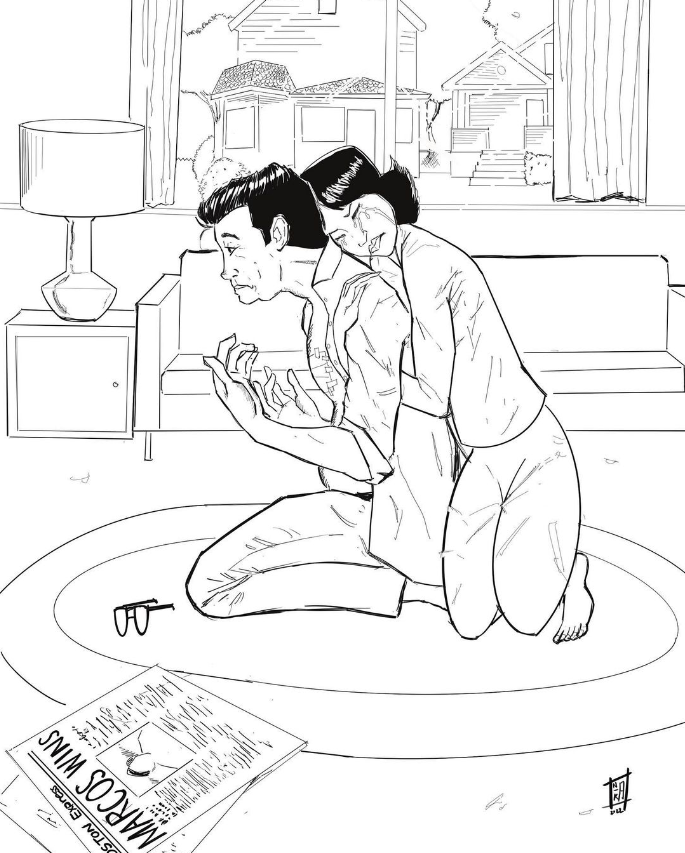
Drawn by Nathan Cayanan: Ninoy Aquino, a Filipino politician who was assassinated during Ferdinand Marcos’ rule in the Philippines. This illustration depicts Aquino and his wife, future president Cory Aquino, when they lived in Boston, after he was exiled for standing against Marcos.

ADVICE FOR ASPIRING WRITERS OR ARTISTS

It’s not easy, and I think admitting that first is important. Too many young aspiring artists ask for advice, but what I feel like they’re asking is how they make this a career where the opportunities are plentiful, the money is endless, they can do it only from 9-to-5, get a 401K, and feel happy 24/7.

Every person I’ve met in the creative world (especially in comics) has said the same thing. It’s a grind. But, if you love the art, I mean genuinely love it (as opposed to the potential for fame and money), then go for it. But, as many writers and artists have told me, 90% of us have a day job. So, prepare to work, even if you make it. And even when you do, enjoy it, because it may not last.

Also, while it may not feel like it should be important, your ability to work and communicate with others is highly important. VERY few people are talented enough to never have to interact with others. Instead, most must be able to work with each other.

Editors have told me that they don’t care if you’re talented. If you’re not professional, no one’s going to give you the opportunity, especially if you’re rude, always late, flakey, or overly stubborn. You don’t have to be the life of the party or admired by the masses. But surely, you have to be reliable and don’t be a d*&k. 

Drawn by Nathan Cayanan: “It just speaks to the times as we see Asian hate crimes on the rise.”

Website: nathanielcayanan.com

Instagram: @nathan_a.k.a

cj

Stories

This Gen-Z Quit Her Job And Turned Stressful Life Challenges Into Quirky Creations

Crystal was feeling emotionally and physically drained from her job before she finally decided to quit. She didn’t have any plans lined up when she did, which was very unlikely for her. So she decided to pursue something she’s passionate about – stickers and stationery.

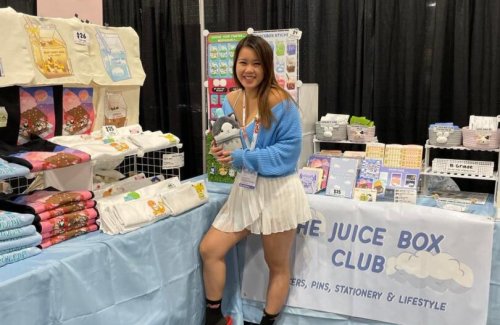
Juice Box Club was molded out of creativity, perseverance, and determination. This small business has faced numerous hurdles along the way, from financial uncertainty to unexpected delays in product arrivals. But despite the challenges, Crystal has remained committed to her dream of sharing her unique designs with the world.

Crystal’s designs are inspired by real-life experiences, from personal passions like fitness and mental health to inside jokes with friends. And speaking of friends, Crystal recently launched a new collection of plushies called Boba Friends, inspired by her own friend group and their real-life pets.

Now, her small business is more than just a sticker shop. She is now designing and selling lifestyle items (glassware, tote bags, apparel) and even plushies! Let’s dive into the story of how The Juice Box Club was born.

HOW THE JUICE BOX CLUB CAME TO LIFE

The process of setting up my own stationery shop was very nerve-racking and exciting at the same time. When I first started off, I used Etsy and I had a lot of support from people back home in New York City, where I was born and raised. However, when I learned that it took a huge chunk of the profits, I took it off and started my own website. I registered my shop as an LLC because I felt like this was going to be a long-term commitment.

I decided to start my own stationery shop because it was always a hobby and passion of mine. I would always collect envelopes, paper, and stickers. 

The concept of The Juice Box Club came from some drawings I did and then while I was sharing it with my friend, we were messaging about a cute name. The Juice Box Club kinda reminded me a little bit of The Breakfast Club, an extremely memorable movie, and that’s what I wanted my brand to be.

OVERCOMING BUSINESS HURDLES

The challenges I have faced circled around finance, having too many ideas, running it by myself, products not arriving on time, machines not working, and rejection.

Finance — in terms of not knowing if I’ll make any sales this week or the next. I do sign up for a lot of in-person pop-up events! I rely on that more than my online sales since the internet nowadays is so funky with algorithms. I also like interacting with customers because they have an opportunity to get to know the brand firsthand.

Having too many ideas — definitely a challenge because I didn’t wanna grow too fast and then have a bunch of inventory. I used to work in fashion and I was used to always developing NEW items. I felt like I had to do the same with my brand, but I realized that I don’t and it’s okay to slow it down. 

Running the business by myself — also pretty hard! Sometimes I would ask my friends if they’d want to help me at bigger events. But most of the time, I’m a one-woman team. I had to do everything from designing, packaging, shipping, content creation, handling emails, etc.

Products not arriving on time — There are times when I outsource items since I don’t have the time or the tools or make them. When I first started, I outsourced my stickers and they were LATE by 1-2 weeks. There was also another time when all of my plushies came EARLY and I had to store 12 big boxes (1,200 plushies total) in my garage and some in my house. 

My Cricuit machine was not working in the beginning — I was making and hand-cutting all my stickers. I gave my Cricut a break and went back and tried it again until it finally started to work properly.. after 5 months.  

Rejection is something I dealt with a lot growing up, so I thought I’m okay with it by now. But getting rejected by big conventions or wholesale sites hits differently. However, I learned to see it as dodging a bullet. If it’s meant to be, it will be, maybe at the right time.

DESIGNS INSPIRED FROM LIFE

Everything designed in my shop all ties into my life somehow. When I first started, I had seven juice box designs. Six of them were themed — three were inspired by my personal passion for fitness/bodybuilding and the other three were inspired by the importance of mental health because I’m a very functional-anxious person and have a hard time relaxing. 

Some of my juice box designs were inspired by my texts with my friends so you might find cute and funny quotes on them. For example, “broke b*tch juice” was inspired by my convo with my bestie, Beth, we always talk about how things are so expensive and how we’re always broke. Or if you see the Pokémon x Soju collection, it was a merge of my childhood and adulthood — because I grew up playing Pokemon with my brother and spent my college years pounding shots of soju.

The Juice Box Club Pokémon x Soju Collection

THE BOBA FRIENDS

Growing up, I didn’t have a consistent group of friends. Most of them just either change or grow apart. But when I moved to California, I met my best friend who later on introduced me to my current friend group.

Some of us in the group have pets, so I then designed characters based on our pets, and their personalities reflect the owner! I called them Boba Friends because boba gatherings are one of the most common hangouts to do now! They have different flavors as well. I own the two cats, Platinum and Luna. My best friend Beth owns Sesame, a lionhead rabbit, and my friend Justin owns Kona, the Shiba Inu. Now none of us owns a bear or frog but I dedicated Ribberto the Frog and his personality to my late friend Josh because it was his favorite.

The Boba Friends Plushies

In the future, I plan to continue producing more drawings and products for The Juice Box Club. I hope to have my products in shops and stationery stores. I am also working on a YouTube channel to show my journey and reach more people.

Website: www.thejuiceboxclub.shop

Instagram: @thejuiceboxclub

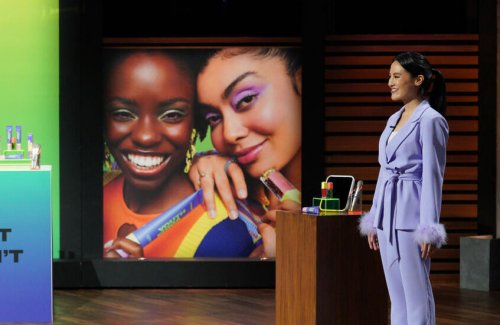
SHARK TANK - Ò1416Ó - Entrepreneurs come to the Tank to present their ideas to the Sharks in hopes of landing a deal, featuring an edible flower company, a sun protective solution, a clean makeup brand, and a modern dental tool used for oral care. FRIDAY, MARCH 3 (8:00-9:01 p.m. EST), on ABC. (ABC/Christopher Willard)
FIONA CO CHAN

Awaken* newsletter

Inside the Mind of Youthforia Founder Fiona Co Chan During Her Epic Shark Tank Pitch Revealed

From sleeping in makeup to owning a makeup brand that lets you do just that, Fiona Co Chan’s innovative beauty brand, Youthforia, is taking the beauty industry by storm.

When the pandemic hit, many of us were forced to adapt to a new way of living. For Fiona, it was a chance to create something truly innovative. The founder of Youthforia has been making waves in the beauty industry with her bio-based formulas.

And if that wasn’t impressive enough, Fiona recently appeared on Shark Tank, where she wowed the Sharks with her BYO Blush and nailed the negotiation process. Fiona let us dive deeper into her mind during the biggest pitch of her life.

Fiona revealed that she practiced a lot for her pitch, but changed it at the last minute to include a demo of their BYO Blush. “I was really nervous about doing that because normally when I do makeup at home, I have a lot of time to apply my makeup on – but for the Shark Tank pitch, I applied it in seconds,” she said.

Fiona applying the BYO Blush in front of the Sharks

She admitted to feeling nervous up until the point she applied the BYO Blush, “You can see it in the clip – but I can see myself in the mirror and I crack a big smile – that’s when I felt really confident and decided to have a lot of fun with the experience.”

But the real highlight of Fiona’s Shark Tank experience was her fierce negotiating skills, she was determined to make a deal that she was comfortable with. “The entire time I kept thinking to myself, ‘Is this something I want to do?’ and I kept countering until it was something I’d accept,” she said.

Fiona’s negotiation skills did not go unnoticed, Mark Cuban offered her a deal and she was over the moon. When asked what was going through her head at that time, she said, “So much – it all went by really quickly. There are parts of it that, watching it back, I didn’t even realize happened!”

Mark Cuban and Fiona Co Chan (ABC/Christopher Willard)

The entire time I kept thinking to myself, ‘Is this something I want to do?’ and I kept countering until it was something I’d accept.

-Fiona co chan, youthforia

Throughout her entrepreneurial journey, Fiona’s husband has been a constant source of support, “When we first started Youthforia, he was the only person I was interacting with because it was lockdown,” she said. Having someone by her side during this challenging time gave her the strength to keep pushing forward.

Launching a company in the middle of a pandemic wasn’t easy., Fiona had to create formulas that no one had done before, using bio-based ingredients instead of fossil fuels. Finding manufacturers willing to work with her was a challenge, but with determination and hard work, she made it happen. She told herself, “If it’s never been done before – you don’t need imposter syndrome.”

Looking ahead, Fiona is excited about the future of Youthforia and has plans to deepen the brand’s relationship with its existing retailers. She said, “My dream is to make a full face of Youthforia products!”

To other entrepreneurs just starting out in the beauty industry, Fiona’s advice is to share your authentic story, “My biggest advice for brand founders is to share your authentic story – of why you’re starting a company or why you created a product.”

Fiona’s journey with Youthforia is one of determination, hard work, and a passion for changing the beauty industry. With her innovative approach to makeup and her commitment to bio-based ingredients, she is sure to make a lasting impact.

Watch Fiona’s Shark Tank pitch here:

Image Source: Madeline Arenas Facebook

Stories

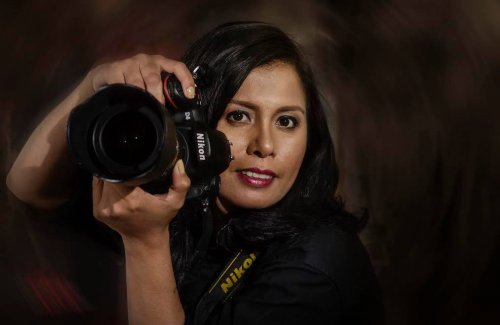
Award-Winning Photographer’s Pursuit of Art Against All Odds, “Throughout the years, I was told, there is no money on art.”

Her passion for art started at an early age, and she fell in love with photography when she got her first camera in elementary school. However, like many artists, she was told that there was no money in art and decided to pursue a different career path.

She went back to photography when she purchased her first digital camera in 2003. As a mother with a young baby, she started Cubrix Photography during the recession in 2008 and posted on Craigslist with her son as a sample portfolio.

Today, she specializes photographing in newborns, marriage proposals, weddings, and Bar Mitzvahs – “pretty much the milestones of their life” as she says. Madeline’s unique perspective on storytelling in photography and her empathy for others makes her work truly stand out.

In this interview, Madeline shares her most memorable moments as a photographer, how her Filipino heritage shapes her work and her personal and professional goals as an evolving artist.

PURSUING ART DESPITE ADVERSITIES

I was born & raised in Pangasinan, Philippines. Art has been a huge part of me growing up. My loving mother thought I had a great left hand when it came to art and sent me to art class at the early age of 7. Since then, I can see art everywhere through my eyes. I developed an interest in photography when I was in elementary years, my first camera was Kodak Ultralite (Film). 

Throughout the years, I was told, there is no money on art. So, I have set aside my passion and pursued a different career path. By 2003, I purchased my first digital camera. Photographing became my hobby again, I would capture the beauty of nature, my favorite being sunsets.

I started Cubrix Photography when the recession began in January 2008. My first child was only 1-month-old back then when I started taking his photos with little to no props. With no incoming income from my previous web development firm, I have to rapidly think, my camera was my only valued asset I have left which makes money. I immediately started posting on Craigslist LA/SF/IE/OC – on a daily basis with my son as a sample portfolio. That’s how I first started to get my first batch of clients.

My children – Dylan and Kyla

By 2nd quarter of 2009, I drove to San Francisco once a month to sustain my daughter’s baby formula & diaper supply for Dylan & Kyla. There was a season, I had barely any bookings and I was forced to sell some of my photography equipment so we can go to Costco to buy our necessities. By the year 2009, I was nominated and rank the top 5 out of 32 portrait photographers in Los Angeles. LA City Voter. The awards continue 2011 (3/57), 2012 (1/61), 2013 (1/45) & 2014 (2/29)

Expertise picked Cubrix Photography as one of the top 23 out of 1,336 newborn photographers serving Los Angeles (2017 & 2018)

As of today, my business runs based on “referrals/word of mouth”, I average 10-14 sessions per week including newborns, baby milestones, family, headshots, marriage proposals & special events. I still travel to San Francisco yearly, expanded to Great Neck, NY for the past 3 years, and travel 2x a year. I am currently I’m on my 4th batch in the newborn + children Photography workshop in Manila Philippines this July 2023.

INCORPORATING STORYTELLING INTO PHOTOGRAPHY

I was once taught by my first mentor, Alex Hernandez from Lifetouch, “Paint with light”. You may have some astonishing pictures that are technically perfect; however, there are two more elements that make a strong image even much stronger. The images should evoke strong emotional feelings in the viewer’s psyche.

Calasiao, Pangasinan

CAPTURING MORE THAN JUST PICTURES: THE MOST MEANINGFUL MOMENTS AS A PHOTOGRAPHER

So many, I feel each session, event, or newborn workshop I photograph was all memorable for me. But there were few who really stood out the most. As a portrait photographer, I trained myself to be emotionless despite what was happening during the time of the documentary.

I had this newborn session many years ago, while I was doing my craft, out of the blue, the mom started crying. Her husband passed away recently.  I had no words to say and kept doing my job. I keep telling her baby was so beautiful – her dad will be so proud of her someday. 

Yearly, I teach newborn workshops in the Philippines. While I was telling my students the profits were donated to a charity that makes special shoes for claw feet babies. It was hard for me to finish my speech – I was so emotional as I taught them the importance of giving back whenever your life is very comfortable.

On a lighter note, for this one-year-old boy’s milestone, every time I sing, he gives me a bad look. When I stop singing, he will stop the grin. I don’t have a talent for singing at all!

The little boy giving me his bad look

At events – Photographing 25 Billionaires during a private meeting event  – one of the guests was Bill Gates. I was so nervous I didn’t even say hi and shake his hands!

STAYING INSPIRED AND CONTINUING TO GROW AS A PHOTOGRAPHER

Surround Yourself with Success: Physically surround yourself with successful photographers. Go to photo conferences, and meet-ups, join a mastermind, and go to photography events and photo walks. If these don’t exist in your area, start them.

Booking signing with Anne Geddes, world-renowned baby photographer for 35 years.
Belly Baby and Beyond: A Collaborative Conference

HOW MY FILIPINO HERITAGE SHAPES MY WORK AROUND THE WORLD

Filipinos have extremely strong cultural empathy. I would like to think that we would never have been able to succeed across such a varied portfolio of countries (across six continents) without embodying this very strong Filipino value.

PERSONAL AND PROFESSIONAL ROADMAP AS AN EVOLVING ARTIST

Personally, to stay healthy and be able to photograph my children’s newborns. To be able to get grants and build 20 libraries per year for our children’s charity – JollyBox Philippines. 

Jollybox Philippines

Professionally, to be the first South/North East Asian Nikon USA Female Ambassador. To achieve a Master’s in WPPI (Wedding & Portrait Photographers International ), currently at the associate level. To continue to teach newborns workshops in the Philippines on a yearly basis. 

ADVICE FOR ASPIRING PHOTOGRAPHERS

An artist will always be an artist, in spite of everything. Pursue it, no matter what. No Matter what, you are emphasizing that you are definitely going to do it, even if there are obstacles or difficulties.

CONNECT WITH MADELINE

Whether you’re a fellow photographer or simply an admirer of stunning visual imagery, connecting with Madeline through social media and exploring her photography portfolios is a great way to stay up-to-date on her latest creations and gain inspiration for your own creative pursuits.

Babies and Family Photography

Event Photography

Marriage Proposals & Weddings Photography

Newborns Photography

Lifestyle, Birth, Fresh48 Photography

Maternity Photography

Creative Fashion

Photojournalism / B&W Photography