Awaken* newsletter

March 6, 2024

SHARE:

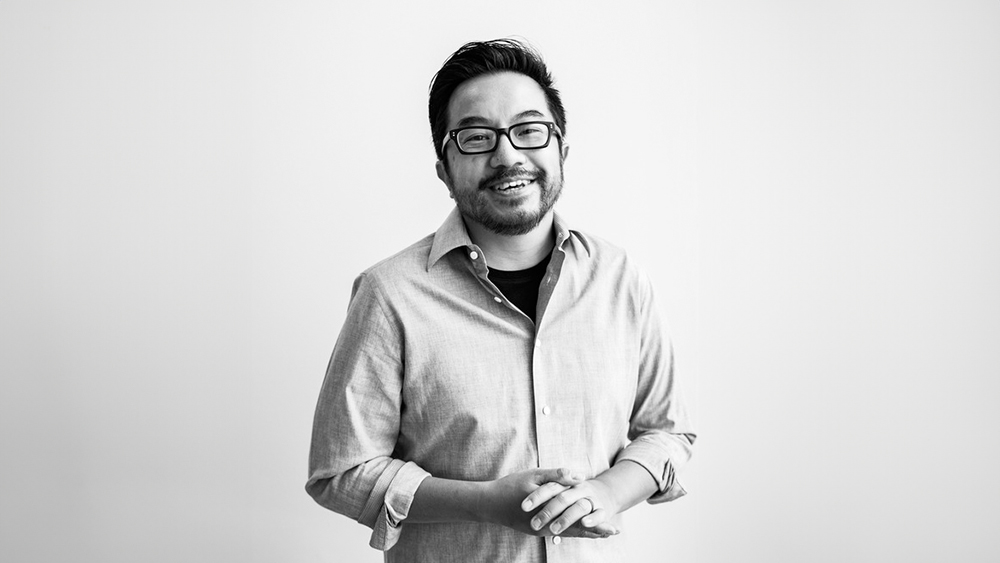
Few people in Silicon Valley are as high-profile as Y Combinator’s President and CEO, Garry Tan. Garry has worn many different hats over his illustrious career. In addition to leading the world’s most successful startup accelerator, Garry was the 10th employee at Palantir, co-founded Posterous (one of the earliest blogging sites), founded Initialized Capital (a VC fund with over $3.2B AUM), and has even ventured into the world of politics, becoming a prominent activist in San Francisco local politics. I got the chance to pick Garry’s brain about how being Asian has affected his life, and I hope that his answers can help and inspire our readers. Without further ado:

OVERCOMING DETRIMENTAL MINDSETS

My experience is that children of working class parents (especially Asian immigrants) tend to have a sticky mindset of scarcity–even when they improve their socioeconomic status. Garry has previously talked about his “$200 million mistake”. That is–he declined Peter Thiel’s offer to be a founding member at Palantir. To me, this seemed like a manifestation of this mindset, so I asked Garry how he overcame it:

I was able to realize that these things were two-way doors. Quitting a big tech company on good terms actually means you can go back anytime. There are one-way doors and two-way doors. For people who grow up with our upbringing, everything feels like a one-way door. But if you can recognize when that is wrong, then you have reclaimed some of the privileges those who come from money have by default.

The one-way vs two-way door framework is something Amazon founder Jeff Bezos has talked about extensively. You can hear him go more in depth here.

The stigma around mental health in the Asian community is another mindset that is gaining more attention. Personally, because my immigrant parents had to fight tooth and nail for survival, I don’t feel that I have the right to complain about my mental health since my life is comparatively easy. I asked Garry if this resonated with him and how he overcame this mental block:

I pretended I didn’t have any problems and spent a lot of time just trying to blend in, but in the end things about my childhood or unusual trauma-based reactions would pop up in my professional life. At some point I started going to therapy individually and it helped me immensely. All these things I didn’t have control over suddenly became something I could integrate and be aware of, and make better choices about. Carl Jung says if you don’t make the unconscious conscious, it will rule you, and you will call it fate. 

A third common mindset I see among Asian Americans is to keep their heads down and avoid rocking the boat, even if it means holding in their thoughts. Given that Garry is a very outspoken person, I asked him how he developed his confidence:

I remember in high school, I was editor of the school newspaper and noticed that students in our poorer high school got much more harsh sentences and expulsions for the same infractions that would get a slap on the wrist at the rich school. I was so angry about it, and I wrote an article exposing it but that was censored by my high school newspaper teacher. I was already going to graduate and go to Stanford so I let it slide, but deep inside me there was an anger at being silenced that I never forgot. Before newspaper, I would publish underground newspapers using Pagemaker and my English teacher would photocopy the newspapers for the class – it gave me a power I never forgot because otherwise I was the scrawny Asian nerd in the corner, but when I could channel the words of my community it gave me standing. I never forgot that.

ON ASIAN COMMUNITIES

On the topic of communities, I asked Garry about what motivated him to become a fierce advocate for the Asian community:

I feel strong solidarity with my Asian American community in San Francisco. We are a major part of the city but we are not seen. We are not heard. The local leaders would even denigrate our attempts at securing safety for our Asian American elders. Now I know I need to fight for those who don’t have a voice. One of the coolest things I found was a nonprofit called Dear Community that connects Asian Americans new to SF, often young professionals, to each other and to the existing SF Chinatown communities. It’s amazing to see smart driven people come together around that, and fight for our people in this city.

I also pointed out how he recently went to Singapore to attend a startup event called SWITCH, and asked him how he felt about the startup scenes popping up in Asian countries:

Startups are happening all around the world. You can learn from YouTube and the web. YC alums are everywhere in the world. I’m excited to see that what started in the Bay Area is now a global phenomenon and only growing.

THE ASIAN FOUNDER EXPERIENCE

On a friend’s recommendation, I asked Garry “Who are some non-technical Asian founder role models I might want to look towards? In terms of working at an early stage startup as a non-technical employee, what are the most valuable skills to learn?” Garry’s response kind of challenged the premise of my question:

In startups and in technology, being technical is a key strength. Be technical if you can be. And then be a polymath: it’s far easier for a technical person to pick up the soft skills than the other way around. 

In hindsight, I will admit that it seems silly to expect to get an outlier outcome (in the positive direction) in the tech industry if you aren’t willing to put in the effort to become technical. He got me on that one.

Lastly, I asked Garry the same question I ask all our guests–how does he think about his Asian-ness in the context of being a founder:

I didn’t think about it until much later. Frankly I tried to pretend it wasn’t an issue, even though there was absolutely a bamboo ceiling even for me. I was passed over for promotions and/or people didn’t think I was capable of doing what I have done. I would rage-quit jobs and it would work out, but I could see it going a different way. As a founder, I found that I needed to up-level my ability to speak up and speak out, and especially be as assertive as possible when I knew I was absolutely right. I had an unspoken desire that I was not even aware of for harmony, and without being aware of it I would sometimes self-abandon, and then be passive aggressive about it later. I don’t do that anymore, and it was a key step in my development as a leader. I wish I developed it earlier, and it was all because of unconscious programming from my childhood. 

The biggest lesson I took away from this interview was how the infallible and outspoken Garry Tan was not always so, and that at one point he was very much like the stereotypical Asian kid. Garry’s story proves that with self-awareness and determination, anybody can undergo tremendous growth and become an industry leader.

SHOUTOUTS

If you have an ambitious startup idea and want to be part of an amazing community of founders, apply to Y Combinator! Y Combinator runs batches twice a year–in the winter and summer. Applications for the summer 2024 batch are open, you can apply at https://www.ycombinator.com/apply

Thank you Garry for the interview!

Featured Image Source: Y Combinator
Related Articles

Founder-doll

Stories

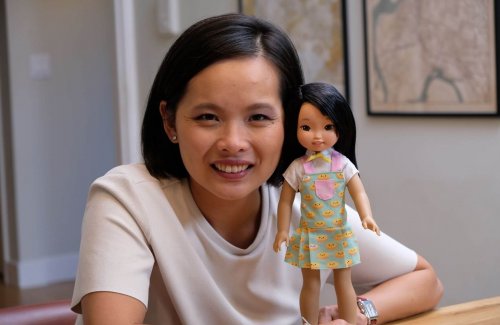
Mom Entrepreneur Creates Asian American Doll After Seeing A Glaring Lack Of Representation On Toy Shelves

Meet Elenor Mak, the founder of Jilly Bing, a company that is changing the face of the dolls and toys industry. Her journey to creating Jilly Bing began with her desire to break down stereotypes and provide a positive reflection of Asian-American girls.

Elenor believes that toys play an essential role in helping children make sense of the world around them, and dolls are an essential tool in building self-esteem and self-acceptance. Her mission with Jilly Bing is to create a line of dolls and toys that accurately represent Asian-American children and help to nurture a deeper appreciation of Asian culture.

By involving children and families in the creation process of Jilly Bing, Elenor hopes to create a community that celebrates diversity and encourages a sense of belonging. 

Read through as Elenor shared about her childhood as a first-generation Chinese-American, and her mission to create dolls that reflect the diversity of Asian American girls and promote cultural understanding.

FROM MACAO TO AMERICA

I am a first-generation Chinese-American. My Mom was born in Singapore, and my Dad was born in China. They met in Macao and immigrated to the US before I was born. Growing up, both of my parents worked as back-office postal clerks, which required grueling night shifts and strenuous manual work. Their limited English disqualified them from jobs that would have been easier, like a front-desk clerk. 

Despite that, my Mom firmly believed in only speaking Chinese (Cantonese) at home and even sent me to Saturday classes for Mandarin. As an adult, I am so grateful for my Mom’s insistence that I am fluent in her native language because it helps me remain connected to my heritage.

MY MOTHER MADE SURE I HAD A VOICE

As a young child, I was rather shy. By contrast, my Mom is a strong, outgoing woman. But being a non-English-speaking immigrant, she lost her “voice.” She would make me challenge adults when she didn’t get the right change at a shop or something was wrong with an order she had placed. Perhaps because of this, I came out of my shell by the time I was in second grade.

Looking back, I believe my Mom was determined to make sure I knew I had a voice or say in matters, even as a kid, so that I would not be afraid to use my voice as an adult. 

My daughter’s voice is Loud with a capital “L,” even at the age of 3, which is so at odds with the stereotypical representations of Asian girls and women as demure, pretty little things. I wanted to break down those stereotypes and create a doll that is similar to the Asian American girls we know and love

My mom was determined to make sure I knew I had a voice or say in matters, even as a kid, so that I would not be afraid to use my voice as an adult. 

-Elenor Mak

A REFLECTION ON MY FIRST DOLL

I don’t recall my first impression of my first doll, named Ada, but she was a gift from my parents, and I was only 5 or 6 years old, so I’m pretty sure I was thrilled. She wore a baby bonnet, and I remember wanting to take care of her as any good Mommy would.

I also remember thinking that her blonde hair and blue eyes were so beautiful. Of course, I didn’t have those features, so on some level, I guess I wanted us to look more similar. My Mom tells a story that, one day, I took scissors to Ada’s hair because I wanted her hair to be like mine, which — like many Asian girls growing up in the 1980s — was a short bob. Long, blonde hair was something beautiful people had, something “other” people had. I do remember feeling like an “other” when I looked at Ada. 

I took scissors to Ada’s hair because I wanted her hair to be like mine.

-Elenor Mak

THE IMPORTANCE FOR CHILDREN TO SEE THEMSELVES REFLECTED IN THEIR TOYS

Toys help children make sense of the world around them, and some of the first toys ever discovered are dolls that date back to 8,000 BC in Japan and 2,000 BC in Egypt. What is baffling to me is that the year is 2023, and missing from toy shelves in US stores are authentic-looking Asian dolls.

The ones that are available are cartoony-looking or dressed in very traditional clothing that does not reflect today’s Asian American children. Several dolls are brunettes with round eyes, an Asian-sounding name, and an upward swish of black eyeliner that supposedly creates Asian eyes.

While I was initially saddened by this, I’m now thrilled that I get to create a company that solves such a glaring error. We are so proud when parents see our first doll and say, “She looks like my daughter.” 

HOW NOT HAVING A DOLL THAT LOOKS LIKE THEM AFFECT CHILDREN AS THEY DEVELOP SELF-ACCEPTANCE

When an Asian child walks into a national chain store and heads to the doll aisle, and sees lots and lots of dolls, but does not see a doll that looks like them, that is the moment that the first damage is done to their self-esteem and self-acceptance.

The moment they start to wonder, “Why not?” Or even worse, the moment they think, “Is there something wrong with me because I look Asian?” 

DOLLS AS CULTURAL MIRRORS TO NURTURE DEEPER HERITAGE APPRECIATION

Role-playing with dolls, action figures, or even stuffed animals, help children sort through their emotions. When they pretend to be superheroes, they are trying to feel powerful. If you hear a child tell a stuffed animal to “wash your hands before dinner,” they are probably trying to make sense of their parent’s rules. 

We want our dolls to help children understand their heritage. We are creating accessories that help recast their interpretation of Asian food, for example. It is not smelly and embarrassing, as I thought it was when I was in elementary school. Asian food is something that their doll loves to make and celebrate. If the doll herself plays with mini egg tarts or sushi rolls, the barrier to understanding is instantly lower. 

As strange as it may seem, there is no one-stop-shop for parents who want to teach their kids about Asian cultures. It requires a lot of legwork to find resources, and parents are busy. In fact, 91%of Asian American parents we surveyed replied “yes” when asked, “Do you need help finding educational content to teach children about Asian culture and heritage?”

I want Jilly Bing to be the brand that makes it easy for parents to introduce and deeply explore every aspect of all Asian cultures.

INVOLVING CHILDREN AND FAMILIES IN THE CREATION PROCESS OF JILLY BING DOLL

When we were creating the prototype of the doll, we leaned on my children and our friends and family to see if our vision was resonating with them. To gather data, we surveyed adults through several social media networks that have huge followings. It was not a short survey, so I was amazed to see how many people gave us feedback; it was another moment when I knew we were striking a chord with many Asian adults who felt unseen as children.  

Now we have the luxury of formalizing feedback with focus groups and people who want to support our mission of representation. We created an official Jilly Bing Ambassador Community for our strongest supporters, and we will turn to them for feedback on future dolls and new products.

It was not a short survey, so I was amazed to see how many people gave us feedback.

-Elenor Mak

WHAT MY DAUGHTER THOUGHT WHEN SHE FIRST SAW THE JILLY BING DOLL

Jillian was just shy about her third birthday when she saw the prototype of the doll. First, she did a big dramatic gasp, and then she said, “Me!” and hugged the doll so hard that its not-quite-fully-secured head popped off the body. At that moment, I knew we had a winner. 

WHAT PARENTS ARE SAYING ABOUT JILLY BING

Much of the feedback is coming from adult women. Just like my daughter’s first reaction, they say they gasped out loud, and many say they proceeded to cry. I keep hearing, “This is the doll I always wanted when I was growing up.”

One woman captured how heartbreakingly wrong the status quo is: “Even in play, Asian girls have had to envision life as someone else … This vision is so much more than a toy, it is being seen!”

ADDRESSING THE NEED FOR INCLUSIVITY AND DIVERSITY IN THE TOY INDUSTRY

The toy industry needs a refresh, as do media companies that are creating content for children. It feels as though they are checking off boxes. They want to be able to say, “Look, we have an Asian doll. We have a Black doll.” Or “Here! We did a movie with Chinese immigrant parents and US-born kids.” But they are just doing the bare minimum.

I like to think Jilly Bing is the first company to take a holistic view of how representation can live and breathe within our children’s daily lives, instead of being compartmentalized inside a checkbox. My analogy is Paw Patrol. Those pups are everywhere, from socks to movies to enough toys to fill a football stadium.

If our vision becomes a reality, the fun, cheeky characters and accessories, books, and content that celebrate Asian American culture will be everywhere too. 

What can consumers do to drive this change? I ask them to support us by purchasing a doll at www.jillybing.com and spreading the word. As the famous saying goes, “Be the change you want to see in the world.”

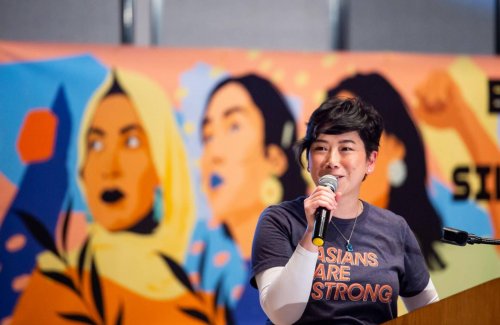
Event organizer Zeien Cheung speaks during the 'Break the Silence' event at the Asian Art Museum in San Francisco on March 16, 2022. (Beth LaBerge/KQED)

News

Asians Are Strong’s Annual Event Shines Light On Protecting And Empowering Asian Women This March

This historic event on March 12th, Sunday, at the iconic Ferry Building in San Francisco, seeks to spotlight the unique experiences and challenges of Asian women both in the past and present.

Asians Are Strong’s founder, Hudson Liao, shared that last year’s event was inspired by the national day of remembrance for the 6 Asian women victims who were murdered during the Atlanta Spa Shootings in 2020.

Shinhong Byun (center), president of the Korean American Bar Association of Northern California, is comforted by friends and family after an emotional address during the ‘Break the Silence’ event at the Asian Art Museum on March 16, 2022. (Beth LaBerge/KQED)

‘Our Time’ is the only event of its kind that solely focuses on Asian Women. Attendees can expect to see 20+ resource groups for Asian women, an interactive, global art project, a live podcast taping of the renowned May Lee show, a stand-up comedy set by rising star Jiaoying Summers, speeches from Asian women leaders like Helen Zia and Gia Vang (co-founder of The Very Asian Foundation), and panel discussions with Asian women business leaders like Victoria Fu (CEO of a skincare brand, Chemist Confessions).

Left to right: May Lee, Jiaoying Summers, Gia Vang, Victoria Fu

In addition, there will be free self-defense workshop led by TUFF Love, poetry readings, resource tabling from community groups like the Asian Women Shelter and Narika, an art exhibit dedicated to historical Asian women figures.

Asians Are Strong’s mission is to empower and protect Asian and Pacific Islanders, which aligns with the event’s goals. It is crucial to highlight the experiences of Asian women in mainstream discourse to prevent their experiences from going unnoticed and forgotten, “Representation is the only way to break stereotypes.” said Liao.

Interested individuals can support the organization’s mission beyond attending the event by signing up to be a volunteer, and supporting their programs including free self-defense workshops for the elderly. The organization also accepts donations.

Liao also urges people to be engaged and active with organizations like Asians Are Strong and other groups that they will be showcasing at the event., “We would also love help to amplify this event so all Asian women and our allies can come to be a part of history. 

For those unable to attend in person, they will have a live stream of the event so that anyone, anywhere in the world can participate in this historic celebration.

Featured Image Source: Beth LaBerge/KQED

Image Source: HBO

News

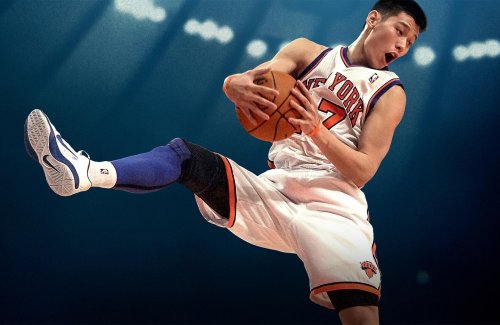
Former NBA Player Jeremy Lin Features In New Oscar Shortlisted Documentary ‘38 At The Garden’

The Taiwanese-American basketball player Jeremy Lin features in the HBO documentary short 38 at the Garden, which has been nominated for an Oscar.

The documentary follows New York Knicks point guard Jeremy Lin’s remarkable 2012 season. Lin, an undrafted Harvard graduate, scored 38 points at Madison Square Garden against the Los Angeles Lakers, confirming his hot streak and the “Linsanity” craze.

38 at the Garden honors a turning point in Lin’s life and highlights a global phenomenon that went beyond basketball. The video contrasts the pride that the Linsanity era afforded Asian-Americans with the recent rise in anti-Asian sentiment.

38 At The Garden is a Mr. Fahrenheit and GTG Entertainment production. The film is directed by Frank Chi and produced by Travon Free and Samir Hernandez. Executive Producers, Patricia Sun, Brandon Chu, Kai Huang, Mike Lee, Dave Lu, and Paul Sri. For HBO, executive producer, Bentley Weiner.

VideoScreenshot--YouTube-NielsenNoodlesGenerationalViewsonEquitableJournalismwithAsAmNewsandAsianFeed-3’23”

Stories

Nielsen Noodles: Generational Views on Equitable Journalism with AsAmNews and AsianFeed

First Slurp! 

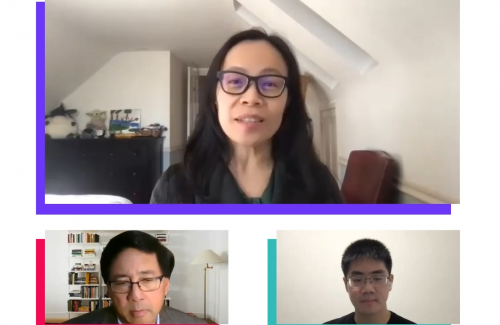
Food is a way for us to connect and tell stories by engaging all of our senses. Nielsen Noodles is a series where we gather to share our own stories while discussing insights and current events over a bowl of instant noodles. We virtually shared a bowl of noodles with Michael Lai, CEO and Co-Founder of Famous Media Group and AsianFeed, along with Randall Yip, Founder and Executive Editor of AsAmNews; two trailblazers in AANHPI news and journalism. 

(Top) Randall Yip , (Bottom L-R) Patricia Paturangi, Michael Lai

Which noodle dish did you choose to bring to the conversation?

Randall brought a bowl of wonton noodle soup from his family’s favorite hole in the wall, sharing, “All of my favorite items thrown into one… I picked this because it reminds me of my mom …  she loved to sit around the table and get the family together and just talk, that was her excuse to get the family together.”  

Michael shares, “I brought my favorite brand of instant ramen, I usually add an egg and some bok choi… I always remember coming home from practice, my parents were a little too tired to cook so we all would eat instant noodles and share conversations about our days. Memories and nostalgia from childhood are what these noodles remind me of.” 

Tell us about your news outlet, what is the story behind founding each of your outlets?

Randall recalled growing up in a time where the only Asian American role model on TV was Bruce Lee. While he and his friends idolized the kung fu star, he felt his community was missing critical daily representation in news.

“I wanted to share a different light, we tried to focus on Asian Americans who were role models breaking stereotypes. On the second front, we wanted to have a daily news site because Asian Americans were missing a news site where you could follow Asian American News on a daily basis. So from the very beginning, we’ve operated 365 days a year and we have not deviated from that, ” says Randall.

Michael comes from a different generation of representation. While striving for authentic storytelling connects both Michael and Randall, Michael aims to build a community of Gen Zers through short form, sociable content.

 “We’re an Asian-centric digital media brand, founded just last year, and grown to more than 200,000 followers across social channels. Designed at conception as a media brand to celebrate the shared cultural experiences of the younger generations in America and around the world. 

Growing up I was one of three Asian Americans in my entire school district, I often felt alienated from my Asian American identity. Outside of my parents, there weren’t really many opportunities for me to connect with others who shared my culture and ethnic background… My goal was to create a digital space that I feel I would have benefited from when I was younger, where stories that were important to me were the focus and where I could connect with others who shared similar cultural experiences.” says Michael. 

Why is it so important that diverse media be well-represented in the industry?

Nielsen research has found that certain shows with diverse representation both in front and behind the scenes, attracted more of that audience group – we want more of what’s familiar. From a similar standpoint, it’s also important to have diverse-owned media equally represented in the media ecosystem. 

“There are so many diverse community-centric stories to be told. The only way to make sure these stories are told in an authentic manner is for them to be told by members of the community in front of the camera, and behind the camera as well. It’s so important because there are so many cultural nuances and contextual clues that I think are important. Audiences these days can really tell when something is just superficial versus something that is truly authentic and a project designed to forward and advance the community,” notes Michael. 

He continues to say, “Especially this younger generation growing up, I think there are so many independent content creators emerging, creating amazing content that resonates not only with their own individual community, but also with the broader community at large. I think that is super important, and a trend that will continue to really advance the representation.”

Why is it so important for advertisers to invest in Asian American-owned media?

When we think of advertisers, we often think of Fortune 500 companies and major brands but in a community, such as Asian Hustle Network, we have inspiring entrepreneurs building Asian American-owned businesses. This year Nielsen started a Diverse-owned Media Initiative to help raise visibility of diverse media suppliers so they have a fair and equitable chance to get in front of ad buyers. 

Randall says, “I think the smart brands realize that they can’t continue doing what they have been doing. They need to expand their reach and customer base.” 

Michael says, “[Advertisers] are really starting to realize that Asian Americans are an important audience too. I think we’re one of the most rapidly growing consumer demographics in terms of pace of growth and authentic messaging is important… For advertisers to want to connect with those audiences, I think it’s extremely important, specifically for Asian Americans, to diversify their marketing budgets to allocate some of that budget for those audiences. 

Michael explains further “It’s not just Asian-Americans consuming this content, there are so many instances where K-POP, BTS, Blackpink, Squid-game, Korean dramas, as well as other Asian Entertainment groups. It’s just amazing how widespread it has become, it’s not just Asian-Americans, it’s really everybody is engaging as a whole in these stories that are inherently culturally Asian-based.

Final Slurp!

Michael and Randall have many things in common, especially their desire to champion equity in journalism, entertainment, and storytelling.

Randall urges up-and-comers: “Every brand comes with its own story, every entrepreneur has their own story to tell. Don’t be afraid to tell your story and don’t be afraid to pitch it to media outlets. You’re going to find that there will be a lot of interest…Be Inspiring!” 

Media is where the unique stories and voices of our community can be found. As our community becomes even more diverse, providing opportunities for greater equity in media and enabling more diverse voices becomes even more critical. The people behind the stories who are from our community — from journalists to media owners — continue to stand together to open up more opportunities for future generations of storytellers. Thank you Michael and Randall for paving the way with your passion and commitment.

Watch the full Nielsen Noodles episode here!

Learn more about Nielsen at www.nielsen.com.