Awaken* newsletter

June 6, 2024

SHARE:

Venture capitalist Ann Lai is, by all measures, an absolute beast. From earning a PhD from Harvard at 25 to becoming Managing Director at her own firm–Skeleton Key, Ann has clearly achieved a great deal of success throughout her career. Ann is also notable for speaking up publicly about the misogyny she has faced in VC, despite it nearly forcing her out of the industry. I had the honor to chat with Ann about her career journey pre-VC, reflections on her identity, and also about her exciting new firm.

Journey to Venture Capital

Ann’s journey to Venture Capital is at least 50x cooler than mine. In fact, it’s one of the coolest there is. It all started when she read a biography of Marie Curie at the age of six. I asked Ann to explain what drew her to Marie Curie so much that it set her on a trajectory she is still on today:

The recognition of women in science has historically been insufficient, and I have consistently been attracted to narratives that feature an underdog. Marie Curie’s achievement as the first woman to win a Nobel Prize, and then winning it a second time, was profoundly significant to me as a young person. From a very young age, I had an affinity for science and engineering. My mother, a teacher of literature, encouraged me to read or listen to autobiographies of diverse individuals. My early fascination with NASA was spurred during the time my father worked there. Marie Curie significantly altered the landscape and methods of many scientific endeavors.

Marie Curie’s story inspired Ann to study science. By age 25, she had earned three STEM degrees from Harvard including a PhD in microfluidics. While studying, Ann was starting to notice things that would push her away from being a scientist towards investing:

I noticed that many significant scientific advancements were transitioning to privatization. There was a golden era of science in the United States during the 1970s, characterized by substantial government funding and innovative labs such as Xerox and Bell Labs, but it is now over. I hypothesized that the most groundbreaking scientific discoveries would increasingly be funded privately. The sectors that remained vibrant, like CRISPR and space exploration, were those receiving substantial private investment. And although I was satisfied in the laboratory, my broader interests and extroverted personality drew me toward the funding side of science.

However, that was not quite what the universe had in mind for Ann. Ann graduated right around the 2008 financial crisis, which had pretty much killed off all appetite for investments in science. Thus, she instead started her career at a firm pioneering big data analysis:

I joined a company on Wall Street that pioneered what is now commonly referred to as “alt data”. We acquired, scraped, and sourced new and proprietary datasets, transforming them into predictive models for public company earnings. This was a rigorous introduction to the underlying forces that influence corporate dynamics; we had to understand the key performance indicators driving stock market values. (It was like going through a condensed MBA program.) By modeling quarterly earnings, where data points were scarce, I applied methodologies from my graduate research, collapsing extensive data sets by normalizing or parameterizing the variables, allowing for a comprehensive, dynamic model. This approach was highly effective, blending scientific and business analytics.

After her stint working in finance, Ann went on to lead business intelligence for international territories at Riot Games and then worked in a few early-stage startups in preparation for a transition into Venture. One thing she said especially caught my attention:

There was noticeable skepticism towards PhDs and academics in venture capital. Despite my extensive scientific background, I was told to strategically minimize the emphasis on my PhD on my resume. It’s evident in the venture space that there is a prevailing belief that academics lack practical business acumen.

When asked whether this skepticism extended to PhD founders, Ann elaborated:

This skepticism is indeed still prevalent. However, many PhDs are exceptionally practical. For companies involved in iterative development, such as SaaS companies, the requirements are different. In these fields, the emphasis is more on user interaction and less on deep scientific knowledge. But, for science-driven enterprises, a thorough understanding of the fundamental sciences is crucial.

Hopefully, this gives some hope to the PhDs out there who are looking to start a company! In fact, VC has been trending more towards deep tech evidenced by an increased share of investments into the space.

Advice for Women in Venture

One aspect Ann has been noted for is her outspokenness on the misogyny she has faced in the Venture ecosystem. For more specifics about her experiences, you can check out this Elle article written about her. Given her experiences, I asked her what advice she would give to women who want to go into the VC or startup space, but are concerned about the misogyny and fraternity culture that is still rampant.

Establishing a close network of mentors and peers for support is essential. This has been invaluable to me. Unfortunately, the prevailing culture remains challenging, and the progress we’ve made has perhaps deteriorated in the past year due to decreased venture capital availability on the LP side. There’s still a lot of work to do. The solidarity of women supporting one another is crucial for fostering progress. Maintaining a commitment to support each other is critical. Although most days it may not seem particularly difficult, there are specific moments where you can just feel a very big demographic difference in terms of who’s empowered. Partners are partners, but managing partners are different categories of partners. Until more women are managing partners or running their own sizable firms as partners, there’s still not enough leverage in the space.

Being Asian

I asked Ann to reflect on how her identity as an Asian woman has affected her lived experience:

My mother is incredibly liberal for her generation of Taiwanese. She has always been supportive, telling me I don’t need to get married early or worry about having kids, which is rare for Asian moms of her generation. At the same time, my parents weren’t financially very well off when we came back to the States. I contributed to my family’s income from the age of 12. There was no safety net. If I didn’t make it, nobody could pay the bills. It taught me resilience and gave me a “no way back” approach to life.

My dad raised me with a strong sense of right and wrong (We watched a lot of Asian martial arts dramas and stories.) It’s not really about being visible–it’s about doing the right thing. This Asian heroism as defined by martial arts movies approach is quite different from American heroism, and it’s the reason why I stood up for myself even when it might have prevented me from working again.

Being an Asian woman in the US is difficult. I often get the assumption that I’m a lot younger, for example. So, you always have to go into a meeting fighting that. That’s something my cohort and I have talked about a lot, like, you learn how to dress and style yourself to appear older sometimes so that you will be taken more seriously.

For meetings in East Asia, I was coached to open meetings by stating my qualifications, the PhD from Harvard, etc.This way, they respect the degree and then they respect you. Male executives and men who attend meetings weren’t prepped in this way. But I’m starting to see more evolution, especially with the younger, successful Asian male founders and groups. They’re very supportive, which is great. The older generations still tend to have a more patriarchal mindset, but it’s getting better, especially in the US.

Anecdotally, children of first-generation immigrants often pursue more stable, high-paying careers (doctor, lawyer, etc.), yet Ann has clearly bucked this trend. I asked her why she thought she ended up doing so:

My parents have been very modern in their thinking. They’ve never said I had to do things in a certain way. They’ve always supported my decisions. It made me feel like I could do anything. I’ve never worried that I might not succeed. If you are fearless, you end up doing aggressive things, aggressive in a good way.

Having grown up in both the US and Taiwan, I think Western and Eastern education are quite different. The American system encourages exploration and aspirations, whereas there’s a lot more regimen in the Eastern education system. The way I was raised was very much a marriage of those two aspects in an unexpected way. I have a lot of friends who were told to be a doctor or a lawyer, but if you think you can do better at other things, why do you have to do that?

Skeleton Key

A Skeleton Key is a type of master key in which the serrated edge has been removed in such a way that it can open numerous locks. It is also the name of Ann’s new firm. While researching for this interview, I came across this article by Ann, where she lays out the argument for why Deep Tech is venture-backable. Towards the end of the article, she shifts the focus to ScienceTech (SciTech), which she defines as: the software, platforms, or tech-enabled services that accelerate scientific discovery or assist in bringing science to life. I asked Ann why she chose Skeleton Key’s focus to be on SciTech instead of Deep Tech:

Deep tech is definitely fundable, as I’ve talked about. But now with AI, I’m thinking about how to make deep tech happen faster. Instead of investing in a drug, I’m looking at the platforms helping people discover drugs faster. Those layers are interesting to me, and I think those are the layers where a lot of the accelerated computing power can come into fruition in an interesting way. The accelerated computing power means you can map out a lot of things that have historically been very difficult such as fatigued glass behavior or certain thermal dynamics, nonlinear dynamics, and anything that’s related to nonlinear systems. 

There’s even a lot of interesting stuff happening around the application layer of science. For instance, bringing chemicals to real-life applications usually takes a long time. You find a chemical and wonder where to use it and what it can be used for. Then, usually, you need a different type of manufacturing protocol or a different variation for each use case. But now,  you can find a lot of those variants much faster. The formulation or the tuning of that molecule, protein, etc. can be assisted on by AI and you accelerate that process of bringing it to a real-life application much faster.

As you may have gathered from her background, one of Ann’s specialties is data analysis. In her previous VC roles, Ann leveraged her background to evaluate companies based on their data in an apples-to-apples way. You can hear more about her approach in this podcast. Given that Skeleton Key is working with a type of company that isn’t what the typical VC invests in, I was curious to know if she had to adapt her process:

It’s definitely different for Skeleton Key. We deal with a lot more data around R&D and early applications because we’re focusing on a second or third institutional round for these folks–so it’s a post- R&D but before they actually hit ramping revenue. That means you still have time to work with them on exploring the business–is it a software platform approach, or is it a single molecule approach, or a single robot approach? 

I asked Ann what revenue the companies typically are at in their second or third institutional round:

I think the specific revenue number doesn’t really matter. It’s the mechanics of what the early performance looks like. If they have a couple of contracts which are scalable over time and show real adoption and real usage–that’s a lot more important than one marquee SaaS contract that you can get through relationships. It’s more around the usage, the actual day-to-day functionality or day-to-day use. 

Earlier in our chat, Ann touched on how Skeleton Key plans to help startups explore different business angles, I asked Ann to elaborate on this process:

Our approach is very collaborative. My philosophy has always been to provide as much help as the founder wants. The goal post-investing is to help them with monetization, go-to-market strategies, and thinking about how to scale from a scientific lab mindset into building a company. We also assist them in fundraising. There are a lot of resources post-investment, and whether a founder will leverage them is their choice, but we prefer that they are open to us being more involved. In this category, where there are no established revenue models and many founders are coming from academic backgrounds, this advisory capacity is helpful to give them the full lay of the land, let them explore, and let them test different monetization hypotheses quickly.  Inflexibility or lack of adaptability can be a problem down the line, especially in these categories that require a lot of money for ramping up and the revenue models aren’t so obvious. In fact, we’re planning on helping founders in this way before even investing, as part of our process.

I mentioned to Ann that this kind of help seems very valuable, especially since the only resources available online tend to be very reductive:

My biggest pet peeve is when VCs prescribe a framework without actually understanding the problem. When we help companies, we don’t do that. We workshop their unique situation and how to price best for their product, without capping future revenue. For example, a lot of people like to suggest ARR subscription SaaS, but that model doesn’t work for everyone. There’s a lot of possibilities around pricing and revenue that isn’t just about “getting ARR.” I think those are the interesting exercises to think through when you’re in these new categories.

Shoutouts

Ann is amazing  and I am super excited for the launch of Skeleton Key. If you’d like to hear more from Ann, you can sign up for her Science Fair newsletter here, where she writes about science and venture. Thank you Ann for the great interview!
Related Articles

Angel Zhen Built a $500K Solo CPA Firm and Redefined Success

Stories

Angel Zhen Built a $500K Solo CPA Firm and Redefined Success

From Public Accounting to Personal Freedom

For most people in the accounting world, success looks like a corner office, a big team, and an endless stream of clients. For Angel Zhen, CPA, MST, success meant something entirely different — independence.

“I wanted to build something that valued freedom, quality, and impact,” he says. “After years in public accounting, I saw how the system rewarded long hours over real results. I knew there had to be a better way — to build a high-performing firm without sacrificing your life.”

That clarity led Angel to found Pasadena Tax CPA, a one-person practice that now generates over $500,000 in annual revenue and serves more than 300 clients nationwide. Angel’s work has earned national recognition from both CPA.com and the AICPA, including being named a 2025 Innovative Practitioner Award Finalist and 2025 Leadership Academy Selectee.

From Public Accounting to Personal Freedom

Turning Loss into Leadership

Angel’s story didn’t begin with business success. It began with loss.

“In April 2020, my dad passed away unexpectedly,” he recalls. “Because COVID hit and I was deep in tax season, I didn’t get to see him one last time. That moment changed everything — life, time, and purpose.”

Like many in Asian families, Angel describes his father as the pillar — the provider and decision-maker everyone looked up to. When he passed, Angel knew it was his turn to step up.

He moved back home to Rosemead, California, to take care of his mom and rebuild his life. What began as a moment of grief became a defining transformation. “Starting over during a pandemic forced me to innovate to survive,” he says. “I turned loss into fuel and fear into focus.”

Five years later, that focus became a thriving solo CPA firm built on innovation, strategy, and heart.

“There’s a Chinese saying, 苦尽甘来 — after bitterness comes sweetness,” Angel says softly. “Every struggle built the clarity, strength, and mindset that led me here today.”

Challenging the Traditional CPA Model

Angel’s biggest challenge wasn’t the market — it was his own mindset. As an Asian CPA, he grew up with messages about safety and stability: work hard, follow the rules, don’t take risks. But entrepreneurship demanded something different.

“I had to unlearn the belief that success required a big team, long hours, or a corporate ladder,” he explains. “I built systems, automations, and pricing models that gave me confidence and time back.”

Those systems didn’t just make him efficient — they made him exceptional. Today, Pasadena Tax CPA is recognized as one of the most efficient solo CPA firms in the nation, a model of what’s possible when technology meets intention.
His book, The Profitable Solopreneur Playbook, expands on that mission — teaching other CPAs and solo business owners how to build practices that generate both profit and freedom.

Challenging the Traditional CPA Model

Redefining Success in the Modern Asian American Dream

Angel’s success challenges a long-held cultural narrative — that stability and ambition are mutually exclusive. His mission is to show Asian professionals that they can have both.

“For the Asian community, I want to normalize the idea that you don’t have to choose between stability and ambition,” he says. “You can honor your roots while building your own path.”

Through mentorship, education, and storytelling, he’s helping others reclaim the idea of financial independence — not as a luxury, but as a form of empowerment. His philosophy is simple but powerful: “Build with intention, clarity, and courage.”

A Beacon of Innovation and Leadership

Angel’s recognitions from CPA.com and the AICPA are more than professional honors — they’re milestones in a larger movement to modernize the accounting industry.

“Being recognized by CPA.com as one of the most innovative practitioners isn’t just about accounting,” he says. “It’s about leadership, legacy, and resilience.”

His nomination for the 2025 Innovative Practitioner Award celebrates his ability to merge technology and empathy — running a fully remote, tech-driven practice that still feels deeply personal.
🗳️Vote for Angel Zhen, CPA → cpa.com/innovative-practitioner

Rooted in Legacy, Driven by Purpose

What drives Angel today isn’t just revenue or recognition — it’s the promise he made to himself after his father’s passing: to live with intention.

“I’m proud of building a $500K+ one-person CPA firm from scratch — without a team, referrals, or outside funding,” he reflects. “It’s proof that with clarity, systems, and consistency, one person can do extraordinary things.”

Beyond his business, he continues to inspire thousands of professionals across CalCPA, Asian Hustle Network, and beyond — showing that even in an industry built on rules, creativity and freedom can lead the way.

Rooted in Legacy, Driven by Purpose

About Angel Zhen, CPA, MST

Angel Zhen is the founder of Pasadena Tax CPA, a one-person firm serving clients nationwide with a focus on tax strategy, clarity, and efficiency. He has been recognized by CPA.com as a 2025 Innovative Practitioner Award Finalist and by the AICPA as a 2025 Leadership Academy Selectee. Angel is also the author of The Profitable Solopreneur Playbook, helping others design businesses that create both wealth and freedom.

🗳️Vote for Angel Zhen, CPA as the 2025 Innovative Practitioner

https://www.cpa.com/innovative-practitioner

Connect with Angel Zhen

LinkedIn: linkedin.com/in/angelzhencpa 

Website: www.pasadenatax.cpa

Founder-Images_3-2-scaled-jpg

Stories

Singapore’s Snack Revolution: How The Golden Duck Turned Salted Egg Yolk Into a Premium Global Phenomenon

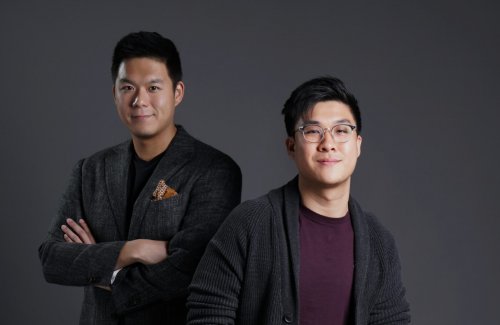
Chris Hwang (left) and Jonathan Shen (right) – founders of The Golden Duck

Growing up with Asian snacks like salted egg yolk chips meant savoring flavors that felt both comforting and unforgettable. Yet when Jonathan Shen and Chris Hwang turned their eyes to the global market, they saw a different reality: these beloved treats were undervalued, underpriced, and largely overlooked by international consumers.

Back in 2015, Singapore’s FMCG market was crowded, dominated by established Western brands. Asian flavors were largely seen as niche, affordable snacks rather than premium products you’d gift or showcase in events.

Jonathan and Chris quickly recognized a gap: millennial consumers craved adventurous, culturally rooted flavors, but no brand was presenting them in a way that made people proud to share them.

They founded The Golden Duck with a vision to elevate Asian snacking to a globally aspirational experience.

Today, The Golden Duck has sold over 20 million packs worldwide, and is stocked in 650+ Woolworths and Metro stores.

How It Began: Inspiration from a Familiar, Unlikely Flavor

Jonathan Shen and Chris Hwang didn’t start with a massive budget or fancy offices. What they had was complementary expertise, and a shared passion for snacks. 

Jonathan, with a keen eye for branding and marketing, looked at salted egg yolk and asked: what if salted egg yolk could feel luxurious? 

While ubiquitous in Asia, it was rarely found outside hawker stalls or home-cooked dishes.

Chris, a stickler for quality and craftsmanship, understood that getting the recipe and packaging right could make all the difference.

When it launched, crowds queued for hours, wanting to get their hands on chips that tasted like home but looked like luxury. The Golden Duck’s Salted Egg Yolk later earned Jonathan & Chris recognition on Forbes 30 Under 30 Asia.

How It Went: Bold Flavors, Relentless Hustle

Entering a competitive FMCG market without big funding meant bootstrapping everything—from sourcing ingredients to hand-packing orders. They had to balance daring flavors with high-quality production, ensuring every snack met premium standards.

It wasn’t just about product innovation. Breaking into a market dominated by Western brands meant shifting perceptions: convincing consumers that Asian snacks could be modern and premium. Every unconventional pairing, every new flavor, was a calculated risk.

Chris ensured every ingredient and recipe exceeded expectations, while Jonathan told the story in a way that resonated with millennial snack enthusiasts.

They launched pop-ups, engaged directly with customers, and refined details one by one. Salted egg yolk became their signature flavor, but it was only the beginning. The Golden Duck now offers a growing range of gourmet Asian-inspired snacks, from Chilli Crab Seaweed to Tom Yum Goong and Spicy Mala Hot Pot.

What’s Next For The Golden Duck?

The Golden Duck isn’t slowing down. In 2025, the brand launched a new line of canister chips for Western markets including Australia, the United States, and Canada, with bold flavours like bold flavours like Truffle Wagyu, Kombu Seaweed Butter, and Sour Cream & Sriracha. At the same time, the company is actively entering new markets such as the UK, Europe, and China.

Innovation and sustainability remain at the heart of The Golden Duck’s strategy. The company continues to explore new flavors and formats while sourcing real ingredients to deliver premium, authentic taste experiences.

With every new flavor and product, Jonathan Shen and Chris Hwang are proving that Asian snacks can be premium and globally celebrated. Every bite is a story of heritage, innovation, and taste waiting to be told.

Connect With The Golden Duck

Website: https://www.thegoldenduck.co/

IG: @thegoldenduck.sg

@thegoldenduck.au

IMG_6214 (1)

Stories

From Prison to Purpose: How Tuan Huynh Brewed Redemption Into VietFive Coffee

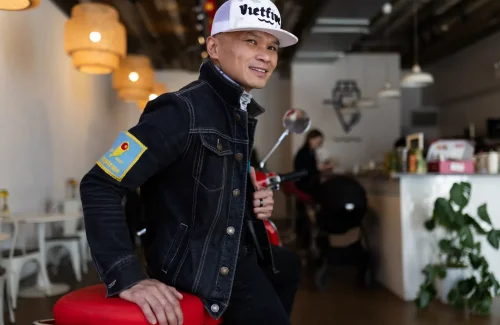
When you walk into VietFive Coffee in Chicago’s West Loop, the first thing you notice isn’t the rich aroma of Vietnamese Robusta beans. It’s the energy. Strangers sit shoulder-to-shoulder, conversations spark, and a sense of belonging fills the air. For founder Tuan Huynh, this space is far more than a café. It’s proof that redemption is real.

Tuan didn’t set out to build a coffee brand. He set out to rewrite a life story that once seemed destined to end behind prison walls. Today, he’s not just serving bold coffee; he’s serving hope, heritage, opportunity, and community.

The Darkest Chapter

Tuan’s early life was marked by conflict. Born in Vietnam, his family fled to the U.S. when he was just three years old, carrying little more than hope for a better future. They settled in government housing, where poverty pressed down on daily life. Like so many kids searching for belonging, Tuan got swept into the culture of gangs and drugs. At just 18 years old, barely an adult, his life took a devastating turn.

Convicted of first-degree murder, Tuan was sentenced to life in prison with the possibility of parole after 15 years. He spent the next decade and a half in Lansing Correctional Facility, one of the country’s maximum-security prisons.

Prison has a way of stripping people of their identity. For many, it cements a cycle of despair. But for Tuan, it became the crucible where transformation began. “Even in the darkest places,” he says, “I knew my story wasn’t finished.”

Choosing Creativity Over Despair

Inside those walls, during the latter half of his prison experience, Tuan chose to reimagine his life. He leaned into art and design, creative outlets that gave him purpose and revealed a talent for visual storytelling. Every sketch, every concept was an act of defiance against the idea that his future had already been written.

When he was finally paroled on June 21st, 2011, a date and time he still recalls with reverence, Tuan stepped into a world that had changed beyond recognition. He was a free man, but freedom didn’t come with an instruction manual. He carried the stigma of incarceration, the weight of lost time, and the daunting task of rebuilding from scratch.

A Door Opens in the Most Unexpected Place

Determined not to waste his second chance, Tuan pursued higher education, earning a Bachelor of Fine Arts in Conceptual Design. His portfolio caught the attention of the world’s largest advertising agency, which offered him a role in Chicago. For a refugee kid who had once been told he would never amount to anything, it was validation.

But something was still missing. After eight years in advertising, Tuan felt the pull of something deeper, something personal. On a trip back to Vietnam, the first since leaving as a child, he discovered his family’s legacy: generations of farmers cultivating Robusta coffee. That revelation ignited a vision.

Coffee, he realized, could be the perfect medium. It wasn’t just a drink. It was heritage, resilience, and connection poured into a cup. And with that, VietFive was born.

Tuan Huynh (right) with his uncle

Building VietFive Against All Odds

Launching a business as a formerly incarcerated person was no small feat. Doors closed before Tuan could step through them. Banks hesitated, investors doubted, and skeptics assumed his past would define his future. But Tuan refused to let rejection write his story.

Instead, he built VietFive from the ground up, importing beans from his family’s farm, shaping the brand through design, and pouring his heart into creating not just a business, but a movement.

VietFive is vertically integrated, meaning Tuan controls the process from farm to cup. That ensures authenticity, quality, and fair practices. But more than that, it provides every sip tells a story. A story of Vietnamese resilience. A tale of personal redemption.

The Power of Representation

For Tuan, VietFive is not just about coffee. It’s about representation. Too often, the stories of immigrants, refugees, and formerly incarcerated people are missing from mainstream narratives. By building VietFive, Tuan created a stage where those voices can’t be ignored.

“When people drink our coffee,” he says, “I want them to taste more than flavor. I want them to taste legacy, survival, and pride.”

That representation extends to the community VietFive has built. Walk into the café, and you’ll see it as a true “third space” where all are welcome. From business leaders to students, from immigrants to lifelong Chicagoans, VietFive has become a gathering point for connection.

Turning Pain Into Purpose

Tuan’s proudest achievement isn’t revenue numbers, though VietFive is on track to approach seven figures this year. His real pride is seeing familiar faces return, watching conversations unfold, and knowing that his café has become a home for many.

The struggles he faced, incarceration, rejection, and underrepresentation, didn’t vanish. But he reframed them. Each obstacle became a stepping stone, each “no” a chance to persist, each bias an opportunity to prove that transformation is possible.

In Tuan’s words, “VietFive is not just about beans. It’s about belonging.”

A Vision for the Future

Tuan’s mission is clear: to elevate Vietnamese Robusta on the global stage, to create spaces of connection, and to rewrite narratives that society often overlooks. He envisions VietFive not only as a coffee brand but as a global movement rooted in heritage and social impact.

For the Asian community, VietFive stands as an affirmation, proof that their culture, history, and voices belong at the table. For those who carry the weight of incarceration or failure, it’s a beacon of hope that broken beginnings can lead to beautiful new chapters.

Redemption in Every Cup

At its core, VietFive is more than coffee. It’s a story of redemption steeped into every brew. It’s the story of a refugee child who stumbled, a prisoner who refused despair, and an entrepreneur who now builds bridges where walls once stood.

When you sip VietFive, you’re not just tasting Robusta, you’re tasting resilience. You’re part of a narrative that proves our past does not define our future.

As Tuan Huynh himself puts it: “VietFive is my second chance in a cup. And I want every person who walks through our doors to feel that same possibility, that no matter where you’ve been, there’s always a way forward.”

Connect with Tuan Huynh

AHS EMAIL ANGLE (5)

Blogs, Development

Understand Conversions with Attribution

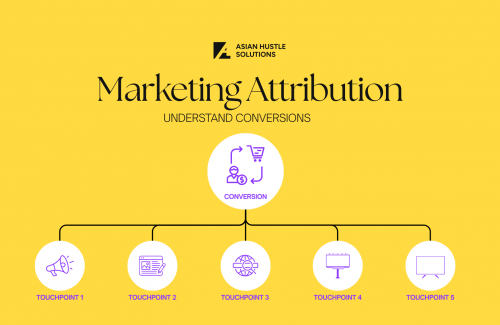
To win your customers, you need to run many marketing activities across multiple channels. And then those conversions came pouring in, but you don’t exactly know where those conversions come from since there are too many ongoing activities. That’s what marketing attribution does. By assigning credit to touchpoints, you can gauge how effective each touchpoint is to the conversion.

There are two types of Attribution:

  • Single-source attribution: Credits are given fully to one touchpoint, assuming that is the most effective one at driving conversion.
  • Multiple-source attribution: More complex models. This type of attribution model acknowledges that multiple touchpoints contribute to the buying decisions and gives partial credit to each.

Understanding attribution will help you to know where the revenue comes from so you can optimize your budget and gain more from your spending. to said touchpoint makes it more effective and less costly. Understanding the journey can help you win the race.

Why Asian Hustle Solutions?

At AHS, we specialize in helping brands capture attention and inspire action — whether you’re launching a new product or scaling your business, we’ll guide you to marketing that resonates and delivers results.

If you want to learn more about our services, visit the Asian Hustle Solutions website at asianhustlenetwork.com/services/