Stories

March 17, 2023

SHARE:

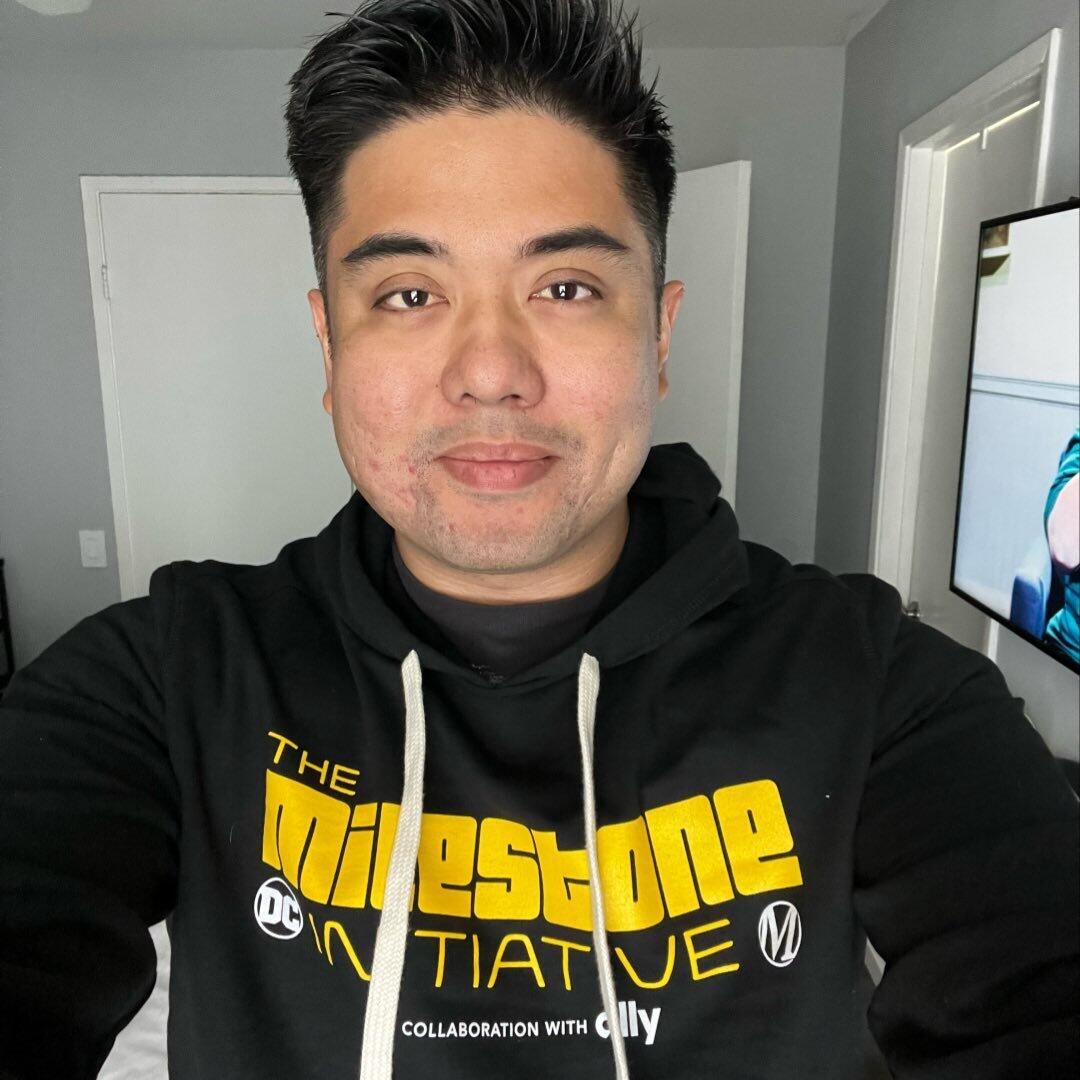
Nathaniel “Nathan” Cayanan is a Filipino-American currently working as a lecturer at Cal State Fullerton part-time, where he teaches business communication. He has been teaching English composition and academic writing for almost a decade and has been in education for 17 years, 8 of those years in college. He studied creative writing and screenwriting at USC and earned a master’s in writing because he wanted to be a filmmaker, but found himself teaching English comp – which he loved for a time.

On a whim last year, Nathan applied for DC Comics Milestone Initiative, a talent development program created in partnership with groundbreaking publisher Milestone Media and Ally Financial for marginalized writers and artists who want to break into the industry. It was highly competitive, but, somehow, the story he wrote for the application caught their eye, and he was officially accepted into their inaugural class. He took part in a program that mentored them as they tried to advance in the comic book industry.

He’s putting more effort into his creative career, not only writing some comics or graphic novels but drawing too. Now, he will be making his DC Comics debut as a writer. His story features the superhero Icon during the Cambodian Civil War.

With his first story to release in just a few months, Nathan’s career is on the rise. But how did he get to this point? Let’s explore the decisions and experiences that brought him here.

I APPLIED BELIEVING THAT I WOULD FAIL

I’ve always loved stories, be they in movies, books, or comics. I have read comics ever since I was about eight years old, my first comic being Batman #416. I watched movies as much as I could growing up, falling in love with not only the stories, but also the craft of telling them. 

I studied creative writing and screenwriting, but as most people know, it’s not a career rife with opportunities, so I found a day job teaching while I tried to develop my creative career. But teaching was a job that took a lot of time and energy, so the amount of effort into my writing career was relatively low. I loved teaching, so I was okay with this for a while, especially since I constantly got rejections for stories I wrote. In short, I settled.

However, about 5-6 years into my college teaching career, I started to feel pigeonholed. Despite earning stellar reviews and even winning Teacher of the Year in 2018, I wasn’t getting consistent opportunities. I was passed up for full-time positions several times. And even though it’s common for adjuncts to make up for a lack of full-time work by finding employment at multiple colleges, many community colleges would not hire me to teach part-time despite me having more experience and qualifications than other candidates they did hire.

So, I realized I needed to let go of this career and go back to school in 2019 for something more practical and get an MBA to pursue opportunities outside higher ed. My logic was that I would continue to teach part-time at only one school and leave my admin job at another school, while I went to graduate school (again).

Then the pandemic happened, and I started to also lose some of the classes at that school because of low enrollment and cut hours. Simultaneously, while I was doing well in my business program (I was earning a 4.0 at the time), I was a bit depressed. The world was collapsing, people were just very unpleasant, student-teacher dynamics changed, and I felt like a failure in TWO careers I pursued.

I applied for the Milestone Initiative, thinking that I’m going to just go work in an office if I give up my passions completely, so I might as well make one last effort and “die trying,” knowing that I fought until the bitter end. I actually applied believing that I would fail and that I just needed one more rejection letter to make it official. But, instead, I was accepted, and that really changed things moving forward.

The world was collapsing, people were just very unpleasant, student-teacher dynamics changed, and I felt like a failure in TWO careers I pursued.

nathan cayanan

CREATIVE INFLUENCES

I have so many creative influences. In film, there are Wong Kar Wai, Christopher Nolan, Quentin Tarantino, Martin Scorsese, and Aaron Sorkin.

If we’re talking literature: Haruki Marakami, Juno Diaz, Amy Tan, Lan Samantha Chang, Edgar Allan Poe, Cormac McCarthy. Comics, Tom King (who was my mentor in the Milestone Initiative), Scott Snyder, Jim Lee, Alan Moore, and Frank Miller. I mean, this list can go on and on, and they all have different influences on my creative voice and eye.

Digital illustration of Sugar Pie DeSant, Filipina jazz singer in the mid-1900s. Drawn by Nathan Cayanan. Colors by Lala Narita.

CHALLENGES OF TRANSITIONING INTO THE CAREER

Most of my work so far is indie and still in the process of being made. I have one comic I’m writing and drawing and any money I get will come after it’s printed, and assuming that it sells enough.

Similarly, I have a graphic novel I’m writing, and an artist is drawing it, and we’ve been offered the opportunity to publish it when it’s finished, but we won’t see a dime until we see units sold in the future. This is why many of us have day jobs. I still teach, just less than I did, and only at a university closer to home. But we do this because we love the art of telling stories.
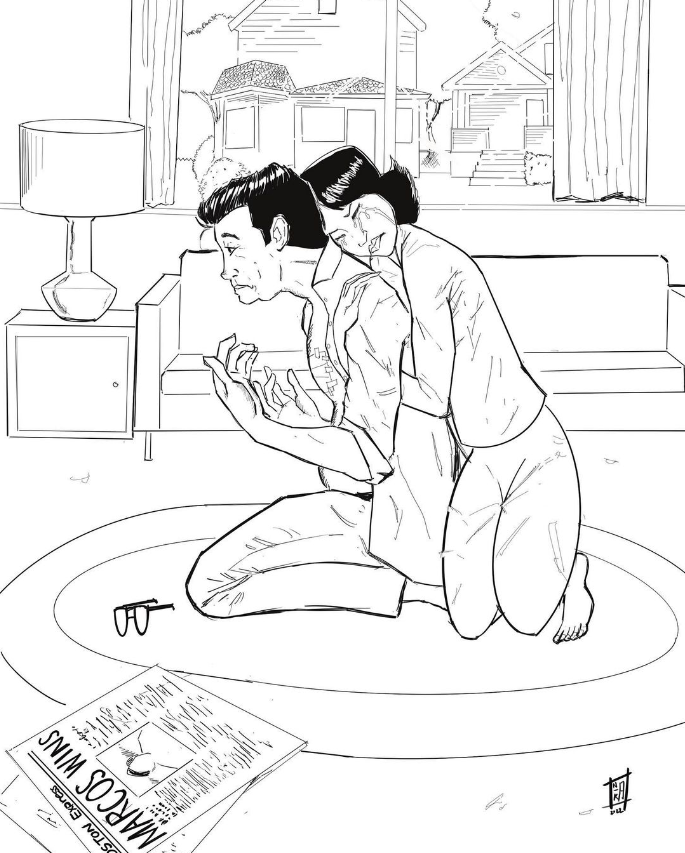
Drawn by Nathan Cayanan: Ninoy Aquino, a Filipino politician who was assassinated during Ferdinand Marcos’ rule in the Philippines. This illustration depicts Aquino and his wife, future president Cory Aquino, when they lived in Boston, after he was exiled for standing against Marcos.

ADVICE FOR ASPIRING WRITERS OR ARTISTS

It’s not easy, and I think admitting that first is important. Too many young aspiring artists ask for advice, but what I feel like they’re asking is how they make this a career where the opportunities are plentiful, the money is endless, they can do it only from 9-to-5, get a 401K, and feel happy 24/7.

Every person I’ve met in the creative world (especially in comics) has said the same thing. It’s a grind. But, if you love the art, I mean genuinely love it (as opposed to the potential for fame and money), then go for it. But, as many writers and artists have told me, 90% of us have a day job. So, prepare to work, even if you make it. And even when you do, enjoy it, because it may not last.

Also, while it may not feel like it should be important, your ability to work and communicate with others is highly important. VERY few people are talented enough to never have to interact with others. Instead, most must be able to work with each other.

Editors have told me that they don’t care if you’re talented. If you’re not professional, no one’s going to give you the opportunity, especially if you’re rude, always late, flakey, or overly stubborn. You don’t have to be the life of the party or admired by the masses. But surely, you have to be reliable and don’t be a d*&k. 

Drawn by Nathan Cayanan: “It just speaks to the times as we see Asian hate crimes on the rise.”

Website: nathanielcayanan.com

Instagram: @nathan_a.k.a

Related Articles

AHS EMAIL ANGLE (4)

Blogs, Development

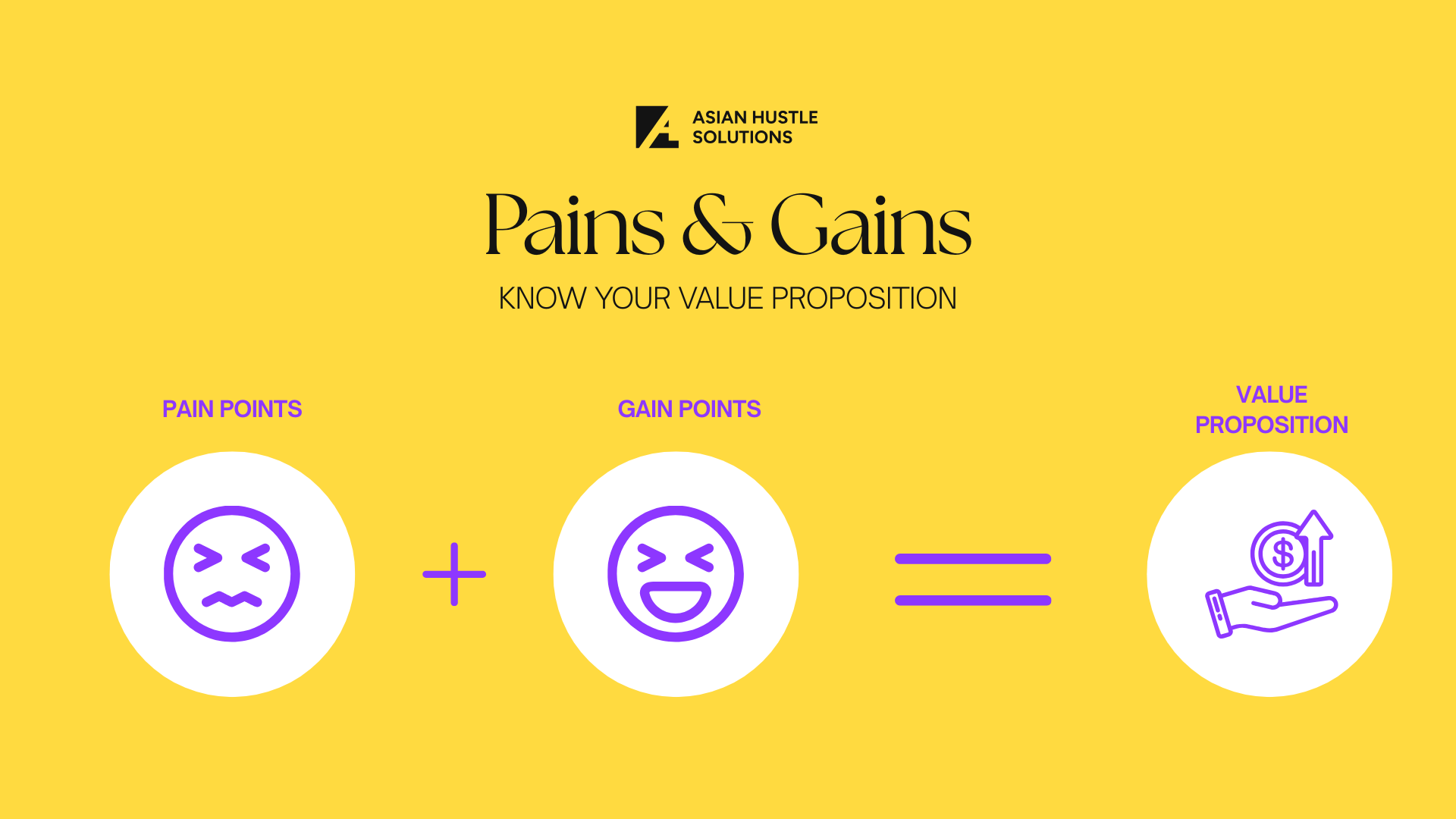
Know Your Value Proposition

Pain points and gain points are not necessarily new concepts, but some might think they are opposing concepts, when in contrast, the two complement each other. Through customer pain and gain points, you can get a better understanding of your customers’ needs, and offer a unique value proposition.

  • Pain point: As the name suggests, it’s something that “pains” your customers; an issue that they have that needs to be addressed; a challenge that they need to overcome.
  • Gain point: Gain point, on the other hand, is more about you. What can your product or service do for the customers; what can they gain from using your service; what can you help them with?

The two are extremely simple and are a good place to start when you’re trying to advertise your product or service since they consider both your and your customer’s sides to offer a value proposition that is valuable. 

[Book a FREE call with us]
If you want to explore our services more, visit the Asian Hustle Solutions website at AHS.

Development

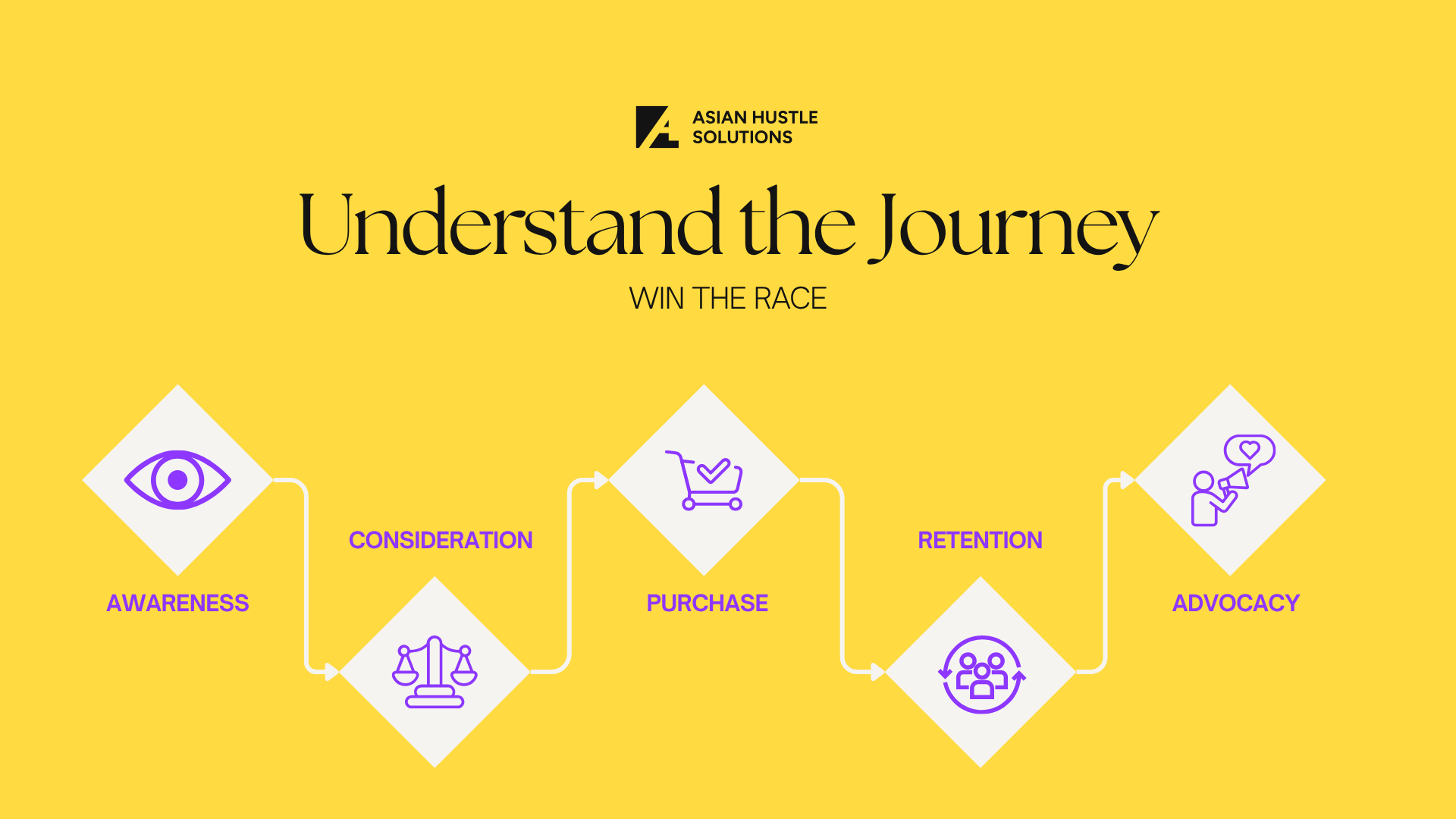
Winning The Race by Understanding Customer Journey

Before becoming a loyal customer, a lead has to interact with your product/service at various stages. This entire process is summarized in the customer journey, divided into 5 main stages:

  • Awareness: The customer becomes aware of your brand and your product, usually through search engines when searching for a solution to their problem.
  • Consideration: The customer is aware of your brands but also your competitors’;, they start wondering which of the options they should choose from.
  • Purchase: The customer makes a buying decision, either from your brand or your competitors’.
  • Retention: After the purchase, you need to consider how to get them to repurchase many more times, since retaining is cheaper than recruiting.
  • Advocacy: At this stage, the customer is basically your brand ambassador., Tthey love your product;, they tell their acquaintances about your product.

Understanding the journey and what stage the audience is at can help you understand their needs and adjust accordingly. Each stage has a different touchpoint as well, so adjusting to said touchpoint makes it more effective and less costly. Understanding the journey can help you win the race.

Why Asian Hustle Solutions?

At AHS, we specialize in helping brands capture attention and inspire action — whether you’re launching a new product or scaling your business, we’ll guide you to marketing that resonates and delivers results.

If you want to learn more about our services, visit the Asian Hustle Solutions website at asianhustlenetwork.com/services/

AHS EMAIL ANGLE (1)-png

Blogs, Development

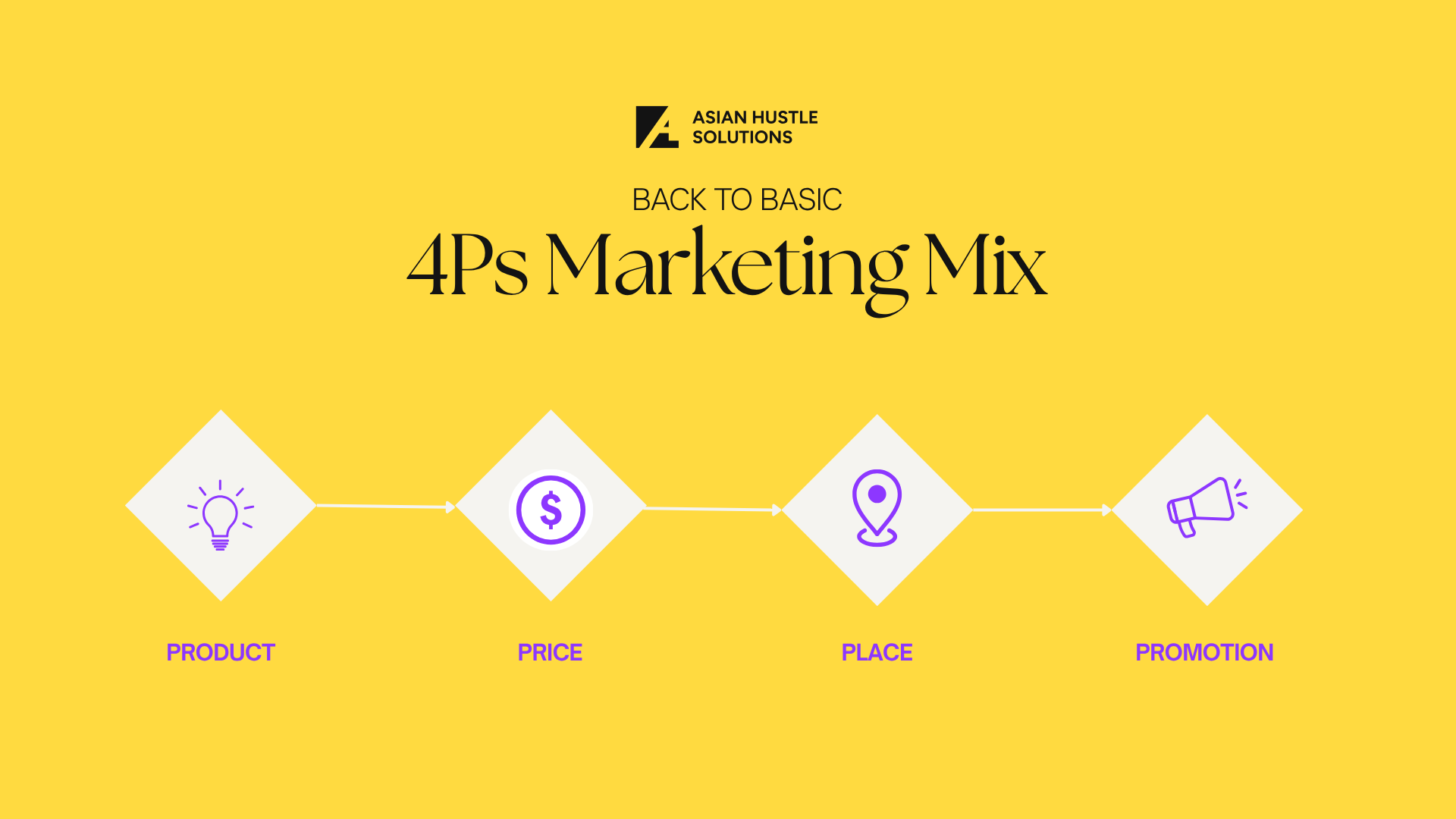
Getting Back To Basics: 4Ps Marketing Mix

Sometimes, to create an effective marketing strategy for your business means going back to the basics. Popularized by Neil Borden, the 4P’s model is still widely used today, with each P representing a core aspect of the marketing mix:

  • Product: The core of your business, whether it is a physical product or a service. Understanding your product, what differentiates it from the competition, what is unique about it, etc.
  • Price: How much your product should be sold for. This should be based on the supply cost, how you position your product, and whether you should increase or decrease the price based on your target audience.
  • Place: The “where” of your product. Where can the customers purchase your products (online or physical stores, drug stores or supermarkets, etc). More so, it is also where you choose to advertise.
  • Promotion: How you reach your customer, either through advertising, public relations, or promotion, increases your brand awareness.

Why Asian Hustle Solutions?

At AHS, we specialize in helping brands capture attention and inspire action — whether you’re launching a new product or scaling your business, we’ll guide you to marketing that resonates and delivers results.

If you want to learn more about our services, visit the Asian Hustle Solutions website at asianhustlenetwork.com/services/

Stories

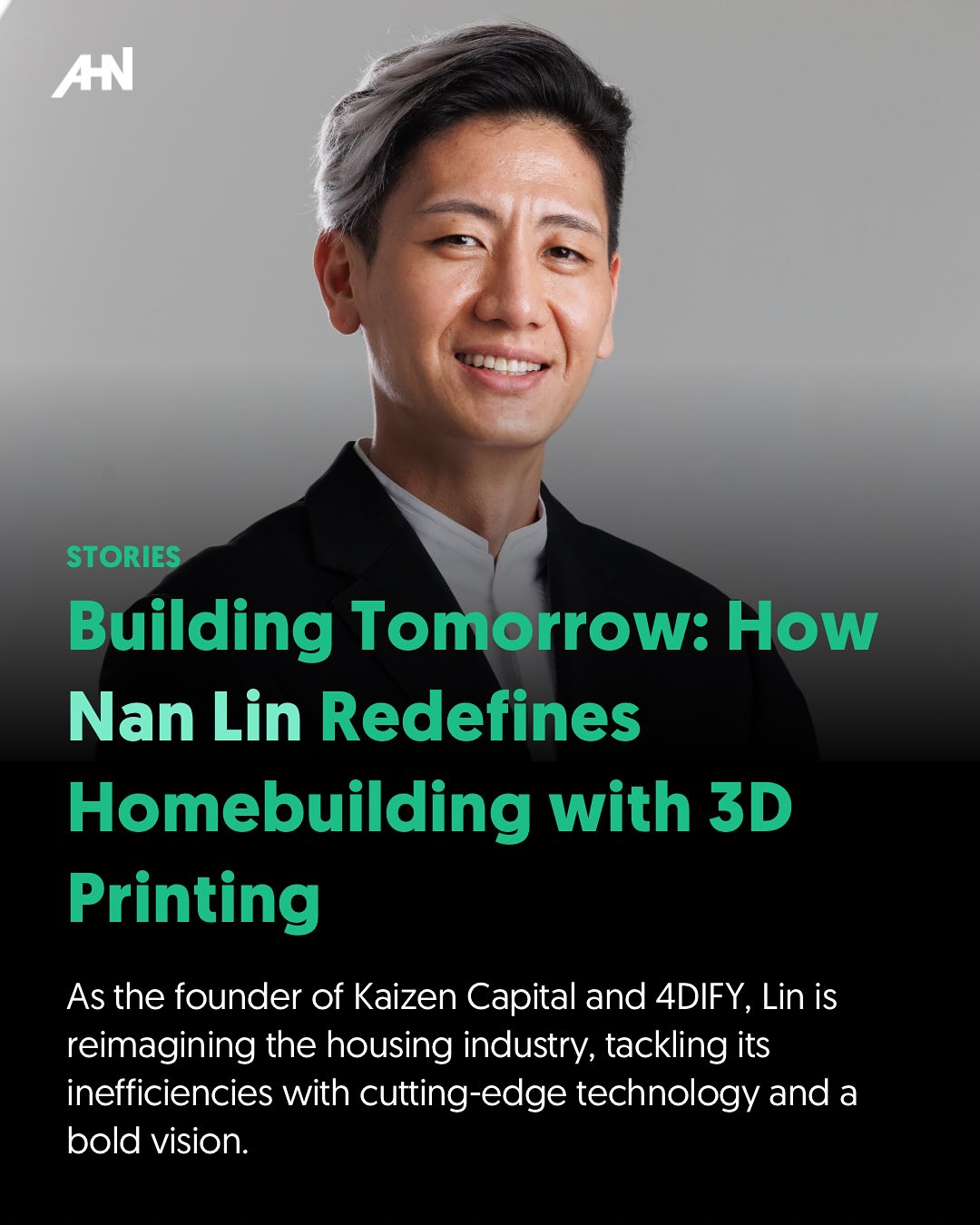
Building Tomorrow: How Nan Lin Redefines Homebuilding with 3D Printing 

For Nan Lin, entrepreneurship isn’t just business; it’s freedom. A freedom earned through sacrifice, relentless execution, and a refusal to accept the limits of a broken system. As the founder of Kaizen Capital and 4DIFY, Lin is reimagining the housing industry, tackling its inefficiencies with cutting-edge technology and a bold vision. His mission? To build stronger homes faster, at lower costs, empowering communities and challenging the status quo.

From Immigrant Roots to Visionary Leadership 

Lin’s journey began at age 10, when he immigrated to America with his mother. While adapting to a new country, he was inspired by his loving parents’ sacrifices, which shaped his relentless drive. “I saw the lengths they went to give me a better life,” Lin says. “Their love and dedication became my compass.” Years later, that resolve led to the creation of Kaizen Capital, where he transforms underutilized properties into vibrant housing solutions: ADUs, subdivisions, condo conversions, and luxury short-term rentals. By unlocking hidden value in land, he delivers market-rate and affordable housing that strengthens neighborhoods.

But Lin saw a deeper problem: traditional construction is slow, costly, and vulnerable to fire, pests, and natural disasters. Frustrated by an industry stuck in the past, he founded 4DIFY to lead a new era of construction through 3D-printed concrete homes.

Nan Lin | Founder and Principal of Kaizen Capital and 4DIFY

3D Printing: The Future of Housing, Today

Lin’s vision for 4DIFY was sparked by a frustrating reality: “Wildfires destroy neighborhoods every year, yet we keep building stick-frame homes that burn like kindling,” he says.

After visiting several 3D printer manufacturers, Lin partnered with New York–based SQ4D. It took nearly a year to secure exclusive licensing rights, navigate regulatory hurdles, and obtain building permits, but he got it done.

Now, 4DIFY is building California’s first community of 3D-printed concrete homes. As this article goes live, their first printed home is nearing completion, despite heavy regulations and a steep learning curve. The team is already outperforming traditional timelines and cost benchmarks. The second and third homes will soon print simultaneously, targeting completion in two months, effectively one home per month at under $200 per square foot.

Despite challenges as an Asian immigrant, Lin managed to transform them into motivation and success. 

“We’re aiming to build at half the cost and in a quarter of the time,” Lin says. “That’s not a dream. It’s the direction we’re heading.”

Built with concrete, reinforced with rebar, and topped with metal roofs, these homes are resilient against fire, wind, earthquakes, mold, and pests. They’re also designed for long-term savings, with lower maintenance, less waste, and reduced energy and insurance costs.

“Critics doubted it would work,” Lin reflects. “But seeing is believing. This is the future.”

A Philosophy of Purpose and Resilience

Lin’s journey has been marked by relentless challenges, some seemingly insurmountable. “Obstacles never stop,” he admits. Yet he transforms adversity into opportunity, fueled by a positive mindset, solution-driven focus, and disciplined execution. His trusted team is his backbone. “No one succeeds alone,” he says. “My team turns the impossible into reality.” This resilience shapes his leadership, blending bold vision with purposeful action to create opportunities, particularly for communities long excluded from wealth-building. “Housing isn’t just a product,” Lin says. “It’s a platform for empowerment.”

Recognition and Inspiration

Lin’s impact is gaining notice. The Sacramento Bee named him one of the Top 20 AAPI Change Makers, and he was honored in the Business Elite Awards’ 40 Under 40. But for Lin, the real reward is inspiring others. “I want to show the next generation of Asian entrepreneurs what’s possible when we claim our seat at the table,” he says.

Lin wants to create opportunities for those marginalized by elevating the future of construction, making it more accessible for his community.

Join the Housing Revolution

Nan Lin isn’t just building homes, he’s redefining what’s possible. Through Kaizen Capital and 4DIFY, he’s creating a future where housing is affordable, resilient, and sustainable. Follow his journey and see the revolution unfold.

Connect with Nan Lin: